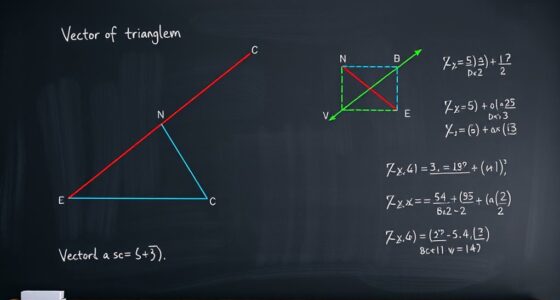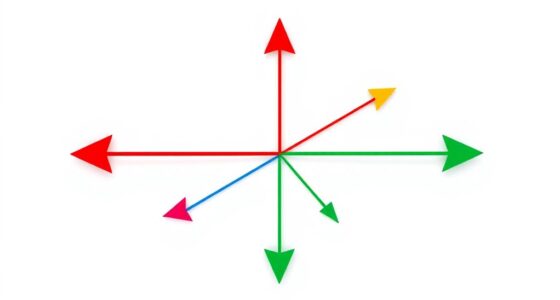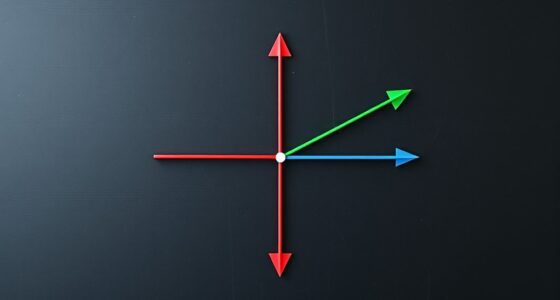

Vector thinking simplifies position and motion problems by breaking complex movements into horizontal and vertical components. This approach allows you to analyze each direction separately, making calculations clearer and more manageable. By combining these components, you can easily determine overall displacement and understand multi-directional forces. This method also helps you visualize motion and adapt calculations quickly when conditions change. Continue exploring these concepts to discover how they make solving motion problems more efficient and intuitive.

Prime made for students and young adults
- Fast, free delivery for dorm and study essentials
- Prime Video and Amazon Music included
- Member-only deals
Key Takeaways
- Vector decomposition breaks complex motions into manageable horizontal and vertical components for easier analysis.
- Combining components via vector addition simplifies calculating total displacement and path direction.
- Breaking forces into orthogonal components clarifies multi-directional influences on motion.
- Vector properties enable quick adjustments when motion parameters change, improving problem-solving efficiency.
- Visualizing motion through components enhances understanding of multi-dimensional movement and forces.
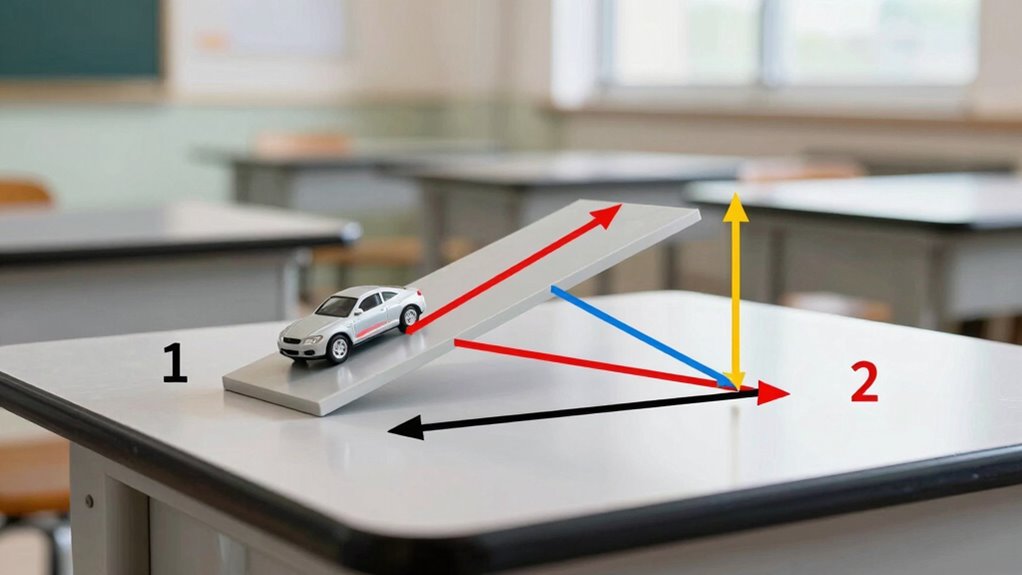
When tackling complex motion problems, using vector thinking can make the process much simpler. Instead of juggling multiple separate quantities like speed, direction, and position, you can break everything down into manageable parts called vector components. These components represent the motion along specific axes—usually horizontal and vertical—and make it easier to analyze how objects move over time. By doing this, you transform complicated, real-world movement into straightforward algebraic calculations. This approach helps you visualize and solve problems more efficiently, especially when multiple forces or motions are involved.
Understanding vector components is key. Imagine you’re trying to determine the overall displacement of an object that moves in two different directions: east and north. You can decompose this motion into two vectors: one pointing east and the other pointing north. Each of these vectors can be broken down into components along the coordinate axes. Once you have these components, you can perform vector addition to find the total displacement. This process involves adding the horizontal components together and the vertical components together, giving you a clear picture of the overall movement. Using vector addition in this way simplifies what would otherwise be a complex problem, particularly when multiple vectors are involved.
Decomposing motion into east and north components simplifies complex displacement calculations through vector addition.
The beauty of vector thinking lies in its ability to turn a multi-faceted problem into a set of simpler calculations. Instead of trying to analyze the movement directly in a single step, you work with the components separately, then combine them at the end. This method is especially useful in physics and engineering, where motion often involves many forces acting in different directions. By focusing on vector components, you can accurately predict where an object will end up after a certain period, considering all contributing factors. It also enables you to quickly adjust your calculations when forces or directions change, since you can simply update the relevant components. Additionally, understanding the vector magnitude helps you interpret the size of the overall displacement in relation to its components. Recognizing the importance of these vector properties allows for more precise and efficient problem-solving. Moreover, the use of vector resolution techniques can further simplify complex motions by breaking them down into orthogonal components.
Furthermore, vector thinking streamlines the process of solving for unknowns. For example, if you’re given the total displacement and some components, you can use vector addition to find the missing parts. This approach also helps you understand the relationship between different motions, such as how a combination of horizontal and vertical movements results in a diagonal path. Overall, embracing vector thinking and mastering the use of vector components and addition makes solving position and motion problems more intuitive, precise, and less prone to errors. It turns what can be a formidable task into a logical, step-by-step process that enhances your problem-solving skills considerably.
By recognizing the importance of vector components, you can develop more efficient methods to analyze and solve complex motion scenarios with confidence.
Frequently Asked Questions
How Do Vectors Differ From Scalar Quantities?
Vectors differ from scalar quantities because they include both magnitude and direction, unlike scalars, which only have magnitude. When you use vector representation, you specify both aspects, making it easier to analyze position and motion problems. Comparing a vector to a scalar, you see that vectors give you a complete picture of movement, while scalars only tell you how much. This distinction helps you understand and solve physics problems more effectively.
What Are Common Mistakes in Vector Addition?
You might fall into vector confusion, leading to addition errors. A common mistake is adding vectors tip-to-tail without respecting their directions. Another mistake is ignoring the sign or angle, which skews the result. Remember, vectors require both magnitude and direction, so guarantee you align them correctly before adding. Use the head-to-tail method to avoid confusion, and double-check directions to prevent simple addition errors.
How Does Vector Decomposition Help in Complex Problems?
Vector decomposition helps you tackle complex problems by breaking a vector into its components, typically along coordinate axes. Using decomposition techniques, you analyze each component separately, making calculations more manageable. This approach simplifies the process of solving for unknowns in position and motion problems, as you can focus on individual directions, then combine the results. Ultimately, it makes understanding and solving intricate vector problems much clearer and more straightforward.
Can Vectors Be Used to Solve Real-World Navigation Issues?
Yes, vectors are essential for solving real-world navigation issues. They improve navigation accuracy by representing directions and distances precisely, allowing you to calculate ideal routes, account for wind or current effects, and determine your exact position. In real-world applications like GPS, aviation, and marine navigation, vectors help you plan safer, more efficient paths, ensuring you reach your destination accurately despite environmental challenges.
What Tools or Software Assist With Vector Analysis?
Imagine a compass guiding your journey—software tools like GeoGebra, MATLAB, and Desmos become your digital compass, offering robust vector visualization features. These programs allow you to plot, analyze, and manipulate vectors with intuitive interfaces. They simplify complex calculations, visualize forces and directions, and help you understand motion dynamics. With these tools, you can confidently navigate real-world problems, turning abstract vectors into clear, visual solutions.
Conclusion
By embracing vector thinking, you unseal a powerful tool that cuts through the chaos of motion problems like a hot knife through butter. It’s as if you hold a magic wand, turning tangled equations into clear, straight paths. With vectors as your guiding stars, you can navigate complex positions and movements with confidence and precision. So, next time you face a tricky problem, remember: vectors are your trusty compass, guiding you smoothly to the solution’s horizon.
Fall Picks
fall essentials
As an affiliate, we earn on qualifying purchases.