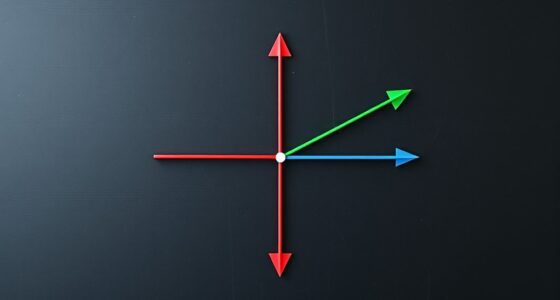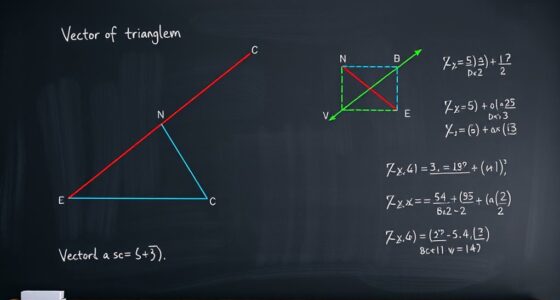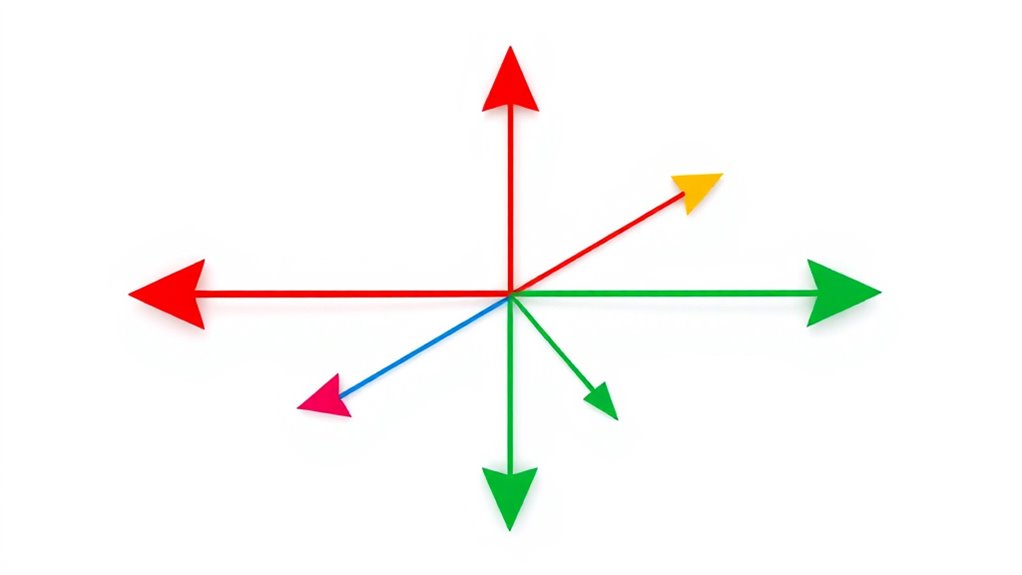

To understand vector addition and subtraction visually, imagine each vector as an arrow with a specific length and direction. Adding vectors means placing the tail of one arrow at the tip of another, forming a tip-to-tail chain; the resultant is the arrow from the start to the end. Subtraction involves reversing a vector’s direction and then adding it. By exploring these geometric constructs, you’ll gain clearer insight into how forces combine or oppose each other, helping you grasp the concepts more fully.
Key Takeaways
- Vector addition is visualized by placing vectors tip-to-tail and drawing the resultant from the start to the end point.
- Vector subtraction is represented as adding the negative of a vector, reversing its direction, and then performing addition.
- Geometrically, the resultant vector’s magnitude and direction are obtained using the tip-to-tail method and the Pythagorean theorem.
- Decomposing vectors into components simplifies addition and subtraction by allowing separate algebraic handling of each axis.
- Visual interpretation of vector operations enhances understanding of how forces or directions combine or oppose in physical scenarios.
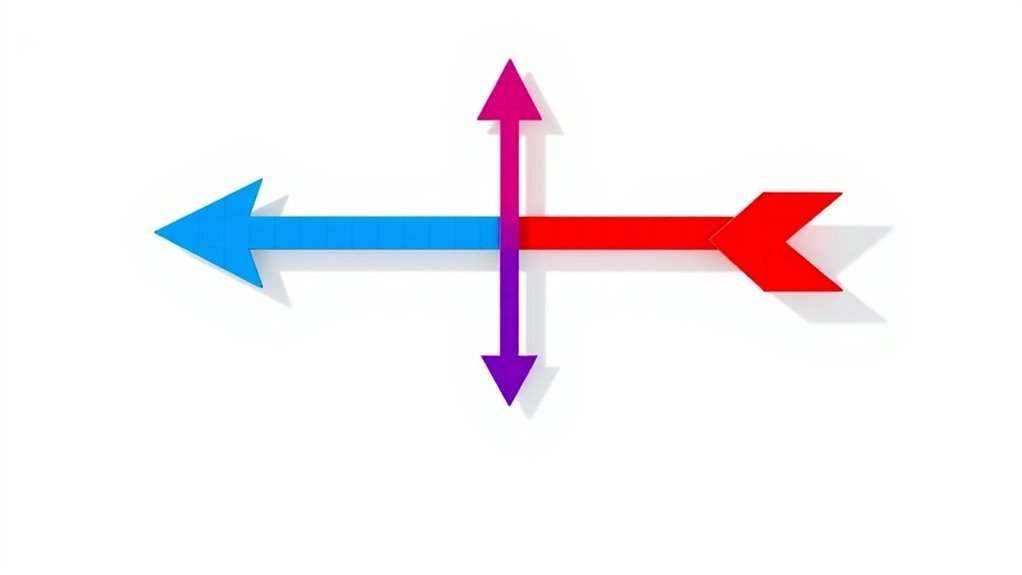
Have you ever wondered how to combine or compare different forces or directions? Understanding vector addition and subtraction from a geometric perspective can clarify this process. When you work with vectors, breaking them down into their vector components is often the first step. These components are the projections of a vector onto the axes, allowing you to analyze each part separately. Vector resolution involves decomposing a single vector into its horizontal and vertical components, making it easier to perform addition or subtraction. Imagine a vector representing a force acting at an angle; by resolving it into components, you can see exactly how much of that force acts along each axis. This breakdown simplifies complex problems and makes the overall process much clearer. Additionally, appreciating the geometric interpretation of these operations enhances understanding of how forces or directions combine in real-world scenarios.
Once you’ve resolved vectors into their components, vector addition becomes straightforward. Picture two vectors represented graphically as arrows. To add them, you draw the first vector, then from its tip, draw the second vector. The resulting vector — the sum — is represented by the arrow stretching from the tail of the first to the tip of the second. Geometrically, this is known as the tip-to-tail method. Alternatively, you can add the vector components directly: sum the x-components to find the total horizontal effect, and the y-components for the vertical effect. The combined vector is then reconstructed from these summed components, giving you both magnitude and direction.
Subtraction, on the other hand, involves reversing the direction of the vector you want to subtract and then adding it using the same tip-to-tail method. Think of it as adding a vector with opposite direction. When you perform vector subtraction geometrically, you can also think of it as adding the negative of the vector. This approach simplifies visual understanding: if you want to subtract vector B from A, you invert B’s direction, resolve it into components, and add it to A’s components. The resulting vector points from the tip of A to the tip of A plus the negative of B, representing the difference between the two vectors.
Using vector components and resolution is powerful because it transforms complex vector operations into simple algebraic calculations. It allows you to analyze forces, velocities, or displacements along particular axes, making interpretations more intuitive. Geometric interpretation of vector addition and subtraction helps you visualize how different forces or directions combine or oppose each other, giving you a clearer understanding of the overall effect. Whether working with real-world physics problems or abstract mathematical concepts, mastering these techniques equips you with a precise and effective way to handle vectors in any scenario.

Regal Games Math Flash Cards for Addition & Subtraction – 1st, 2nd, 3rd Grade & More – Flash Cards Math for Kids (112 Cards – 2 Packs)
- Educational Math Flash Cards: Ideal for addition and subtraction learning
- Two-Pack Set: Includes 2 packs with 56 cards each
- Vivid, Colorful Design: Features large, bright, and colorful numbers
As an affiliate, we earn on qualifying purchases.
As an affiliate, we earn on qualifying purchases.
Frequently Asked Questions
How Does Vector Subtraction Relate to the Concept of Displacement?
When you perform vector subtraction, you’re finding the vector difference, which directly relates to displacement. This process involves calculating the displacement between two points by subtracting their position vectors. fundamentally, the vector difference represents how far and in which direction you’ve moved from one point to another. So, in displacement calculation, vector subtraction helps you determine the shortest path or direct route between starting and ending positions.
Can Vector Addition Be Visualized in Three-Dimensional Space?
Yes, you can visualize vector addition in three-dimensional space. This involves using vector visualization tools or diagrams to understand how vectors combine spatially. By representing vectors as arrows in 3D, you see how they add tip-to-tail, giving a clear spatial interpretation of the resultant vector. This 3D approach helps you grasp the concept more intuitively and enhances your understanding of vector operations in a real-world context.
What Are Common Mistakes in Geometric Vector Interpretation?
You often make mistakes like confusing scalar multiplication with vector addition, leading to scalar confusion. Also, avoid the parallelogram misconception—thinking that the parallelogram’s diagonals always represent the sum of vectors, which isn’t true in all cases. Pay attention to the correct geometric interpretation, ensuring you understand how vectors combine visually. Clarifying these common errors helps you better grasp vector addition and subtraction in geometric terms.
How Does Vector Addition Differ in Non-Euclidean Geometries?
In non-Euclidean geometries, vector addition doesn’t follow the same rules as in Euclidean space. You can’t simply place vectors tail-to-head; instead, you need to account for curved spaces where straight lines may bend. This means vector addition involves using the geometry’s specific rules for combining vectors, often involving geodesics or curved paths, which alters how you interpret the sum compared to flat Euclidean space.
Are There Physical Examples Illustrating Vector Subtraction?
You can see vector subtraction in everyday physical examples like navigation and physics. For instance, if you walk north and then south, the difference in your position is a vector subtraction. In physics, calculating the relative velocity of two moving objects involves subtracting their velocity vectors. These applications show how vector subtraction helps us understand and quantify differences in real-world situations, making it a practical tool in various fields.

DIY Drawing Robot Kit with Mechanical Arm – Educational Pen Plotter Writing Robot for Classroom Learning & Kids Creative DIY Projects
- Precise and Stable Drawing: Full-metal gear servo and smooth joints
- Bluetooth Connectivity: Connects easily via Android app
- User-Friendly Operation: No programming needed, simple setup
As an affiliate, we earn on qualifying purchases.
As an affiliate, we earn on qualifying purchases.
Conclusion
Now that you see how vectors dance together and part ways, their geometric interpretations become clear. Think of addition as stacking building blocks to reach new heights, while subtraction is like pulling apart puzzle pieces to see how they fit. With each operation, you’re wielding a powerful brush, painting vivid pictures on the canvas of space. Keep exploring these geometric melodies, and you’ll master the art of understanding the universe’s hidden symphony.
As an affiliate, we earn on qualifying purchases.
As an affiliate, we earn on qualifying purchases.