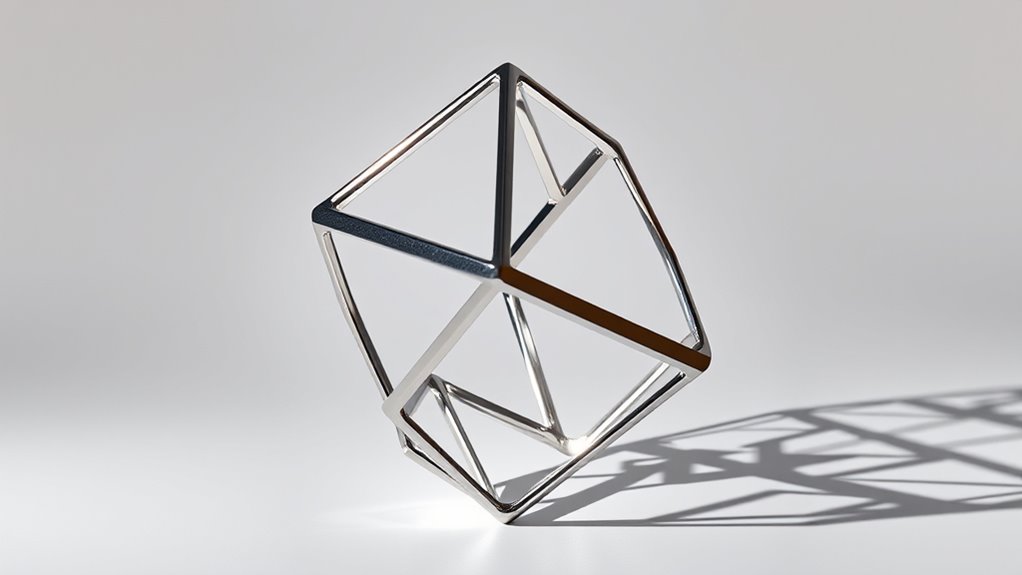
Theory transforms how we see tessellations, revealing their patterns through movements like translations and rotations—discover the logic behind the design.
Browsing Category
Transformations
16 posts
What Translation, Rotation, and Dilation Each Preserve
Noticing how translation, rotation, and dilation each preserve different properties helps deepen your understanding of geometric transformations and their effects.
How Transformations Help You See Structure Instead of Noise
What if transformations could reveal hidden patterns and clarify complex data, helping you see structure instead of noise—discover how they unlock deeper insights.
Why Rotations Feel Harder Than Reflections at First
Offering a glimpse into the mathematical complexity behind rotations, this explains why they initially seem more challenging than reflections.
Solving Problems by Reflecting: Using Transformations Strategically
When tackling complex issues, reflecting through strategic transformations can unlock clarity—discover how to turn chaos into solutions effectively.
Symmetry Groups: The Math of Repeated Transformations
The math behind symmetry groups reveals how repeated transformations create beautiful patterns, unlocking secrets that might change your perspective forever.
3D Transformations: Rotating and Reflecting in Space
Navigating 3D transformations reveals how rotation and reflection matrices can manipulate objects in space, unlocking new possibilities for realistic modeling and animation.
Glide Reflections: When Translation Meets Reflection
Nurture your understanding of symmetry by exploring glide reflections, where translation meets reflection—discover what makes this transformation truly fascinating.
Coordinate Transformations: Shifting and Rotating Graphs
Meta description: Master coordinate transformations by learning how shifting and rotating graphs can transform their positions and orientations, unlocking new insights into graph manipulation.
Combining Transformations: Translations Followed by Rotations
Understanding how translations followed by rotations alter shapes reveals the fascinating complexities behind combined transformations.