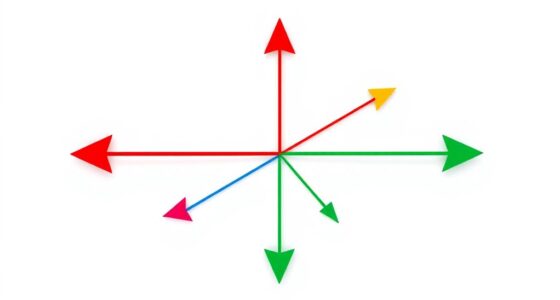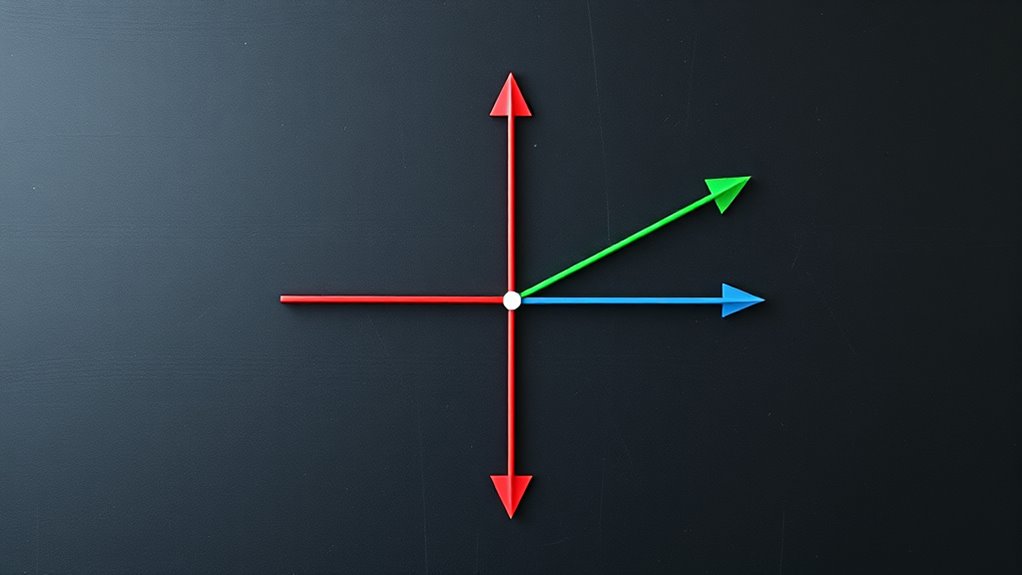

Unit vectors are essential for describing directions in space because they have a magnitude of one, making them a clear standard. They are part of the standard basis, which includes vectors aligned with each axis. By using these vectors, you can easily represent any direction without size interference. Understanding the role of these basis vectors helps you grasp how to analyze and compare spatial orientations. Keep exploring to uncover how this foundation applies to various applications.

Get school and study supplies delivered free — and shop member deals
- Fast, free delivery on millions of items
- Access to Prime Big Deal Days deals on October 6–7
- Prime Video, Amazon Music and more included
Key Takeaways
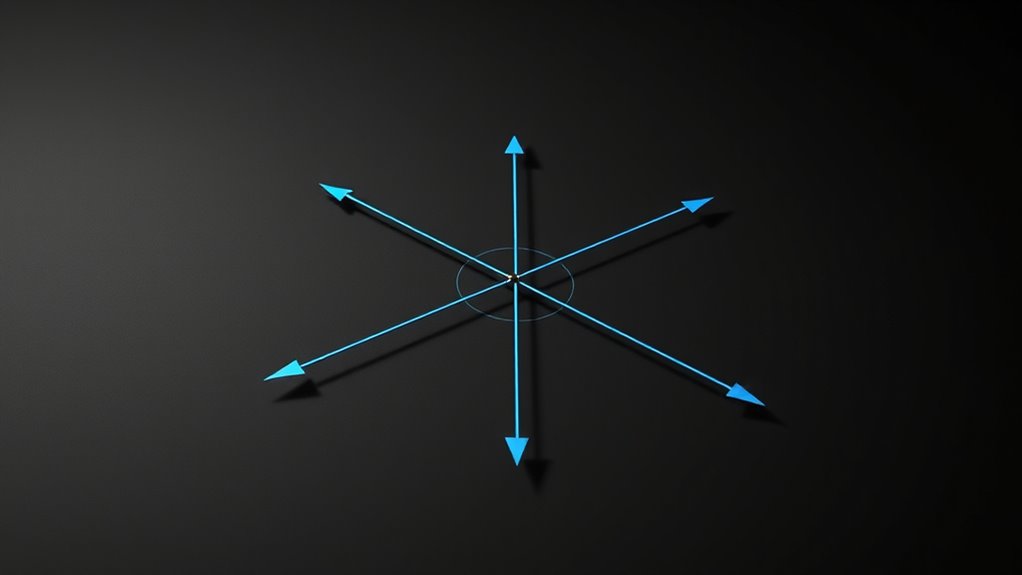
- The standard basis in three-dimensional space consists of three mutually perpendicular unit vectors: i, j, and k.
- These unit vectors serve as the fundamental directions along the x, y, and z axes.
- Any vector can be expressed as a combination of these unit basis vectors with scalar coefficients.
- Normalizing a vector involves dividing each component by its magnitude to obtain a unit vector in the same direction.
- The basis vectors provide a consistent framework for describing directions and performing vector operations in space.
Have you ever wondered how to precisely describe a direction in space? When you’re steering through three-dimensional space, understanding directions becomes crucial. One of the most effective ways to do this is through the use of unit vectors. These vectors have a magnitude of exactly one, which makes them ideal for representing directions without any influence from the vector’s length. To convert a given vector into a unit vector, you perform vector normalization. This process involves dividing each component of your vector by its magnitude, resulting in a vector that points in the same direction but has a length of one. This normalized vector then serves as a standard way to specify direction, regardless of the vector’s original size. vector normalization is fundamental in ensuring that directions are unambiguous and consistent across applications.
Now, once you have a unit vector, you can explore the concept of direction cosines. These are the cosines of the angles that your vector makes with the coordinate axes. In essence, they describe how much of the vector points along each axis. For example, if you have a vector in 3D space, the direction cosines are the cosines of the angles it forms with the x, y, and z axes. These values are particularly useful because they satisfy a fundamental relation: the sum of the squares of the direction cosines equals one. This relation intuitively makes sense because it reflects the fact that a vector’s total magnitude is distributed among its components along each axis.
Understanding the role of vector normalization and direction cosines helps you grasp how to specify directions unambiguously. When you normalize a vector, you’re essentially projecting it onto a unit sphere centered at the origin, which simplifies calculations and comparisons. The direction cosines then directly tell you how the vector aligns with each axis, making it easier to analyze orientations and angles. For instance, if your direction cosines are known, you can quickly determine the angles your vector makes with each axis using inverse cosine functions, enabling precise control and understanding of spatial directions.
As an affiliate, we earn on qualifying purchases.
Frequently Asked Questions
How Are Unit Vectors Used in Real-World Applications?
You use unit vectors in real-world applications like vector navigation and robotic movement. They help you determine direction precisely, making it easier to guide robots or navigate systems accurately. By representing directions as unit vectors, you simplify calculations and guarantee consistent movement. This way, you can control robotic arms or autonomous vehicles efficiently, ensuring they follow the correct path without complex computations, enhancing precision and safety in various technological tasks.
Can Unit Vectors Be Negative? if So, What Does That Mean?
Yes, unit vectors can be negative, indicating negative directions based on vector sign conventions. When you see a negative unit vector, it means the vector points opposite to the positive direction of the axis. This helps you understand vector orientation precisely, especially in applications like physics and engineering. Recognizing negative directions guarantees accurate representation of movement, force, or other quantities that have directionality in space.
How Do Unit Vectors Relate to Vector Magnitude?
Did you know that every vector’s magnitude can be scaled to 1 through vector normalization? When you relate unit vectors to vector magnitude, you’re fundamentally normalizing the vector, making its length exactly one. This process involves magnitude scaling, which preserves the direction but standardizes the size. So, a unit vector always has a magnitude of 1, directly linking it to the concept of vector normalization and direction.
Are There Alternative Ways to Define Directions Besides the Standard Basis?
Yes, you can define directions using alternative coordinate systems or non-orthogonal bases. These systems, like oblique coordinates, offer different ways to describe directions beyond the standard basis. Instead of relying solely on orthogonal vectors, you use bases where vectors aren’t necessarily perpendicular. This flexibility helps when working with complex geometries or specific applications, providing a broader perspective on how directions can be represented and understood.
How Do Unit Vectors Change in Different Coordinate Systems?
Coincidentally, when you change coordinate systems, your unit vectors adjust through coordinate system transformations, aligning with the new basis vectors. These basis vector adjustments guarantee your original directions remain consistent in the new context. As a result, unit vectors may look different in various systems, but they still maintain their magnitude of one, preserving the fundamental directions regardless of the coordinate transformation.
As an affiliate, we earn on qualifying purchases.
Conclusion
Think of unit vectors as guiding stars, each pointing you in a clear direction through the vast sky of vectors. They’re like compass needles, unwavering and true, helping you navigate complex spaces with ease. As you grasp their role, you’ll find yourself sailing smoothly through the universe of mathematics, always knowing the way. Embrace these tiny but mighty guides—they’re your trusty friends on the journey of understanding directions in space.
As an affiliate, we earn on qualifying purchases.
spatial direction measurement device
As an affiliate, we earn on qualifying purchases.
As an affiliate, we earn on qualifying purchases.
Halloween Picks
halloween
As an affiliate, we earn on qualifying purchases.