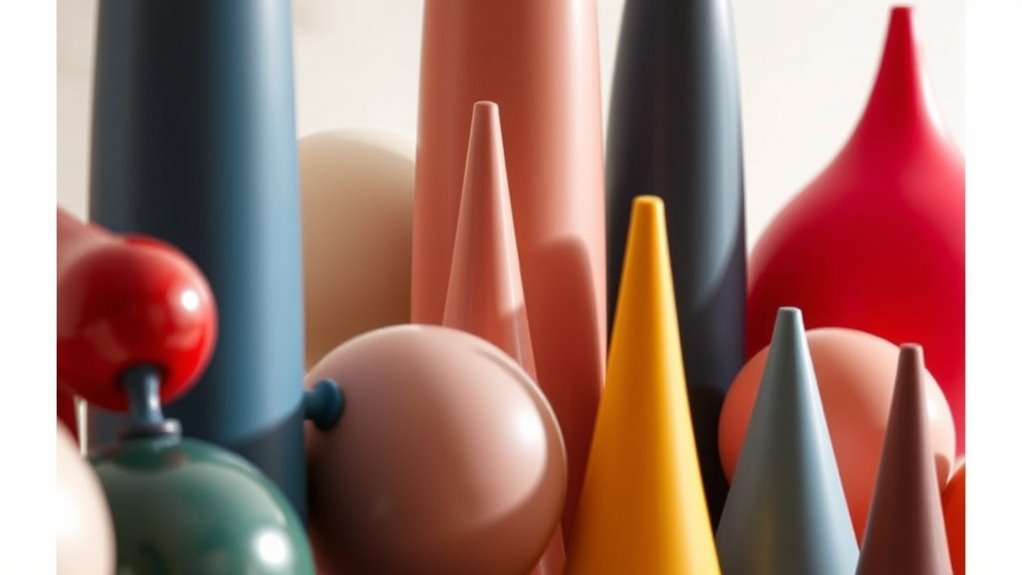

Curved shapes like spheres, cylinders, and cones are common in everyday objects and design. You can find spheres in balls, globes, and decorative items; cylinders in cans, pipes, and jars; and cones in luminaries and funnels. These shapes rely on mathematical formulas for surface area and volume, helping you estimate material needs or storage capacity. If you explore further, you’ll discover how these principles influence both functionality and aesthetics.
Key Takeaways
- Spheres, cylinders, and cones are common curved shapes with distinct surface area and volume formulas.
- Surface area formulas help estimate material needs for coating or wrapping these shapes.
- Volume calculations determine the capacity or space enclosed within each curved shape.
- Understanding their mathematical properties supports effective design, manufacturing, and structural integrity.
- These shapes are widely used in architecture, containers, and decorative objects due to their aesthetic and functional qualities.
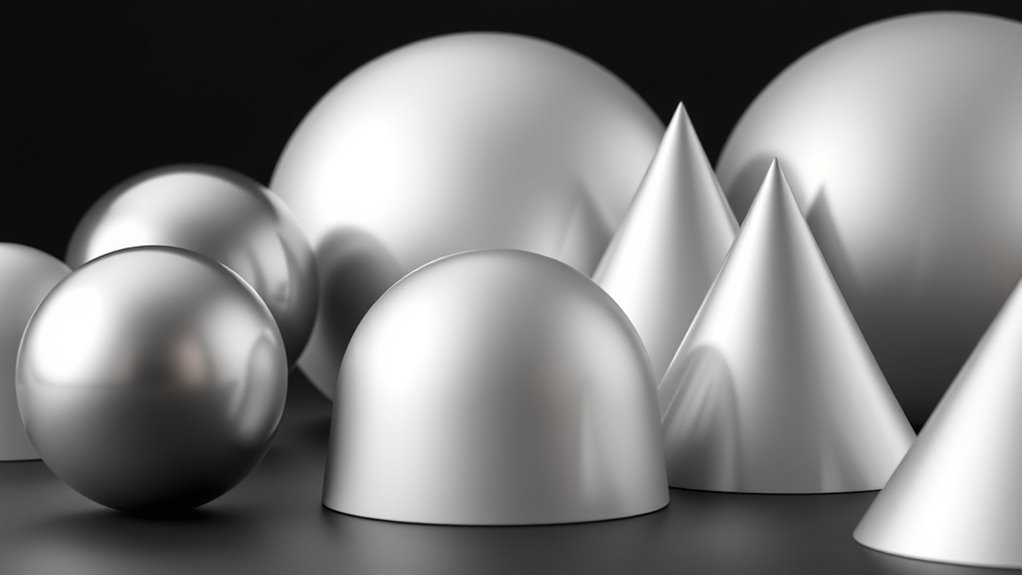
Have you ever wondered what makes curved shapes so visually appealing and versatile? These forms—spheres, cylinders, and cones—are everywhere, from architecture to everyday objects. Their beauty isn’t just aesthetic; it’s rooted in their mathematical properties. Understanding surface area formulas and volume calculations helps you appreciate their design and functionality. When working with these shapes, knowing how to find their surface area allows you to determine how much material you’ll need for construction or coating. Meanwhile, volume calculations reveal how much space they occupy, essential for storage, packaging, or fluid containment. The geometric properties of these shapes also influence their structural strength and efficiency in various applications. Starting with spheres, their symmetry and smooth curvature make them unique. The surface area formula for a sphere is 4πr², where r is the radius. This tells you how much surface you’d cover if wrapping the sphere with paint or fabric. The volume, given by (4/3)πr³, indicates how much space the sphere encloses; this is particularly useful when calculating the capacity of a spherical container or understanding how much material is needed to create the shape. These formulas are elegant in their simplicity but powerful in application. For instance, if you know the radius, calculating both surface area and volume becomes straightforward, allowing you to plan projects with precision. Moving to cylinders, they feature a circular base and a curved surface connecting the two bases. The surface area formula combines the area of the two circular bases (2πr²) with the lateral surface area (2πrh), where h is the height. Adding these parts gives the total surface area: 2πr(h + r). This helps you estimate the amount of paint or material needed to cover the entire surface. When it comes to volume, cylinders are simple yet essential: V = πr²h. This calculation provides the capacity of a cylindrical tank or container, helping you determine how much it can hold or how much material you need to construct it. Cones, with their pointed tip and curved surface, have their own set of formulas. The surface area combines the base area (πr²) with the lateral surface area (πrl), where l is the slant height. The total surface area is πr(l + r). Knowing this helps you estimate the material for cone-shaped objects, such as funnels or decorative items. The volume formula, V = (1/3)πr²h, tells you how much space the cone occupies. This is useful for calculating the capacity of conical containers or understanding how much material is needed to create the shape. In essence, mastering these surface area formulas and volume calculations allows you to work efficiently with curved shapes. Whether designing, manufacturing, or simply appreciating their elegance, understanding these mathematical principles gives you the tools to analyze, create, and optimize curved objects in various contexts.
Frequently Asked Questions
How Are Curved Shapes Used in Modern Architecture?
You see curved shapes in modern architecture enhancing aesthetic appeal and creating unique, eye-catching structures. They improve architectural aesthetics by adding fluidity and organic forms, making buildings more inviting. Additionally, architects use these shapes for sustainable design, as they often reduce material waste and improve energy efficiency through better aerodynamics and natural light flow. Incorporating curved shapes helps you achieve innovative, environmentally friendly designs that stand out and serve functional purposes.
What Are the Mathematical Formulas for Calculating Surface Area?
For curved shapes like spheres, cylinders, and cones, you need specific surface area formulas. To find the surface area of a sphere, use 4πr², where r is the radius. For a cylinder, calculate 2πr(h + r), with h as height. For a cone, use πr(l + r), where l is the slant height. These formulas help you with curved surface calculations accurately and efficiently.
How Do Curved Shapes Influence Aerodynamic Design?
Curved shapes can transform aerodynamic design, making it feel like you’re slicing through air faster than a lightning bolt. They optimize fluid dynamics, helping reduce drag and improve efficiency. By incorporating smooth, rounded surfaces, you can minimize turbulence and air resistance, which enhances performance. Curved shapes are essential for designing vehicles, aircraft, and sports equipment, allowing you to achieve maximum speed and stability with minimal effort.
What Are Common Materials for Manufacturing Curved Objects?
You typically choose materials like plastics, metals, and composites for manufacturing curved objects. Your material selection depends on factors like strength, weight, and flexibility. Manufacturing processes such as molding, casting, or machining help you shape these materials into curved forms efficiently. By understanding these options, you can guarantee your curved objects meet performance needs and aesthetic standards, whether for aerospace, automotive, or consumer products.
How Do Curved Shapes Impact Structural Stability?
Curved shapes act like the backbone of a sturdy bridge, spreading stress evenly across their surfaces. You’ll find that these shapes enhance load-bearing capacity by redistributing stress, reducing weak points. This makes them naturally more stable under pressure, helping structures withstand forces better. When designing with curved forms, you’re tapping into their ability to manage stress distribution, ensuring your structure remains resilient and secure even under heavy loads.
Conclusion
So, next time you marvel at a perfectly round sphere, a sleek cylinder, or a sharp cone, remember—they’re all just simple curves. Ironically, these everyday shapes hide complex mathematics and engineering behind their smooth surfaces. You might think they’re basic, but they’ve shaped everything from architecture to technology. So, don’t underestimate their power—these curves are more than meets the eye, and you’re now officially curious about the secrets they hold!