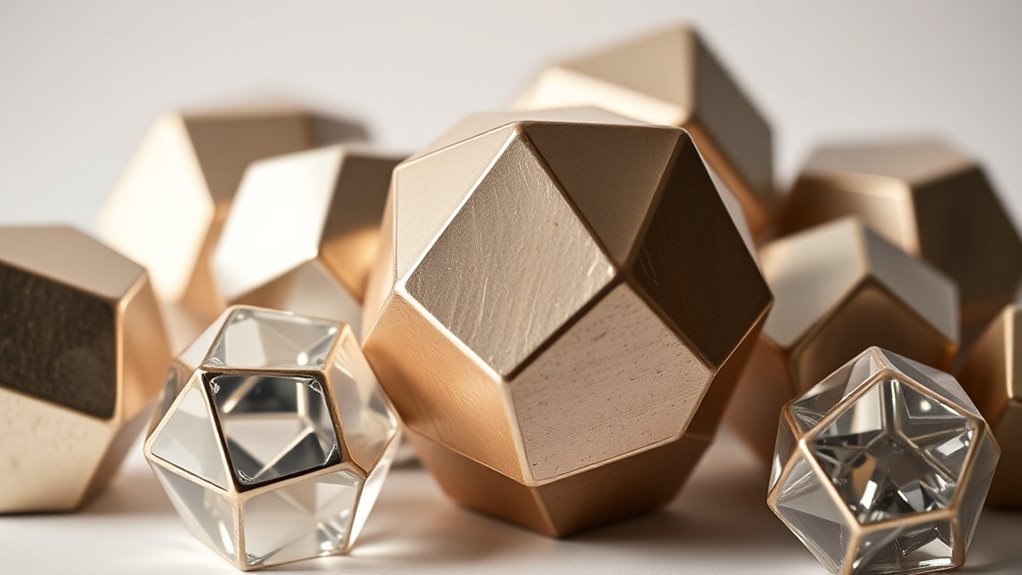

Archimedean solids are almost-regular 3D shapes made of symmetrical arrangements of regular polygons, giving them both beauty and stability. They’re defined by their vertex configurations, where specific polygons meet at each point, and are related to dual shapes that highlight their intrinsic harmony. These shapes demonstrate the balanced combination of geometric principles and symmetry. If you keep exploring, you’ll discover the fascinating structural and aesthetic qualities that make these shapes so remarkable.
Key Takeaways
- Archimedean solids are nearly regular 3D shapes characterized by symmetrical arrangements of regular polygons.
- They feature specific vertex configurations where faces meet, ensuring shape stability and aesthetic harmony.
- Each Archimedean solid has a dual polyhedron, highlighting deep geometric symmetry and structural relationships.
- Symmetry in these shapes enhances both their visual appeal and structural integrity.
- Their balanced, almost-regular structure reflects underlying mathematical harmony found in natural and designed forms.

Have you ever wondered what makes certain polyhedra both symmetrical and balanced? It’s a fascinating question that leads you into the world of Archimedean solids, which are almost regular 3D shapes known for their unique harmony. These solids are distinguished by their vertex configuration, which describes how faces meet at each vertex. Unlike the Platonic solids, where all faces and angles are identical, Archimedean solids feature a mix of regular polygons arranged in a highly symmetrical pattern. This blend creates shapes that are both aesthetically pleasing and structurally stable. The use of symmetry in their design not only enhances their beauty but also contributes to their structural integrity.
One key aspect that contributes to their symmetry is the concept of dual polyhedra. For every Archimedean solid, there’s a corresponding dual shape, where vertices and faces swap roles yet maintain a similar level of symmetry. For example, the dual of a cuboctahedron, one of the most well-known Archimedean solids, is the rhombic dodecahedron. These dual relationships highlight the intrinsic order within these complex shapes, emphasizing how their symmetry isn’t just superficial but deeply rooted in their geometric properties. When you explore dual polyhedra, you see how the arrangement of faces and vertices relates directly to each other, revealing the underlying harmony that defines these shapes.
Dual polyhedra reveal the deep symmetry linking faces and vertices, showcasing the intrinsic harmony of complex shapes.
Focusing on vertex configuration helps you understand why these solids are so balanced. The vertex configuration describes how many faces meet at each vertex, along with the types of polygons involved. For instance, in a truncated icosahedron—famous for resembling a soccer ball—each vertex is where two hexagons and one pentagon meet. This specific arrangement ensures that the solid maintains its symmetry and structural integrity. The vertex configuration acts like a blueprint for how the faces come together, allowing you to predict the shape’s overall form and stability. When you recognize the pattern in these arrangements, it’s like uncovering a secret code that explains the beauty and balance of these complex shapes.
In essence, the symmetry and balance of Archimedean solids stem from their carefully arranged faces and vertices, guided by the principles of dual polyhedra and vertex configuration. These elements work together to create shapes that are not only mathematically elegant but also visually enthralling. By understanding how dual shapes mirror each other and how vertex configurations dictate the meeting points of faces, you gain insight into the harmony that makes these solids so remarkable. Whether you’re a student of geometry or simply a curious explorer, studying these shapes offers a window into the ordered beauty that underpins much of the natural and mathematical world.
Archimedean solids geometric models
As an affiliate, we earn on qualifying purchases.
As an affiliate, we earn on qualifying purchases.
Frequently Asked Questions
How Are Archimedean Solids Used in Modern Architecture?
You see Archimedean solids in modern architecture through geodesic domes and decorative facades, which showcase their unique, almost-regular shapes. Architects use these shapes for their strength, stability, and aesthetic appeal, creating innovative structures that stand out. These solids help distribute stress evenly and add visual interest, making buildings more functional and mesmerizing. Their versatility allows for creative designs that blend practicality with striking visual elements.
What Is the History Behind Discovering Archimedean Solids?
You might find it fascinating that Archimedean solids, discovered through a blend of curiosity and mathematical exploration, date back to the 3rd century BCE. The historical discovery is credited to Archimedes himself, who studied these complex shapes. Their mathematical significance lies in their symmetry and unique properties, which continue to influence fields like architecture and design today. You can appreciate how ancient insights still shape modern understanding of geometry.
Can Archimedean Solids Be Constructed With Everyday Materials?
Yes, you can definitely create homemade models of Archimedean solids using everyday materials. With some material experimentation—like paper, cardboard, straws, or clay—you can construct impressive, accurate representations. These homemade models help you understand their symmetry and structure better. Just gather basic supplies, follow geometric guidelines, and enjoy the process of material experimentation to bring these fascinating shapes to life in your own space.
How Do Archimedean Solids Compare to Platonic Solids in Complexity?
You’ll find that Archimedean solids are more complex than Platonic solids regarding mathematical complexity and geometric classification. While Platonic solids have identical faces, vertices, and edges, Archimedean solids feature faces of different regular polygons arranged symmetrically. This added complexity requires a deeper understanding of geometry, making Archimedean solids a richer and more intricate category of 3D shapes to explore.
Are There Digital Tools to Model and Explore Archimedean Solids?
Yes, you can use digital tools to model and explore Archimedean solids. Programs like Blender, SketchUp, and GeoGebra offer features for digital modeling, allowing you to create precise 3D representations. These tools enable virtual exploration, helping you understand the shapes’ structure, symmetry, and complexity. With user-friendly interfaces and powerful features, you can manipulate, analyze, and visualize these solids easily, making learning engaging and interactive.
As an affiliate, we earn on qualifying purchases.
Conclusion
Now, picture yourself holding one of these stunning Archimedean solids, each face a shimmering polygon, edges perfectly aligned. Feel the intricate symmetry and balanced beauty in your hands, like a finely crafted jewel. These almost-regular shapes invite you to explore their enchanting complexity, blending art and mathematics seamlessly. As you imagine their structures, you realize how they transform simple forms into mesmerizing 3D wonders, inspiring curiosity and wonder in every glance.
mathematical shape models for education
As an affiliate, we earn on qualifying purchases.
As an affiliate, we earn on qualifying purchases.
As an affiliate, we earn on qualifying purchases.