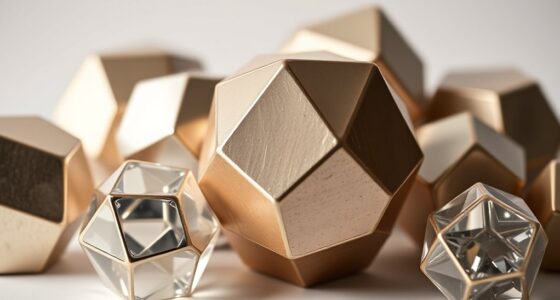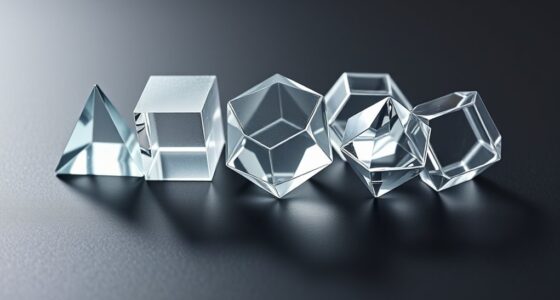

A polyhedron is a 3D shape made up of flat polygonal faces, straight edges, and vertices where the edges meet. The faces can be triangles, quadrilaterals, or other polygons, shaping the overall structure. The relationship between these elements is summarized by Euler’s formula: V – E + F = 2. Understanding these basics helps you explore polyhedra further, revealing more interesting geometric properties along the way.
Key Takeaways
- A polyhedron is a 3D shape made of flat polygonal faces, edges, and vertices.
- Faces are polygons like triangles or quadrilaterals that form the surface.
- Euler’s formula (V – E + F = 2) relates vertices, edges, and faces in convex polyhedra.
- Counting faces, edges, and vertices helps classify and analyze the shape’s structure.
- Polygon types of faces influence the polyhedron’s overall geometry and symmetry.

Have you ever wondered what makes a polyhedron? At its core, a polyhedron is a three-dimensional shape made up of flat polygonal faces, straight edges, and sharp vertices. But what exactly qualifies a shape as a polyhedron? One key aspect is the types of polygons that form its faces. These polygon types can vary widely—from triangles and quadrilaterals to more complex polygons like pentagons and hexagons. The specific combination of these polygons determines the overall structure and symmetry of the polyhedron. For instance, a cube is made of square faces, while an icosahedron is composed of equilateral triangles. Recognizing the polygon types involved helps you understand the shape’s geometry and helps classify different polyhedra.
When studying polyhedra, you’ll often encounter Euler’s formula, a fundamental relationship that connects the number of faces (F), edges (E), and vertices (V) within a convex polyhedron. It states that V – E + F = 2. This simple yet powerful equation allows you to verify the consistency of your shape’s measurements and helps in classifying different polyhedra. If you know any two of these quantities, you can easily find the third. For example, if a shape has 12 faces and 30 edges, Euler’s formula tells you there must be 20 vertices. This relationship isn’t just theoretical; it’s a practical tool for understanding and analyzing polyhedra.
As you explore different polyhedra, you’ll notice that the relationship between faces, edges, and vertices isn’t arbitrary. The numbers are interconnected through Euler’s formula, which applies to convex polyhedra and certain other types. It’s a quick way to check whether a shape is a proper polyhedron and to analyze its structure. When you examine the polygon types of each face, you can predict how many edges and vertices the shape should have, making Euler’s formula a valuable guide in your geometric investigations. Additionally, understanding the geometric properties of faces can help you identify possible polyhedral configurations and classifications.

HGS Polyhedron Molecular Model 1000Alpha Fundamental Organic Chemistry Set
As an affiliate, we earn on qualifying purchases.
As an affiliate, we earn on qualifying purchases.
Frequently Asked Questions
How Are Polyhedra Classified Beyond Faces, Edges, and Vertices?
You classify polyhedra beyond faces, edges, and vertices by examining their symmetry classifications and geometric groupings. You look at how they can be transformed through rotations, reflections, and translations, which helps identify their symmetry groups. These classifications group polyhedra based on shared symmetrical properties, such as regular, semi-regular, or irregular types, providing a deeper understanding of their geometric structure beyond just their faces, edges, and vertices.
What Are Some Real-World Applications of Polyhedron Studies?
You might not realize it, but polyhedron studies shape your world daily. They’re essential in architectural models, helping you visualize sturdy, innovative structures. In packaging design, polyhedra optimize space and protect products efficiently. Their applications extend to computer graphics, gaming, and even spacecraft. By understanding these geometric forms, you can create smarter, more efficient solutions. Keep exploring, and you’ll uncover how polyhedra power the tools and environments around you.
How Do Irregular Polyhedra Differ From Regular Ones?
Irregular polyhedra differ from regular ones because their faces, edges, and vertices don’t follow uniform patterns. You’ll notice irregular shapes lack the symmetry differences that regular polyhedra have, meaning their faces aren’t all the same shape or size. While regular polyhedra are perfectly symmetrical, irregular ones have varied angles and faces, making them more complex and unique in structure.
Can Polyhedra Be Non-Convex or Have Holes?
Yes, polyhedra can be non-convex or have holes. Non-convex shapes bend inward, creating indentations, while polyhedron holes, or tunnels, break through surfaces, making them more complex. You’ll find such shapes in star polyhedra or other intricate structures. These fascinating forms challenge typical geometric ideas, showcasing that polyhedra aren’t always simple solid shapes—they can be twisted, tunneled, and non-convex, adding variety and visual intrigue to geometry’s grand gallery.
What Is the Historical Significance of Polyhedron Discoveries?
You should know that polyhedron discoveries hold great historical significance. Ancient Greek contributions, like Euclid and Plato, laid the groundwork by exploring geometric principles. During the Renaissance, innovations in understanding polyhedra advanced mathematics and art, inspiring new architectural and design ideas. These discoveries shaped our understanding of shapes, space, and symmetry, influencing both scientific thought and creative expression, making polyhedra a cornerstone of mathematical history and cultural development.

Block Puzzle, Hidden Geometric Shape Pattern Jigsaw for Ages 3 to 12 Years
- 3D Hidden Building Blocks: Develops spatial thinking and imagination
- 80 Hidden Motifs: Encourages creativity with double-sided cards
- Group Puzzle Play: Promotes teamwork and social skills
As an affiliate, we earn on qualifying purchases.
As an affiliate, we earn on qualifying purchases.
Conclusion
Now you know the basics of polyhedra—how faces, edges, and vertices come together to create these fascinating shapes. Did you know there are over 10,000 different types of polyhedra? That’s a staggering variety showcasing the incredible diversity in geometry. Keep exploring these shapes, and you’ll discover a world full of stunning structures and hidden patterns. Who knows? You might even design your own unique polyhedron someday!

Aenllosi Hard Case for DND Dice Set 70 Polyhedron DiceSmall
- Perfect Dice Storage: Custom cut holes prevent collision and noise
- High-Quality Material: Durable, dust-proof, scratch-proof EVA case
- Travel-Friendly Design: Lightweight, compact, fits in backpack or pocket
As an affiliate, we earn on qualifying purchases.
As an affiliate, we earn on qualifying purchases.

Learning Resources Wooden Geometric Solids
- Educational Geometry Tool: Introduces children to geometry concepts
- Smooth 3D Shapes: Solid, polished wooden shapes for tactile learning
- Complete Shape Set: Includes 12 diverse geometric solids
As an affiliate, we earn on qualifying purchases.
As an affiliate, we earn on qualifying purchases.