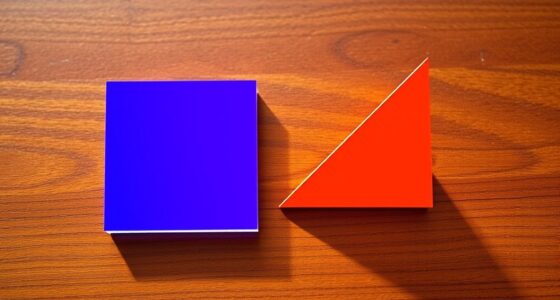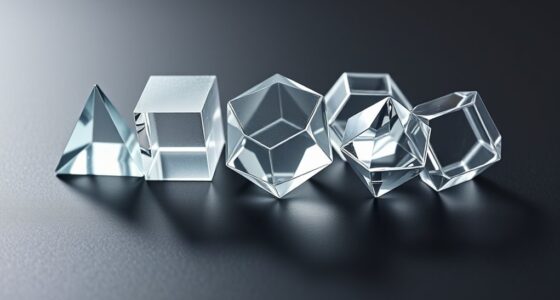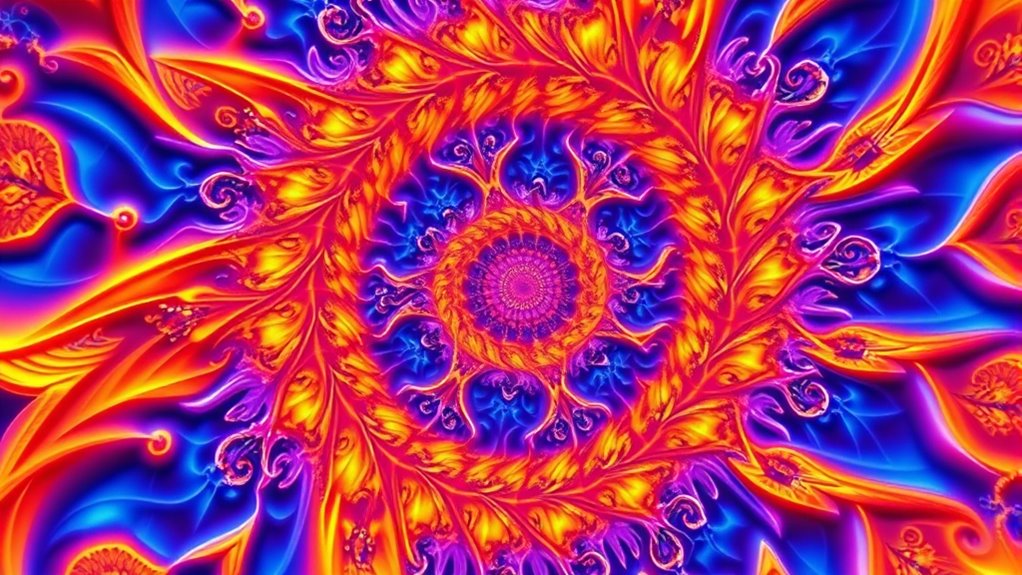

Fractal shapes go beyond traditional Euclidean geometry by showcasing infinite complexity and self-similarity at any scale. Unlike simple geometric forms, fractals are generated by recursive processes that produce endlessly detailed patterns, often mimicking natural phenomena like coastlines or mountains. Their scale invariance means they look similar no matter how much you zoom in. To discover how these fascinating patterns challenge classic ideas of shape and structure, explore further and uncover their underlying principles.

Prime made for students and young adults
- Fast, free delivery for dorm and study essentials
- Prime Video and Amazon Music included
- Member-only deals
Key Takeaways
- Fractals are complex, self-similar patterns that repeat at different scales, challenging traditional Euclidean geometry.
- They are generated through recursive algorithms, creating infinite detail and scale invariance.
- Fractal shapes often have jagged, irregular boundaries that Euclidean shapes cannot describe.
- Natural phenomena like coastlines and mountain ranges exhibit fractal geometry, demonstrating real-world applications.
- Fractals reveal how simple recursive rules can produce infinitely complex structures beyond classical geometric forms.

Fractal shapes are complex patterns that repeat at different scales, creating intricate and self-similar designs. When you look closely at a fractal, you’ll notice smaller versions of the whole pattern embedded within its structure. This recursive nature means each part mirrors the larger shape, forming what mathematicians call self similar structures. These designs are not just visually captivating; they challenge traditional ideas of geometry by revealing how patterns can continue infinitely, no matter how much you zoom in. Unlike Euclidean shapes like circles and squares, fractals don’t rely on simple, smooth boundaries. Instead, their jagged edges and detailed intricacies emerge from repeating processes that generate infinite complexity from simple rules.
Fractals are self-similar, infinitely complex patterns that challenge traditional geometry and emerge from simple recursive rules.
Once you understand the role of recursive patterns in fractals, you realize that the entire structure is built through a process of self-reference. For example, in the famous Mandelbrot set, each zoom reveals smaller versions that look remarkably like the whole. These recursive patterns aren’t just visual tricks—they’re fundamental to how fractals are generated mathematically. You can think of them as algorithms that repeatedly apply the same rules, creating self similar structures at every scale. This repetitive process gives fractals their signature look: infinitely detailed, endlessly fascinating, and inherently recursive. When you observe a fractal, you’re witnessing a self-similar universe, where each part contains a miniature version of the entire pattern. Additionally, fractals often exhibit scale invariance, meaning their pattern looks similar regardless of the magnification level.
In practical terms, these recursive patterns have applications far beyond pure mathematics. You’ll find fractal concepts in nature, from the branching of trees and blood vessels to the rugged coastlines and mountain ranges. Nature’s fractals arise because recursive patterns often produce the most efficient structures for growth and survival. In art and design, understanding self similar structures allows you to create visually compelling works with endless detail. Computer graphics leverage fractal algorithms to render realistic landscapes and textures, mimicking the complexity of natural forms. So, by exploring fractal shapes, you’re tapping into a way of understanding the universe that defies classical geometry, revealing patterns that are both mathematically elegant and organically ubiquitous.
Ultimately, fractals show you that complexity can emerge from simplicity through recursive patterns. They challenge your perception of geometry, illustrating that self similar structures exist not only in mathematics but also throughout the natural world. As you explore more deeply, you’ll see that fractals aren’t just abstract shapes—they’re a window into the infinite complexity that surrounds us, built upon the principles of recursion and self-similarity.
fractal geometry educational kit
As an affiliate, we earn on qualifying purchases.
As an affiliate, we earn on qualifying purchases.
Frequently Asked Questions
How Are Fractals Used in Modern Technology?
You use fractals in modern technology through applications like fractal compression, which reduces image file sizes by exploiting their self-similar patterns, making storage more efficient. Chaos theory helps in modeling complex systems such as weather patterns and financial markets, where fractals reveal underlying structures. These techniques enable better data analysis, image processing, and simulations, demonstrating how fractals are integral to advancing technology and understanding natural phenomena.
Can Fractals Be Found in Natural Biological Systems?
Yes, you can find fractals in natural biological systems. You observe self similarity in plants, like fern leaves and branching trees, where patterns repeat at different scales. In animals, fractal patterns appear in the structure of blood vessels, lungs, and even in the patterns on animal skins. These natural fractals help optimize functions like nutrient flow and surface area, demonstrating nature’s use of complex, recursive designs.
What Is the Mathematical Formula Behind Fractals?
You’re looking for the mathematical formula behind fractals, and it’s simpler than you think! Fractals rely on recursive equations, where each step repeats a pattern infinitely to create self-similarity patterns. For example, the Mandelbrot set is generated by iterating the function ( z_{n+1} = z_n^2 + c ). These recursive equations produce stunning, infinitely complex shapes that captivate the universe’s chaos and order.
Do Fractals Have Practical Applications in Art and Design?
Yes, fractals have practical applications in art and design. You can create stunning fractal art, which captures viewers’ attention with complex, infinite patterns. Designers often use fractal geometry as inspiration for wallpapers, textiles, and digital artwork, giving your projects a unique, mesmerizing look. By exploring fractals, you gain a rich source of design inspiration that pushes creative boundaries and adds depth to your artistic work.
How Do Fractals Challenge Traditional Notions of Dimension?
Think of fractals like the mythical Hydra, endlessly regenerating and defying simple rules. You see, they challenge traditional notions of dimension because their self-similarity creates complex patterns that don’t fit neatly into whole-number dimensions. Instead, they often have fractional dimensions, revealing a complexity that blurs the line between one- and two-dimensional space. This breaks classical geometry, inviting you to see the universe in a new, more intricate way.
As an affiliate, we earn on qualifying purchases.
Conclusion
As you explore fractal shapes, you gently uncover the subtle elegance that lies beyond traditional geometry. These intricate patterns invite you to see the universe in a new light, hinting at deeper complexities woven into nature’s fabric. Embracing their beauty may softly inspire you to appreciate the delicate harmony hidden in chaos. In doing so, you quietly deepen your understanding, appreciating that sometimes, the most profound truths are found in the smallest, most intricate details.
As an affiliate, we earn on qualifying purchases.
As an affiliate, we earn on qualifying purchases.
Fall Picks
fall essentials
As an affiliate, we earn on qualifying purchases.