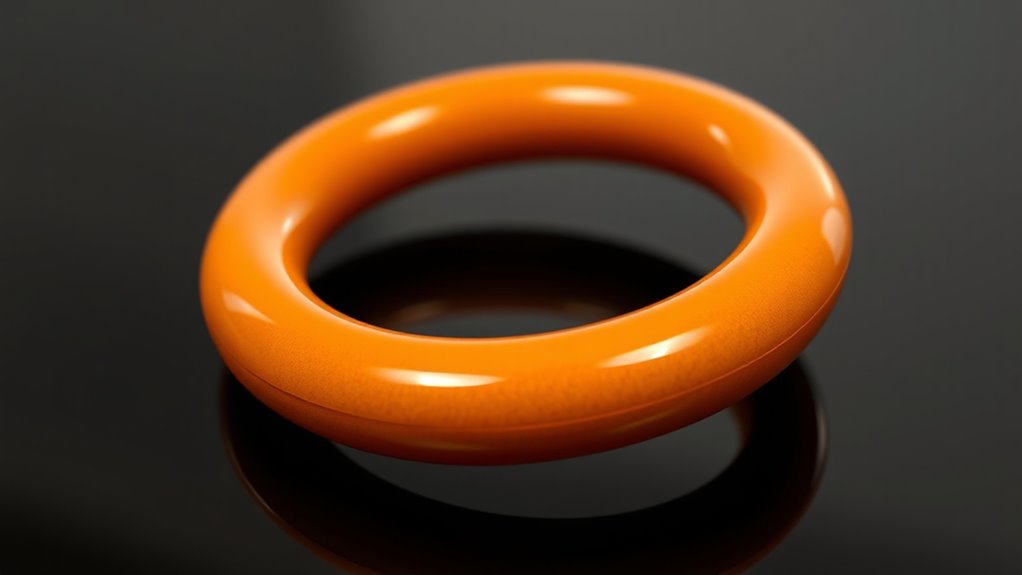

A torus is a 3D shape similar to a doughnut, with a circular hole in the middle and a smooth, continuous surface. It’s created by revolving a circle around an axis outside the circle, giving it rotational symmetry. This shape is important in geometry, engineering, and science, helping with everything from designing mechanical parts to understanding complex spaces. If you keep exploring, you’ll uncover even more fascinating details about this intriguing shape.

Prime made for students and young adults
- Fast, free delivery for dorm and study essentials
- Prime Video and Amazon Music included
- Member-only deals
Key Takeaways
- A torus is a surface generated by revolving a circle around an external axis, creating a donut-shaped object with a single hole.
- Its mathematical properties allow precise calculations of surface area, volume, and curvature, highlighting its symmetry and rotational invariance.
- Tori are widely used in engineering, including magnetic confinement devices, mechanical parts, and toroidal antennas, for optimized performance.
- In topology and geometry, the torus serves as a fundamental example of a surface with genus one, illustrating concepts of continuous deformation and connectedness.
- The torus’s unique shape and properties make it significant in physics, computer graphics, and scientific modeling of complex systems.

A torus shape resembles a doughnut or a ring, characterized by a surface generated by revolving a circle around an axis outside the circle itself. This unique shape has intriguing mathematical properties that make it a fascinating subject in both theoretical and practical contexts. In mathematics, a torus is classified as a surface of revolution, and its properties include a genus of one, meaning it has a single hole. Its surface can be described mathematically using parametric equations that relate angles around the central axis and around the cross-sectional circle. This allows for precise calculations of surface area, volume, and curvature. The symmetry of a torus makes it a prime example of a shape with rotational invariance, which is essential in understanding more complex geometric and topological concepts. Due to its distinctive features, the torus is also studied in fields like differential geometry and complex analysis.
When it comes to real-world applications, the mathematical properties of a torus come into play across various fields. In engineering, for example, the design of certain types of magnetic confinement devices, like tokamaks used in nuclear fusion research, employs toroidal shapes because their geometry effectively contains plasma. In computer graphics and animation, tori are used to create realistic models of objects like donuts, rings, and even certain mechanical components. Engineers also utilize the torus shape in designing gears and seals, where its continuous surface helps distribute stress evenly. Additionally, in telecommunications, toroidal antennas leverage this shape for efficient signal transmission and reception because of its symmetry and surface properties.
Beyond industrial applications, the mathematical properties of a torus aid in understanding complex systems and phenomena. In topology, for instance, it serves as a fundamental example of a surface with a different genus from a sphere, helping students and researchers grasp abstract concepts like connectedness and continuous deformation. In physics, the torus model appears in theories describing the universe’s shape or in the study of magnetic fields in plasma physics. Its ability to model cyclic or periodic processes makes it invaluable for visualizing systems with repeating states. Moreover, the study of torus topology provides insights into the behavior of multi-dimensional spaces.
toroidal magnetic confinement device
As an affiliate, we earn on qualifying purchases.
As an affiliate, we earn on qualifying purchases.
Frequently Asked Questions
How Does a Torus Differ From a Sphere or a Cube?
A torus differs from a sphere or a cube because of its unique topology and donut geometry. Unlike a sphere, which has a continuous, round surface, a torus has a hole in the middle, creating a shape with a different topology. A cube has flat faces and edges, but a torus’s smooth, curved surface loops back on itself. This makes a torus a fascinating shape for studying complex geometries and space.
Can a Torus Be Represented in Three-Dimensional Space Easily?
Yes, you can represent a torus in three-dimensional space easily using parametric equations. These equations allow you to create a 3D visualization by defining the shape with mathematical parameters. With software like MATLAB or Blender, you input these equations, and the torus appears in 3D. This method makes it straightforward to explore and manipulate the shape, giving you a clear, visual understanding of its structure.
What Are the Practical Applications of Torus Shapes in Technology?
You can use torus shapes in technology for magnetic confinement in fusion reactors, where they help contain hot plasma efficiently. Additionally, 3D printing allows you to create complex torus structures for custom components and prototypes. These applications leverage the torus’s unique geometry, making it invaluable in fields like energy and manufacturing. You’ll find that understanding and utilizing torus shapes enhances innovation and problem-solving in modern tech.
How Do Mathematicians Measure the Surface Area of a Torus?
You might think measuring a torus’s surface area is complex, but mathematicians use surface integration and geometric formulas to simplify it. They break down the shape into tiny patches, then sum their areas with calculus. By integrating over the surface, they derive a precise formula, ( 4pi^2 R r ), where R and r are the major and minor radii. It’s elegant math, transforming a complicated shape into a neat calculation.
Are There Natural Objects That Resemble a Torus Shape?
You’ll find natural formations and celestial objects that resemble a torus shape. For example, certain volcanic formations display a donut-like structure, with lava creating a ring. Some celestial objects, like certain nebulae and the magnetic fields of planets such as Saturn, form torus shapes. These natural phenomena showcase the beauty and prevalence of torus structures in nature, revealing how this shape appears across different scales and environments.
As an affiliate, we earn on qualifying purchases.
Conclusion
Now that you understand the torus, you realize it’s more than just a donut shape—it’s a cosmic marvel that defies imagination. With its endless loop and perfect symmetry, the torus is like a gateway to the universe’s secrets. Once you see it in action, you’ll never look at a simple ring the same way again. It’s truly a shape so incredible, it could make even the stars envy its endless beauty.
As an affiliate, we earn on qualifying purchases.
As an affiliate, we earn on qualifying purchases.
Halloween Picks
halloween
As an affiliate, we earn on qualifying purchases.