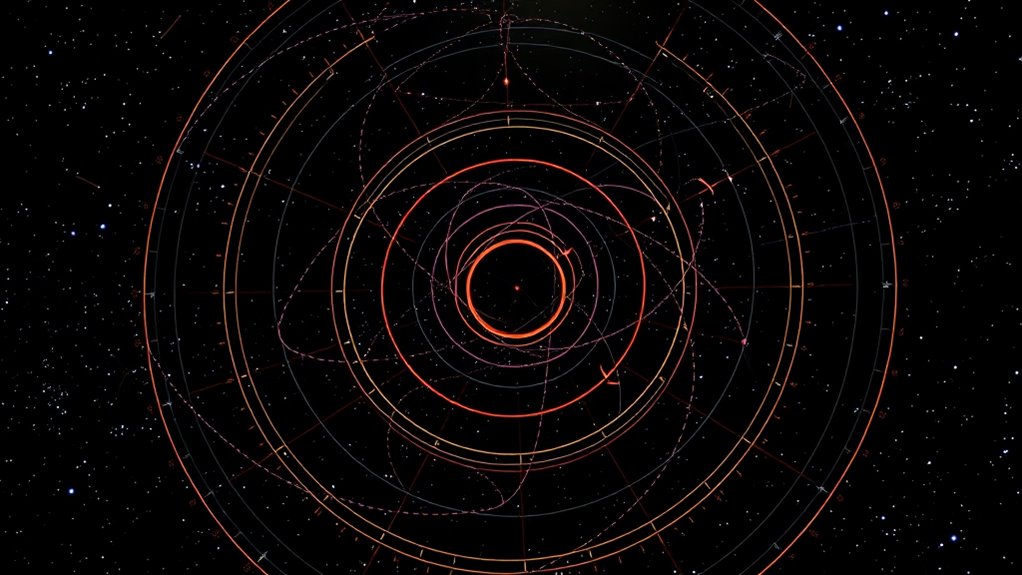

In astronomy, geometry helps you visualize and plot celestial orbits by using parameters like semi-major axis, eccentricity, and inclination to understand their shape and tilt. You use coordinate systems such as equatorial and ecliptic to locate stars, planets, and galaxies precisely. These tools enable you to create detailed celestial maps and predict object positions over time. Exploring these concepts more deeply will help you grasp how astronomers map and navigate the universe.
Key Takeaways
- Orbital parameters like semi-major axis, eccentricity, and inclination define the shape and orientation of celestial orbits for accurate plotting.
- 3D sketches of orbits illustrate spatial movement, aiding visualization of how celestial bodies traverse space.
- Celestial coordinate systems, such as equatorial and ecliptic, provide a universal framework for mapping objects in the sky.
- Converting 3D orbital data into 2D sky maps enables effective visualization and identification of celestial positions.
- Understanding orbital shapes and orientations supports precise predictions of celestial object movements and their appearance in celestial maps.
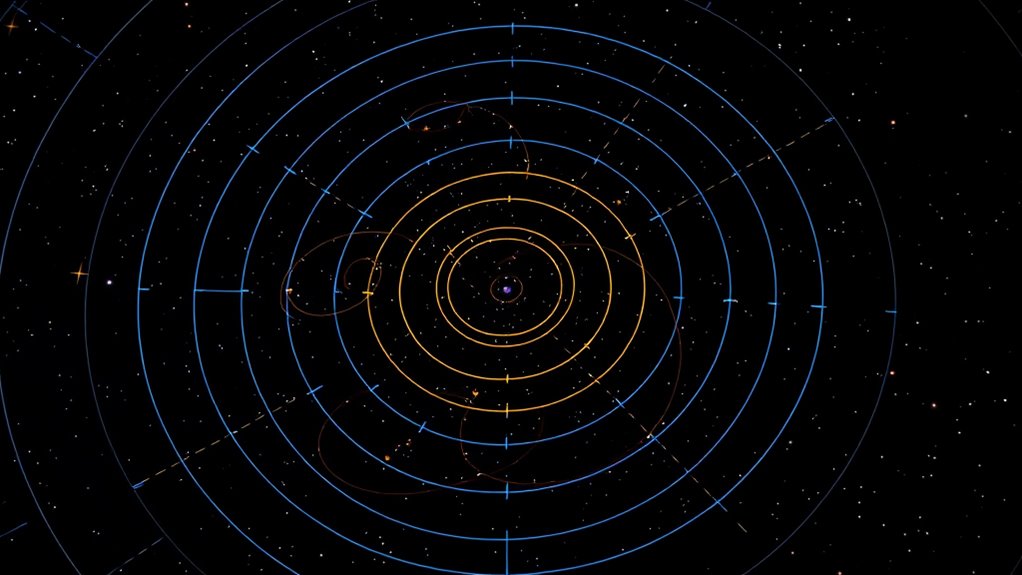
Have you ever wondered how astronomers measure the vast distances and sizes of celestial objects? It all comes down to understanding the geometry behind their motion and position. By analyzing orbital parameters, astronomers can determine the shape, size, and orientation of objects orbiting stars, planets, or even binary systems. Orbital parameters include elements like the semi-major axis, eccentricity, inclination, and the period of orbit. These values help you visualize how an object moves through space and predict its future position with remarkable accuracy. To do this effectively, astronomers rely heavily on celestial coordinate systems, which serve as the universal grid for mapping the sky. Think of celestial coordinate systems as the latitude and longitude for space—they allow you to pinpoint the location of stars, planets, and other celestial bodies precisely. Understanding the fundamental principles of celestial mechanics is essential for interpreting how celestial objects move and interact over time. When plotting orbits, you start with these orbital parameters, which define the shape and orientation of the orbit. For example, the semi-major axis tells you how far the object is from its focal point, usually the star it orbits. The eccentricity indicates how elongated or circular the orbit is. Inclination reveals the tilt of the orbit relative to a reference plane, like the ecliptic plane for planets in our solar system. With these parameters, you can sketch the orbit in a three-dimensional space, understanding how the object moves over time. This process is fundamental in predicting planetary positions and understanding the dynamics of celestial systems.
Celestial coordinate systems come into play once you’ve mapped the orbit; they help you translate the three-dimensional orbit into a two-dimensional map of the sky. The two most common systems are the equatorial coordinate system and the ecliptic coordinate system. The equatorial system uses right ascension and declination, similar to longitude and latitude on Earth, to locate objects relative to the celestial equator. The ecliptic system, on the other hand, aligns with the plane of Earth’s orbit around the Sun. Using these systems, astronomers can create detailed celestial maps that show the positions of planets, stars, and galaxies at any given time.
Frequently Asked Questions
How Are Celestial Coordinates Determined Precisely?
You determine celestial coordinates precisely by using coordinate systems like the equatorial system and measurement techniques such as telescopic observations and radio interferometry. These methods allow you to measure angles accurately between celestial objects and reference points. By calibrating your instruments and applying corrections for Earth’s motion and atmospheric effects, you guarantee your measurements are highly precise, enabling accurate plotting of stars, planets, and other celestial bodies.
What Tools Do Astronomers Use for Orbit Calculations?
You use tools like software and mathematical models based on orbital mechanics to perform orbit calculations. These tools help you analyze planetary ellipses, predict positions, and determine orbital parameters. By applying Newton’s laws and Kepler’s laws, you refine your models for accuracy. Astronomers also utilize telescopic data and celestial measurements to update and verify their calculations, ensuring precise predictions of celestial body movements within their orbital paths.
How Does Gravity Influence Orbital Geometry?
Gravity’s gravitational pull shapes orbital geometry by pulling objects into specific paths. You see this in orbital dynamics, where gravity causes planets and satellites to follow elliptical orbits around their stars or planets. The stronger the gravitational pull, the tighter and more curved the orbit becomes. As a result, gravity determines the size, shape, and stability of an orbit, influencing everything from planetary motions to spacecraft trajectories.
Can Geometry Predict Future Celestial Events Accurately?
Yes, geometry can predict future celestial events accurately, especially when you consider orbital resonance and celestial mechanics. By analyzing the geometric relationships of celestial bodies, you can forecast their movements and interactions. These principles help you understand how planets and moons influence each other’s orbits, enabling precise predictions of events like eclipses, transits, or orbital shifts, as long as you account for gravitational effects and resonance patterns.
How Are Celestial Maps Updated With New Discoveries?
Imagine a celestial map as a living canvas, constantly shifting with new discoveries. You update its accuracy by integrating recent data from telescopes and space missions, ensuring it reflects the latest celestial bodies and phenomena. Discovery updates flow into your charts, refining star positions, planetary paths, and cosmic events. This ongoing process keeps your celestial maps precise, helping you navigate the universe with confidence, knowing they evolve alongside our expanding understanding of space.
Conclusion
As you explore the geometry of astronomy, you’ll notice how plotting orbits and celestial maps often align in surprising ways. It’s almost as if the universe’s design was waiting for you to uncover its secrets. Every accurate orbit or star map feels like a small coincidence that reveals the cosmos’s elegant order. So, keep observing, mapping, and appreciating these beautiful coincidences—they’re your keys to understanding the universe’s hidden harmony.