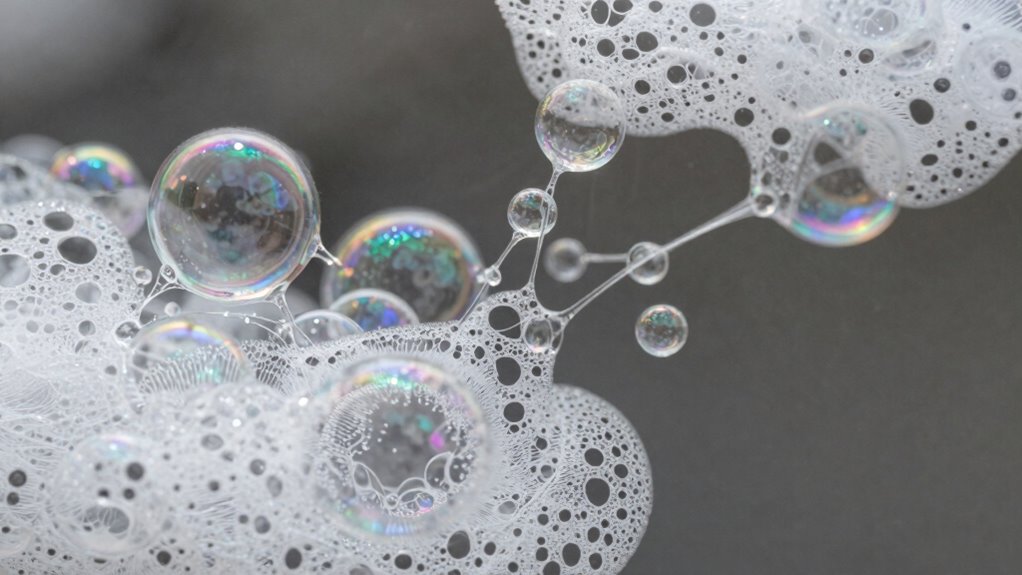

You see bubbles, droplets, and foam form surprising shapes because fluid forces constantly interact with surface tension, external disturbances, and internal pressures. As these forces balance, structures shift, merge, or burst, creating dynamic, intricate patterns. External influences like gravity or contact add to this complexity, shaping transient forms. If you keep exploring, you’ll uncover how these fascinating shapes are governed by simple physical principles that lead to their beautiful, ever-changing systems.
Key Takeaways
- Surface tension minimizes surface area, shaping bubbles, droplets, and foam into stable, energy-efficient configurations.
- Fluid dynamic forces like inertia and drag influence the formation, movement, and merging of bubbles and droplets.
- External disturbances cause thin films to adjust or rupture, creating dynamic, transient structures.
- Interactions between bubbles and droplets are driven by surface energy, leading to merging or breakup.
- The combined effects of internal and external forces produce diverse, often surprising, fluid shape systems.
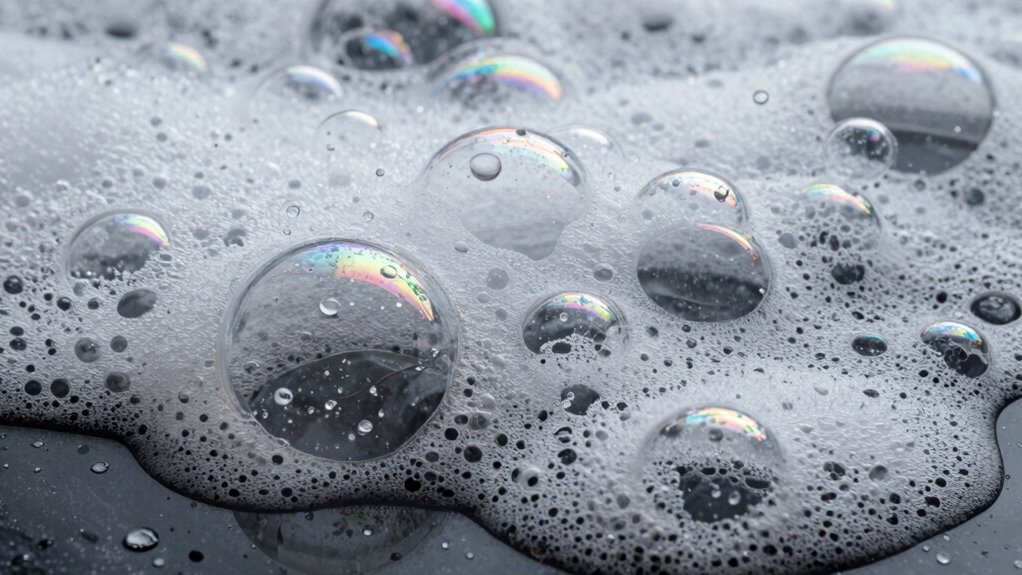
Fluid dynamics plays a crucial role in shaping these structures, influencing how bubbles form, move, and burst. As a bubble rises through the air or a droplet descends through a liquid, it’s subject to forces like gravity, drag, and internal pressure. These forces cause shape changes and movement, often resulting in complex interactions. For instance, when two bubbles come into contact, they might merge into a larger bubble, dictated by the minimization of surface energy. Similarly, foam—a collection of many tiny bubbles—takes on a variety of shapes, often irregular, but collectively following the same principles of surface tension to maintain stability. **The stability of these structures is also influenced by surface tension, which acts to minimize surface area and shape the overall form.** You can see fluid dynamics in action when droplets break apart or coalesce. When a droplet strikes a surface, it may spread out or form smaller droplets, driven by the interplay between inertia and surface tension. The shape and behavior of these droplets are governed by the balance of forces at the interface. The same dynamics govern the stability of foam, where the thin films separating bubbles are constantly adjusting to external disturbances. These films tend to thin out and rupture if overstressed, which is why bubbles pop or foam collapses. Understanding how shape systems arise from surface tension and fluid dynamics gives you insight into phenomena across nature and technology. Whether it’s the delicate architecture of a soap bubble, the way raindrops form and fall, or the stability of foam in industrial processes, the same principles apply. The transient, ever-changing structures you observe are governed by the fundamental physics of liquids and gases interacting—shaped by forces that aim to minimize energy while responding to external influences. This complex dance creates the surprising and beautiful shapes that make bubbles, droplets, and foam endlessly fascinating, with interfacial forces playing a vital role in their behavior.

Soap Making Kit with Melt & Pour Base, Cutting Box, Molds, Fragrances – for Adults & Kids by Prime Creations.
1.GET CREATIVE AT HOME: Get to choose your personal choice of soap every day! With 6 fragrances and…
As an affiliate, we earn on qualifying purchases.
As an affiliate, we earn on qualifying purchases.
Frequently Asked Questions
How Do Temperature Changes Affect Bubble and Droplet Shapes?
Temperature changes cause bubble and droplet shapes to shift through thermal expansion, making them expand or contract. As you heat the system, the increased temperature induces shape changes, often causing bubbles and droplets to become larger or more irregular. Conversely, cooling results in contraction. These temperature-induced shape changes happen because of the differences in thermal expansion rates between the liquid and gas, influencing the stability and forms of bubbles and droplets.
Can Bubbles or Foam Be Used for Structural Engineering?
You can definitely use bubbles or foam in structural engineering, especially through innovative bubble design and foam architecture. These materials offer lightweight, flexible, and energy-absorbing properties, making them ideal for temporary or adaptive structures. Engineers experiment with foam-based systems to create shock absorbers, insulation, or even load-bearing elements. While not traditional, these shape systems showcase potential for sustainable, cost-effective, and creative architectural solutions.
What Role Do Impurities Play in Bubble Formation?
Impurities considerably influence bubble formation by altering surface tension, often making bubbles more stable or irregular. When impurities are present, they can weaken or strengthen the surface tension, affecting bubble size, shape, and lifespan. You’ll notice that pure water produces more uniform bubbles, while impurities create variations. These effects help explain why bubbles and foam behave unpredictably, as surface tension changes due to impurity effects, shaping their unique and surprising forms.
Are There Natural Applications of Bubble Shape Systems?
You’ll find bubble shape systems play a role in natural applications like chemical reactions and biological processes. For example, bubbles facilitate gas exchange in aquatic life, aiding oxygen transfer. In chemical reactions, bubbles signal reactions occurring or help mix substances efficiently. You might also notice foam structures aiding in soil aeration or providing habitats, showcasing how these shape systems naturally support essential processes in ecosystems.
How Do Electrical Charges Influence Foam Stability?
Electrical charges substantially influence foam stability through electrostatic interactions and charge stabilization. You might think that charged bubbles would repel each other, causing the foam to break, but instead, these charges can create a stabilizing effect. By repelling nearby bubbles, charges prevent coalescence and drainage, maintaining foam structure longer. So, electrostatic interactions act as a natural glue, enhancing foam durability and preventing collapse.
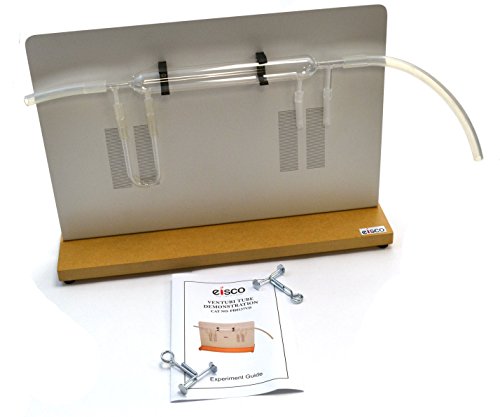
Eisco Labs Venturi Tube Classroom Display Apparatus, 18" Tall
Visual classroom demonstration of the Venturi Effect.
As an affiliate, we earn on qualifying purchases.
As an affiliate, we earn on qualifying purchases.
Conclusion
You might be surprised to learn that foam can contain millions of tiny bubbles, all working together to create intricate, dynamic shapes. These structures aren’t just beautiful—they follow the same physical principles that govern large-scale systems. With over 10,000 bubbles in a single foam, it’s clear how complexity emerges from simple interactions. By understanding these patterns, you discover a new perspective on nature’s surprising ability to organize chaos into stunning, functional forms.

Einstein’s Bubbles and Foam LAB Science Kit for Kids. STEM for Boys & Girls Detailed Picture Guide Included.
DISCOVER YOUR KID’S INNER EINSTEIN! This STEM science kit Introduces science from a young age: This is a…
As an affiliate, we earn on qualifying purchases.
As an affiliate, we earn on qualifying purchases.
droplet and bubble model set
As an affiliate, we earn on qualifying purchases.
As an affiliate, we earn on qualifying purchases.