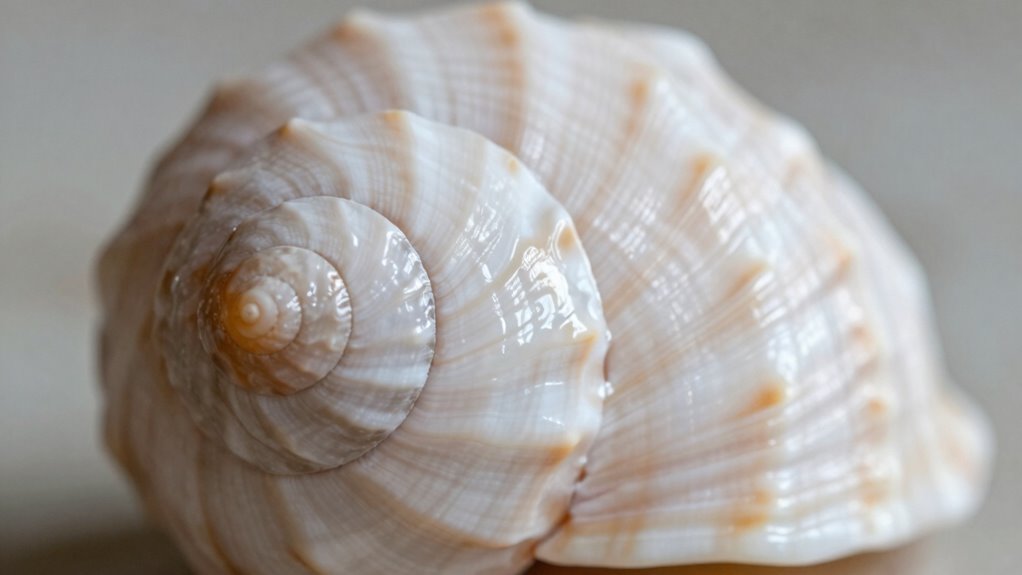

Studying shell growth shows you how curves in nature serve important functions like protection, strength, and adaptation. You’ll see that shells develop spirals, ridges, and intricate patterns through natural processes that improve their resilience against predators and environmental challenges. These shapes are not random; they’re designed by evolution to enhance survival. If you keep exploring, you’ll discover more about how these remarkable curves reveal the secrets of nature’s ingenuity.

Prime made for students and young adults
- Fast, free delivery for dorm and study essentials
- Prime Video and Amazon Music included
- Member-only deals
Key Takeaways
- Shell growth patterns, such as spirals and curves, demonstrate how organisms adapt to environmental pressures for protection.
- The curvature of shells distributes mechanical stress evenly, enhancing durability and resilience.
- Growth processes reflect natural selection favoring shapes that improve survival and reproductive success.
- Shell patterns reveal environmental influences like water chemistry and temperature on biological development.
- Curves and ridges serve functional roles, including camouflage, predator deterrence, and structural strength.

Have you ever wondered why shells often display such elegant curves and intricate shapes? The answer lies in how shells grow and adapt within their environments, revealing fascinating insights about marine biodiversity and evolutionary adaptations. As you observe a shell’s spiral or ridged design, you’re witnessing a product of millions of years of natural selection, where each curve serves a purpose in survival and reproduction. These shapes aren’t random; they’re carefully crafted by the shell’s growth process, which responds to environmental pressures and biological needs. The curves often help shells withstand predators and harsh conditions, showcasing the resilience that’s embedded in marine biodiversity. Over time, species with shells that better blend with their surroundings or provide stronger defense mechanisms tend to thrive and pass on their traits.
The growth process itself is a dynamic form of evolutionary adaptation. As the mollusk inside the shell grows, it secretes calcium carbonate to extend the shell’s structure outward. This secretion follows a pattern that creates the characteristic spirals and curves. These patterns aren’t just decorative—they’re functional. Spirals, for example, distribute stress evenly across the shell, preventing breakage, while ridges and nodules can serve as camouflage or deterrents to predators. These adaptations emerge through natural selection, where the shells that better protect the mollusk or allow it to maneuver more efficiently are more likely to be passed down through generations. Additionally, understanding these growth patterns helps us appreciate the importance of biodiversity in maintaining resilient ecosystems. Recognizing these patterns also highlights the interconnectedness of evolutionary processes and environmental influences shaping marine life. Moreover, studying shell growth can also offer insights into environmental conditions, such as water temperature and chemistry, which influence how shells develop over time. Such knowledge underscores the delicate balance between organisms and their habitats, emphasizing the importance of conservation efforts.
As an affiliate, we earn on qualifying purchases.
Frequently Asked Questions
How Do Environmental Changes Affect Shell Growth Patterns?
Environmental impact and climate influence directly shape shell growth patterns. When conditions change, you’ll notice irregularities, such as thinner shells or abnormal curves, indicating stress or adaptation. Warmer temperatures or pollution can slow growth or cause deformities, while stable environments promote healthy, consistent patterns. By observing these changes, you can understand how nature responds to environmental shifts, revealing crucial insights into the resilience and adaptability of marine life.
Are Shell Growth Patterns Consistent Across Different Species?
Shell growth patterns are like fingerprints—unique yet sometimes similar across species. While some shells display remarkable symmetry, others show growth variability that reflects their environment or lifestyle. You’ll find that shell symmetry can differ, revealing how species adapt, but patterns aren’t always consistent. This diversity highlights nature’s ability to craft shells with different curves, making each species’ growth story as distinctive as a snowflake.
What Role Does Genetics Play in Shell Curvature?
Genetics plays a vital role in shell curvature through genetic variation and morphological inheritance. You can see that specific genes influence how shells grow, shaping their curves. Variations in these genes lead to differences between species and individuals, affecting shell design. As you observe shell shapes, you’re witnessing how inherited genetic traits determine curvature, revealing a fascinating link between genetics and natural forms.
Can Shell Growth Be Artificially Manipulated?
Sure, shell growth can be artificially manipulated, though it’s a bit like playing nature’s artisan. Through shell growth experimentation, scientists explore biomimicry innovations that mimic natural processes. This allows for controlled modifications in shell curvature, offering insights into biological design. While it’s impressive, it also reminds us how much we still depend on nature’s innate mastery, even as we try to rewrite her delicate curves.
How Do Shells Adapt to Predators Through Their Curves?
You see how shells adapt to predators through their curves by enhancing predator deterrence and shell camouflage. Curved shells make it harder for predators to grasp or break them, offering protection. Their shapes also blend into surroundings, helping shells hide from threats. This natural evolution shows how curves serve as defense mechanisms, making shells tougher to attack while allowing them to stay concealed within their environment.
As an affiliate, we earn on qualifying purchases.
Conclusion
By observing how shells grow, you see that nature favors curves—about 95% of shells display spiral patterns, revealing a universal preference for these elegant shapes. This insight shows how growth processes shape the world around you, creating beauty and efficiency. So next time you spot a shell, remember it’s more than just a pretty find; it’s a proof to nature’s incredible design principles that influence everything from galaxies to seashells.
As an affiliate, we earn on qualifying purchases.
marine biodiversity educational kit
As an affiliate, we earn on qualifying purchases.
As an affiliate, we earn on qualifying purchases.
Fall Picks
fall essentials
As an affiliate, we earn on qualifying purchases.