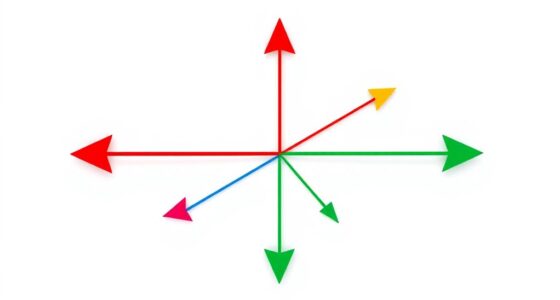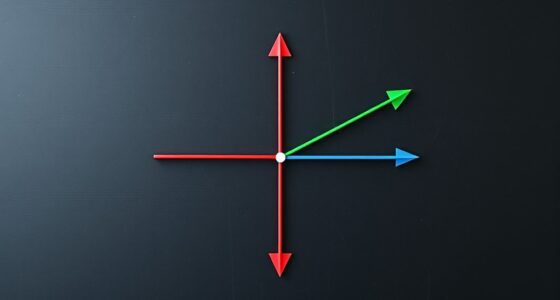
In physics, vectors represent quantities like forces and velocities that have both magnitude and direction. You can add vectors using methods like the tip-to-tail approach, which helps determine the net effect when multiple forces or velocities act together. Understanding vectors is essential because they provide a complete picture of physical phenomena. If you explore further, you’ll discover how these concepts apply to real-world situations, enhancing your grasp of how forces and velocities influence motion.
Key Takeaways
- Vectors represent quantities with both magnitude and direction, essential for analyzing forces and velocities in physics.
- Vector addition combines multiple forces or velocities using tip-to-tail methods to find the net effect.
- Understanding vector components helps resolve and compute combined forces and velocities accurately.
- Visual representations of vectors as arrows aid in grasping their magnitude, direction, and resultant sums.
- Applications include calculating net forces, resultant velocities, and analyzing motion and forces in complex systems.

Vectors are fundamental tools in physics that describe quantities with both magnitude and direction. When you deal with forces, velocities, or displacements, you’re working with vectors. To understand how multiple vectors combine, you need to grasp vector addition. Unlike scalar quantities, which only have magnitude—like mass or temperature—vectors include both size and direction. This distinction is vital because it impacts how you perform calculations and interpret physical situations.
Vectors combine magnitude and direction, essential for analyzing forces, velocities, and displacements in physics.
When performing vector addition, you don’t just add numbers. Instead, you consider both the magnitude and the direction of each vector. Imagine you have two forces acting on an object. To find the net force, you draw each force as an arrow where the length indicates magnitude and the direction shows where it’s applied. You then connect the tail of the second vector to the tip of the first. The resulting vector, called the resultant, stretches from the start of the first to the end of the second. This process, often called the tip-to-tail method, visually demonstrates how vectors combine.
You also need to be aware of the differences between scalar and vector quantities. Scalars are straightforward—just magnitudes. For example, if you walk 5 meters east, that’s a scalar quantity. But if you walk 5 meters east and then 3 meters north, the overall displacement isn’t just 8 meters; it’s a vector sum. To find this displacement, you use vector addition. This involves breaking vectors into components—like resolving the eastward and northward parts—and then combining those components to find the total vector.
Understanding vector addition is essential in physics because it allows you to analyze complex systems of forces and velocities. For forces, it helps determine the net force acting on an object, which influences its acceleration. For velocities, it allows you to find the actual speed and direction of an object moving along different paths. Whether you’re calculating the resultant velocity of a boat crossing a river with current or the combined forces on a structure, knowing how vectors add together makes your work accurate and meaningful. Additionally, the use of visual aids can greatly enhance comprehension of vector concepts.
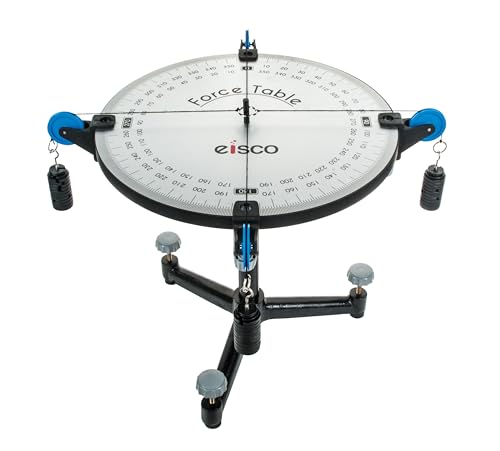
Eisco – Standard Physics Force Table, 40cm Polymer Top, Dual-Angle Measurement Scales, Heavy Cast Base, Leveling Screws, Pulleys and 250g Mass Sets for Vector and Equilibrium Experiments
- Complete Vector Experiment Kit: Includes tabletop, pulleys, masses, and accessories
- Dual-Angle Measurement Scales: Marked every 10° with 0.5° increments
- Stable Cast Base with Leveling: Heavy-duty base with leveling screws for stability
As an affiliate, we earn on qualifying purchases.
As an affiliate, we earn on qualifying purchases.
Frequently Asked Questions
How Do Vectors Differ From Scalar Quantities?
Vectors differ from scalar quantities because they include both magnitude and direction, unlike scalars, which only have magnitude. You can break vectors into components using vector notation, making them easier to analyze. When working with vectors, remember that their components show how they act along different directions. This distinction helps you better understand physical phenomena like forces and velocities, which require both magnitude and direction for complete description.
What Are Common Units Used to Measure Vectors?
You measure vectors using units like meters for displacement, newtons for force, and meters per second for velocity. To fully describe a vector, you break it into components along axes, each with its own unit, and often use unit vectors to indicate direction. These components and unit vectors help you understand the vector’s magnitude and direction precisely, making it easier to analyze physical quantities in various directions.
How Are Vectors Represented Graphically?
Imagine revealing a secret—vectors are graphically represented as arrows. You draw these arrows on a coordinate plane, with their length indicating magnitude and direction showing the vector’s path. To clarify, you can break down the vector into components along axes, called vector components. This graphical representation vividly illustrates the vector’s magnitude, direction, and components, making complex physics concepts easier to understand and visualize.
What Is Vector Addition and Subtraction?
Vector addition combines the components of two vectors using vector decomposition, resulting in a new vector that represents their combined effect. Subtraction involves reversing the direction of a vector and then adding its components. You do this by adding or subtracting corresponding components, which helps visualize the combined or opposing effects of forces or velocities. This method simplifies understanding how vectors interact in real-world scenarios.
How Do Vectors Relate to Real-World Physics Problems?
You use vectors in real-world physics problems to represent quantities like forces and velocities, making complex motions easier to analyze. Break vectors into components to understand how different directions affect the overall motion. By calculating the vector magnitude, you determine the strength or speed of an object. This helps you predict outcomes, optimize paths, and solve practical problems like navigation, projectile motion, or force analysis more accurately.
Eisco – Standard Physics Force Table, 40cm Polymer Top, Dual-Angle Measurement Scales, Heavy Cast Base, Leveling Screws, Pulleys and 250g Mass Sets for Vector and Equilibrium Experiments
- Complete Vector Experiment Kit: Includes tabletop, pulleys, masses, and accessories
- Dual-Angle Measurement Scales: Marked every 10° with 0.5° increments
- Stable Cast Base with Leveling: Heavy-duty base with leveling screws for stability
As an affiliate, we earn on qualifying purchases.
As an affiliate, we earn on qualifying purchases.
Conclusion
Understanding vectors in physics open up the universe’s secrets, allowing you to navigate forces and velocities with confidence. Mastering these concepts turns complex problems into simple puzzles—like wielding a superpower that can shape reality itself. Once you grasp vectors, you’ll feel unstoppable, as if you hold the key to the cosmos. So keep practicing, because the more you learn, the more you’ll realize that vectors are the true language of the universe—more powerful than words.

ALVIN TD1515, Elecric/Electronic Template, Design Tool for Students and Professionals Size: 5.25" x 8.25" x .03"
- Design Templates: Contains standard schematic symbols
- Compact Size: Measures 5.25 x 8.25 x 0.03 inches
- Multi-Purpose Tool: Ideal for architects and electricians
As an affiliate, we earn on qualifying purchases.
As an affiliate, we earn on qualifying purchases.

Visual Learning: Physics: An illustrated guide for all ages (Barron's Visual Learning)
As an affiliate, we earn on qualifying purchases.
As an affiliate, we earn on qualifying purchases.