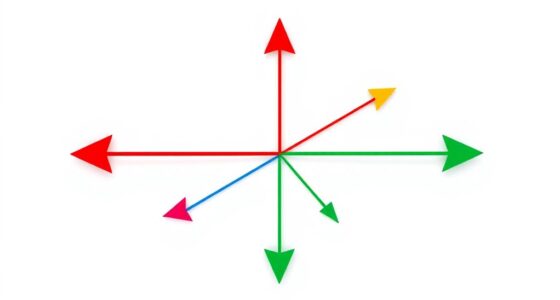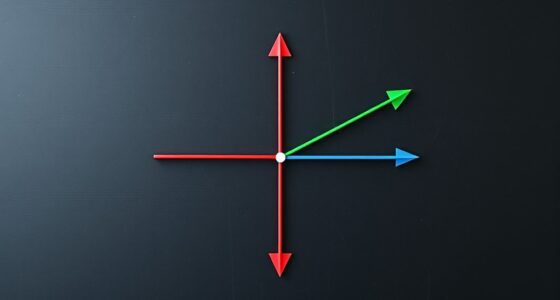

To understand lines and planes with vectors, start by choosing a point and a direction vector for a line, then use the parametric equation (r = r₀ + t d) to describe all points on it. For planes, pick a point and two non-parallel vectors within the plane, then write (r = r₀ + s u + t v). Mastering these basics helps you analyze spatial relationships, and there’s more to explore if you want to deepen your understanding.
Prime for Young Adults — start your free trial
Fast free delivery, streaming and member deals for eligible 18–24 year olds.
As an affiliate, we earn on qualifying purchases.
Key Takeaways
- Lines in space are represented parametrically by a point and a direction vector using the formula r = r₀ + t d.
- Planes are described parametrically with a point and two non-parallel vectors: r = r₀ + s u + t v.
- The parameter t (or s, v) varies over all real numbers, generating all points on the line or plane.
- The dot product helps identify perpendicular vectors and find the plane’s normal vector.
- Parametric equations systematically generate points and clarify the spatial relationship of lines and planes.

Have you ever wondered how to represent lines and planes in three-dimensional space using vectors? If so, understanding the basics of parametric equations and how vectors work together can make this much clearer. When working with lines and planes, vectors become your primary tools because they allow you to describe complex spatial relationships with simple components. To start, remember that any point in space can be represented as a position vector, and lines or planes can be expressed through vector equations. These equations often involve vector addition, where you combine a fixed point’s position vector with a scaled direction vector, to trace out the entire line or plane.
For a line in three-dimensional space, you typically choose a point on the line, represented by a position vector (vec{r_0}), and a direction vector (vec{d}) that indicates the line’s orientation. The parametric equation of the line then becomes (vec{r} = vec{r_0} + tvec{d}), where (t) is a real number parameter. As (t) varies, you move along the line by adding scaled versions of the direction vector to the initial point. This is a straightforward application of vector addition, which allows you to generate every point on the line systematically.
When you’re dealing with planes, the concept extends naturally. A plane can be described by a point (vec{r_0}) on the plane and two non-parallel vectors (vec{u}) and (vec{v}) that lie within the plane. The parametric form then becomes (vec{r} = vec{r_0} + svec{u} + tvec{v}), where (s) and (t) are real parameters. This equation essentially combines two vector additions, scaling each direction vector separately, to cover the entire plane. Additionally, the contrast ratio plays a crucial role in visual clarity when rendering these three-dimensional objects, especially in projectors or displays used for presentations.
The dot product is another key concept when working with vectors in this context. It helps you find angles between vectors, check for perpendicularity, and understand the orientation of the plane or line. For example, if the dot product between two vectors is zero, they’re orthogonal. This can be useful for determining the normal vector to a plane, which is perpendicular to every vector lying within it. Knowing how to manipulate vectors through addition and the dot product makes it easier to set up and interpret parametric equations for lines and planes, giving you a powerful way to visualize and analyze three-dimensional space.
As an affiliate, we earn on qualifying purchases.
Frequently Asked Questions
How Can I Visualize Vectors in Three-Dimensional Space?
To visualize vectors in three-dimensional space, picture each as an arrow starting from the origin, pointing to its tip. Use vector addition to see how combining vectors shifts the arrow’s position, and compare their magnitudes to understand their lengths. You can also sketch on graph paper or use 3D graphing tools to see how vectors relate in space, helping you grasp their directions and relative sizes easily.
What Are the Common Mistakes When Writing Parametric Equations?
When writing parametric equations, you often make mistakes with vector notation and parametric constraints. Guarantee your vector notation clearly shows the direction vectors and points, avoiding ambiguity. Double-check your parametric constraints to match the geometric shape you’re describing. Common errors include mixing up variable roles, omitting parameters, or not aligning constraints with the intended line or plane. Paying attention to these details helps create accurate and consistent equations.
How Do Vectors Relate to Real-World Applications?
You use vectors in real-world applications by understanding their magnitude and the concept of vector addition. For example, the magnitude shows the strength of a force or velocity, helping you measure how powerful something is. Vector addition allows you to combine forces or directions, like steering a boat downstream while facing the current. These principles help solve practical problems in engineering, physics, and navigation, making your work more accurate and efficient.
Can Parametric Equations Describe Curved Surfaces?
Yes, parametric equations can describe curved surfaces. You can create parametric surfaces by defining two parameters, often u and v, which vary over ranges to generate curved geometries like spheres, cylinders, or more complex shapes. By setting equations for x, y, and z in relation to these parameters, you effectively map out curved surfaces, making parametric surfaces powerful tools for modeling and visualizing complex three-dimensional geometries.
What Tools Can Help in Solving Vector Equations Efficiently?
To solve vector equations efficiently, you need to leverage powerful tools like matrix transformations and vector dot products. These tools help you break down complex problems into manageable parts, saving time and effort. Think of matrix transformations as a shortcut to change coordinate systems easily, while dot products help find angles and projections quickly. Mastering these tools makes solving vector equations feel like a walk in the park.
parametric equations for students
As an affiliate, we earn on qualifying purchases.
As an affiliate, we earn on qualifying purchases.
Conclusion
Understanding vectors and parametric equations makes working with lines and planes much clearer. Did you know that in space, an infinite number of lines pass through just a single point? Mastering these concepts open a whole new way of visualizing and solving complex problems. So keep practicing—your ability to navigate three-dimensional space will only grow stronger. Remember, every step brings you closer to confidently working with the fascinating geometry of our universe!
As an affiliate, we earn on qualifying purchases.
As an affiliate, we earn on qualifying purchases.
Fall yard work Picks
leaf blowers
As an affiliate, we earn on qualifying purchases.