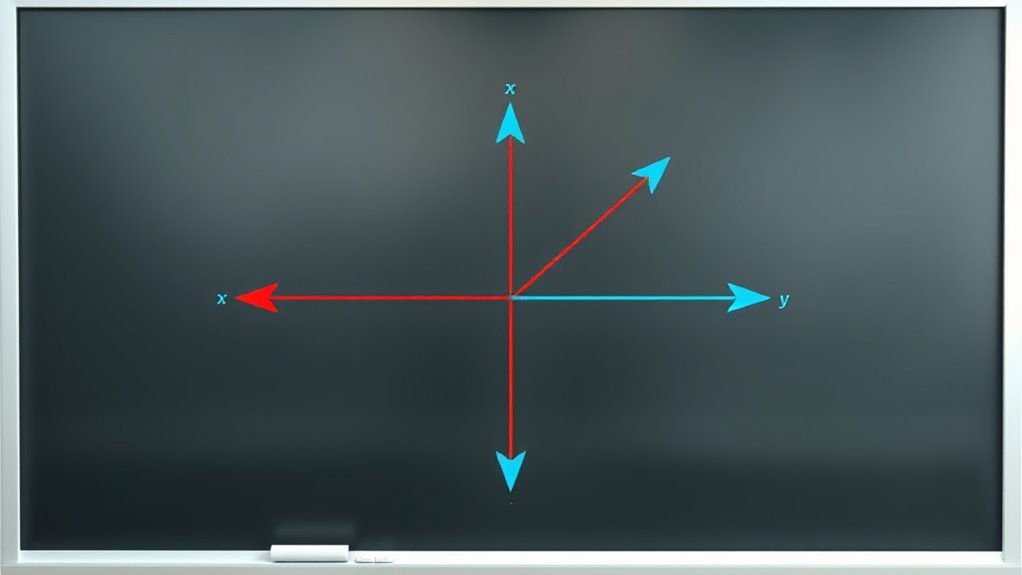

The standard basis vectors are the fundamental unit vectors that define directions along the x, y, and z axes in space. They are denoted as i, j, and k, each with a magnitude of one, making them essential for expressing any vector in terms of its components. These vectors help you analyze directions and decompose complex vectors into simpler parts. If you keep exploring, you’ll discover how these basis vectors clarify vector relationships and orientations.
Key Takeaways
- Standard basis vectors in 3D are unit vectors along x, y, and z axes, typically denoted as i, j, and k.
- These basis vectors are inherently normalized, each having a magnitude of one, representing pure directions along their respective axes.
- Any vector in space can be decomposed into components along the standard basis vectors using scalar multiplication.
- The components of a vector along basis vectors are its directional cosines, indicating the vector’s orientation.
- The standard basis simplifies vector analysis, computation, and visualization by providing a consistent directional framework.

A unit vector is a vector with a magnitude of exactly one, used to specify direction in space. It acts as a fundamental tool in vector analysis because it provides a standardized way to indicate orientation without regard to magnitude. To create a unit vector from any given vector, you perform vector normalization. This process involves dividing each component of the original vector by its magnitude, ensuring the resulting vector has a length of one. Vector normalization simplifies many calculations and helps in comparing directions across different vectors. This process is essential for defining directions precisely in three-dimensional space.
When you’re working with a vector in three-dimensional space, you often want to understand its orientation relative to the coordinate axes. This is where directional cosines come into play. The directional cosines are the cosines of the angles that a vector makes with the x, y, and z axes. They are essential because they provide the components of a unit vector along each axis, effectively describing the vector’s direction in a compact form. If you have a vector ( mathbf{v} ), and you normalize it to get a unit vector ( mathbf{u} ), then the directional cosines are simply the components of ( mathbf{u} ).
In practical terms, to find the directional cosines, you first determine the magnitude of your original vector. Then, normalize it by dividing each component by this magnitude. The resulting components are the directional cosines, which are always between -1 and 1, reflecting the angle’s cosine with each axis. These cosines are particularly useful in applications like physics and engineering, where they help describe the orientation of forces, velocities, or other vectors in space.
Understanding how to perform vector normalization and interpret directional cosines allows you to manipulate vectors more effectively. For example, when working with the standard basis vectors—unit vectors along the x, y, and z axes—you use these as building blocks to express any vector in space. These basis vectors are inherently normalized, making them ideal references for describing directions. Recognizing that any vector can be decomposed into components along these basis vectors simplifies the analysis of complex vector relationships, especially in fields like mechanics, computer graphics, and navigation.
As an affiliate, we earn on qualifying purchases.
Frequently Asked Questions
How Are Unit Vectors Used in Real-World Applications?
You use unit vectors in real-world applications like vector navigation and physics modeling. They help you describe directions precisely, making it easier to calculate movement or forces. For example, in navigation, you can determine a ship’s course by multiplying a unit vector with a speed to find the exact path. Similarly, in physics, unit vectors simplify analyzing forces and accelerations, ensuring accurate and efficient problem-solving.
Can Unit Vectors Be Negative or Only Positive?
Did you know that negative vectors are just as important as positive ones? Yes, unit vectors can be negative, which affects their basis orientation. When a component of a unit vector is negative, it points in the opposite direction along that axis. This flexibility allows you to accurately describe directions in space, especially when dealing with negative vectors, ensuring precise calculations and better understanding of spatial relationships.
What Is the Difference Between a Basis Vector and a Coordinate Vector?
A basis vector is an original vector that, when combined, can generate all other vectors in a space, while a coordinate vector represents a specific point’s position relative to the basis vectors. fundamentally, basis vectors form the foundation, and coordinate vectors tell you where you are on that foundation. You use basis vectors to define the space, and coordinate vectors to locate points within it.
How Do Unit Vectors Relate to Vector Normalization?
You might think unit vectors aren’t related to normalization, but they actually are. When you normalize a vector, you divide its components by its magnitude to get a vector with a magnitude of 1. This process creates a unit vector, which points in the same direction as your original vector. So, vector normalization transforms any vector into a unit vector, making it easier to work with directions without changing the original vector’s orientation.
Are There Alternative Methods to Define Directions Besides the Standard Basis?
Yes, you can define directions using coordinate transformations and non-orthogonal bases. Instead of sticking to the standard basis, you can choose different basis vectors that suit your problem. These bases may not be orthogonal, but they still help you describe directions in space. By transforming coordinates, you can analyze directions relative to these alternative bases, giving you more flexibility in understanding and solving complex geometric and algebraic problems.
As an affiliate, we earn on qualifying purchases.
Conclusion
Understanding unit vectors helps you grasp directions in space, making complex problems simpler. Did you know that in three-dimensional space, the standard basis vectors are orthogonal, meaning they meet at right angles? This unique property guarantees precise movement along each axis. By mastering these concepts, you can confidently navigate any vector problem, knowing the fundamental building blocks are consistent and reliable. Keep exploring, and you’ll find that the beauty of vectors lies in their simplicity and symmetry.
As an affiliate, we earn on qualifying purchases.
directional cosine measurement device
As an affiliate, we earn on qualifying purchases.
As an affiliate, we earn on qualifying purchases.