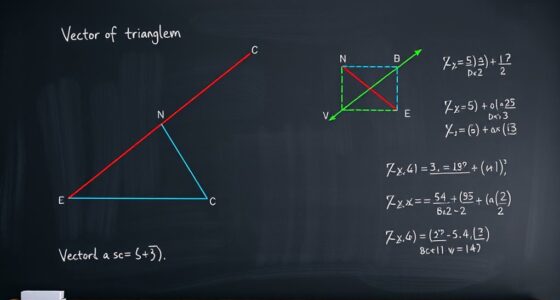

The cross product in 3D gives you a vector perpendicular to two given vectors. You find it by calculating the determinant of a 3×3 matrix that includes unit vectors and the components of your vectors. This method makes it easy to visualize the spatial relationship and determine the direction. It also helps you understand the magnitude and area spanned by the vectors. Keep exploring to uncover more about how this powerful tool connects algebra and geometry.
Key Takeaways
- The cross product produces a vector perpendicular to both original vectors in 3D space.
- It is calculated using a determinant of a 3×3 matrix involving vector components.
- The resulting vector’s magnitude equals the area of the parallelogram formed by the vectors.
- It helps visualize the spatial orientation and relationship between two vectors.
- Widely used in physics and engineering to determine forces, torque, and rotational effects.

In practical terms, calculating the cross product involves a determinant of a 3×3 matrix composed of the standard unit vectors i, j, and k, along with the components of the vectors A and B. This calculation yields the components of the perpendicular vector directly, making it straightforward to find both the direction and magnitude. The process is efficient and precise, giving you a powerful tool to analyze three-dimensional relations. Whether you’re working with force vectors, velocity, or displacement, understanding the cross product’s geometric interpretation and vector magnitude allows you to grasp the underlying structure of 3D space. It’s an essential concept that bridges algebraic computation with spatial intuition, enabling you to solve complex problems with clarity and confidence. Additionally, the cross product is fundamental in applications like determining a perpendicular vector in physics and engineering, which often involves concepts like torque and rotational force.
3D vector cross product calculator
As an affiliate, we earn on qualifying purchases.
As an affiliate, we earn on qualifying purchases.
Frequently Asked Questions
How Is the Cross Product Used in Computer Graphics?
You use the cross product in computer graphics to determine the perpendicular vector to two surfaces, which helps with shading and lighting calculations. It also aids in calculating the angle between vectors, essential for realistic rendering. Additionally, the cross product allows you to find vector projections, ensuring objects are correctly aligned and oriented. This makes your models more accurate and visually appealing, especially when simulating light effects or rotations.
Can the Cross Product Be Applied in 2D Space?
Yes, you can apply the cross product concept in 2D space by treating vectors as 3D with a zero z-component. This allows you to find a vector perpendicular to the plane, useful in scalar multiplication and vector projection. Although the cross product in 2D results in a scalar, it helps determine orientation and area, which are essential in calculations like collision detection or geometric transformations.
What Is the Geometric Interpretation of the Cross Product?
Imagine you’re pushing a box across a table, and the force vectors are at an angle. The cross product gives you a vector whose magnitude equals the area of the parallelogram formed by those forces, indicating the strength of the combined effect. Its vector orientation is perpendicular to both original vectors, showing the direction of the resulting force. This helps visualize how the cross product reveals both magnitude and direction in 3D space.
How Does the Cross Product Relate to Torque?
You relate the cross product to torque because it calculates a vector that’s perpendicular to both the position vector and force, representing the torque’s direction. When you perform scalar multiplication with this torque vector, you get its magnitude, which shows how much rotational force is applied. The vector projection helps in understanding the effective component of force causing rotation, linking directly to the cross product’s role in torque calculation.
Are There Any Alternative Methods to Find a Perpendicular Vector?
You can find a perpendicular vector using alternative methods like solving for vector orthogonality through dot products, which guarantees the dot product equals zero. You might also use geometric approaches, such as plane equations or coordinate geometry, to identify a perpendicular direction. These methods are helpful when the cross product isn’t feasible or you want a more straightforward approach to find a vector orthogonal to given vectors.
vector math physics engineering tools
As an affiliate, we earn on qualifying purchases.
As an affiliate, we earn on qualifying purchases.
Conclusion
Now that you understand the cross product, you’ve gained a powerful tool for exploring 3D space—like having a secret superpower! Whenever you need a vector perpendicular to two others, you can confidently perform the cross product with precision and ease. Remember, mastering this concept is like holding the key to a hidden universe of angles and directions. Keep practicing, and soon you’ll wield it as effortlessly as a hero with a magic wand in a world of endless possibilities!
perpendicular vector in 3D models
As an affiliate, we earn on qualifying purchases.
As an affiliate, we earn on qualifying purchases.
cross product geometry visualization
As an affiliate, we earn on qualifying purchases.
As an affiliate, we earn on qualifying purchases.