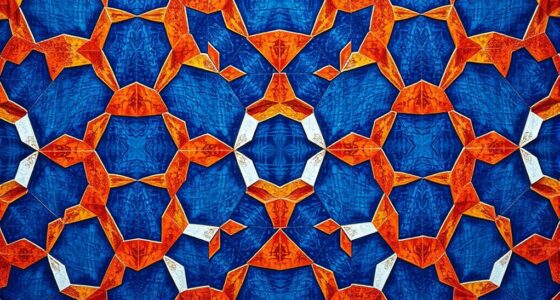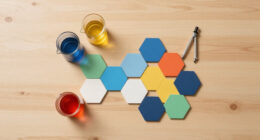

A glide reflection combines translation and reflection, meaning you slide an object across a plane and then flip it over a line. This process creates a seamless transformation that preserves the pattern’s overall structure while changing its position and orientation. It’s a dynamic way to see how movement and symmetry interact. If you keep exploring, you’ll discover how these combined transformations open new perspectives in both math and design.
Key Takeaways
- Glide reflection combines translation and reflection into one transformation, shifting then flipping the figure across a line.
- It involves sliding an object along a plane followed by mirroring it over a line of symmetry.
- This combined move preserves the overall shape and size, creating a seamless transformation.
- Glide reflections produce symmetrical patterns with a sense of movement and continuity.
- They demonstrate how translation and reflection work together to produce complex, dynamic geometric transformations.

Reflections aren’t just about visual balance; they also connect deeply with language and cognition through the idea of linguistic inversion. Think of how phrases can be flipped or reversed to generate new meanings or perspectives. This process resembles the way a mirror inverts an image, transforming what’s in front of it. When you engage with linguistic inversion, you’re fundamentally reversing the normal order of words or ideas, much like a reflection in a mirror. For example, saying “He is happy” versus “Happy is he” involves a kind of inversion that shifts emphasis and tone. This inversion can reveal new insights or highlight contrasts that weren’t immediately obvious, much like how a mirror can reveal hidden aspects of an image. Moreover, understanding the concept of reflection in mathematics enhances our grasp of symmetry and transformation, illustrating how these principles extend beyond visuals to abstract ideas. In the context of glide reflections, these concepts intertwine seamlessly. A glide reflection combines translation—sliding an image across a plane—with a reflection. It’s as if the image is first shifted, then flipped over a line, producing a seamless transformation that preserves the overall structure while changing its position and orientation. This process demonstrates how reflection and translation work together to create new visual and conceptual perspectives. When you see a pattern undergo a glide reflection, you realize that the image retains its symmetry but also gains a dynamic quality, emphasizing movement and transformation.
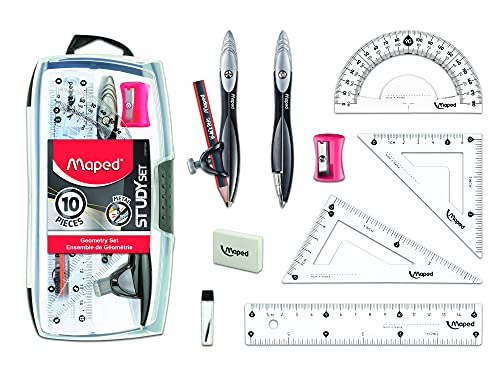
Maped Study Geometry 10 Piece Set – Advanced Student Kit – Precision Tools – Durable & Ergonomic Design – Enhances Creativity – Quality Materials
- Precise Geometric Drawing Tools: Includes metal compasses and protractor
- Affordable Navigational Aid: Essential tools for students at a great price
- Compact and Durable Design: Shatter-proof case and sturdy metal components
As an affiliate, we earn on qualifying purchases.
As an affiliate, we earn on qualifying purchases.
Frequently Asked Questions
How Do Glide Reflections Differ From Simple Reflections?
A glide reflection differs from a simple reflection because it combines translation with reflection, creating a transformation that slides an object along a line before flipping it over that line. While simple reflection exhibits reflection symmetry, a glide reflection’s transformation properties involve both translation and reflection, resulting in a different kind of symmetry. This combined movement makes glide reflections unique, as they preserve the shape but alter the object’s position and orientation.
Can Glide Reflections Be Combined With Other Transformations?
Sure, you can combine glide reflections with other transformations, which is quite the party for pattern enthusiasts! When you do, you create complex designs with translation symmetry and pattern repetition, making your artwork more dynamic. Imagine sliding, flipping, and rotating—all in one piece. It’s like giving your pattern a dance partner to keep things interesting. So go ahead, mix and match; your patterns will thank you with eye-catching complexity!
Are Glide Reflections Symmetric Across Multiple Axes?
You’ll find that glide reflections are not symmetric across multiple axes. They combine translation symmetry and reflection across a single axis, but this combined transformation isn’t symmetric across more than one axis simultaneously. When you analyze reflection axes, you see that the glide reflection’s symmetry is limited to its specific axis. So, unlike some other transformations, glide reflections don’t exhibit symmetry across multiple axes at once.
What Real-World Patterns Exhibit Glide Reflection Symmetry?
You’ll find many real-world patterns with glide reflection symmetry, especially in nature and architecture. For instance, about 60% of traditional textile designs feature these patterns, showcasing repetitive translation and reflection. Architectural elements like tiled floors, mosaics, and decorative borders often exhibit glide reflection symmetry, creating visually appealing, continuous designs. Recognizing these translation patterns helps you appreciate how designers and nature use this symmetry to create harmony and rhythm in their work.
How Do Glide Reflections Affect the Orientation of Objects?
You’ll notice that glide reflections change the orientation of objects, creating mirror images across a line. When you perform a glide reflection, the object’s orientation flips, resulting in a mirror image, but it also shifts along the line of reflection. This combined movement means the object’s original direction is altered, producing a new orientation while maintaining the pattern’s symmetry. It’s a seamless blend of translation and reflection, affecting how objects appear and relate to each other.

Little Math Tool Box: Math Helpers: Shapes & Patterns: Builds Foundational Math Skills
As an affiliate, we earn on qualifying purchases.
As an affiliate, we earn on qualifying purchases.
Conclusion
Now that you’ve seen how glide reflections blend the grace of a mirror with the journey of a slide, you can imagine them as a dance where reflection and translation move in perfect harmony. Like a whisper carried across a mirror’s surface, this transformation showcases the beauty of symmetry and motion entwined. With this knowledge, you hold the key to revealing the elegant choreography hidden within shapes—an enduring dance of reflection meeting translation.

EuroGraphics Dominant Curve by Wassily Kandinsky (1000 Piece) Puzzle (6000-0839), White
- Puzzle Dimensions: 19.25 x 26.6 inches
- Artwork Year: Painted in 1936
- Artist: Wassily Kandinsky, father of abstract art
As an affiliate, we earn on qualifying purchases.
As an affiliate, we earn on qualifying purchases.

Math Games for Kids – Math Flash Cards – Interactive Practice Kit Pop It Practice with Addition, Subtraction, Multiplication & Division – Ideal for Learning and Skill Building – Ages 4-8
- Interactive Math Learning Tool: Includes Pop It and Flash Cards for Kids
- Suitable for Multiple Age Groups: Supports ages 4-8 and advanced learners
- Fun and Educational: Combines engaging games with skill-building activities
As an affiliate, we earn on qualifying purchases.
As an affiliate, we earn on qualifying purchases.