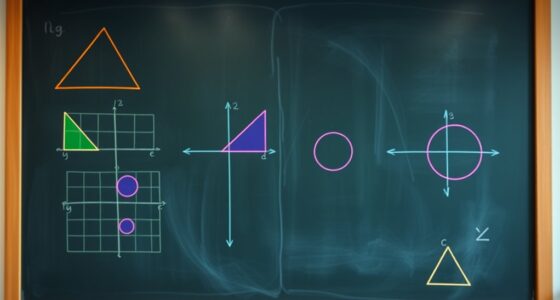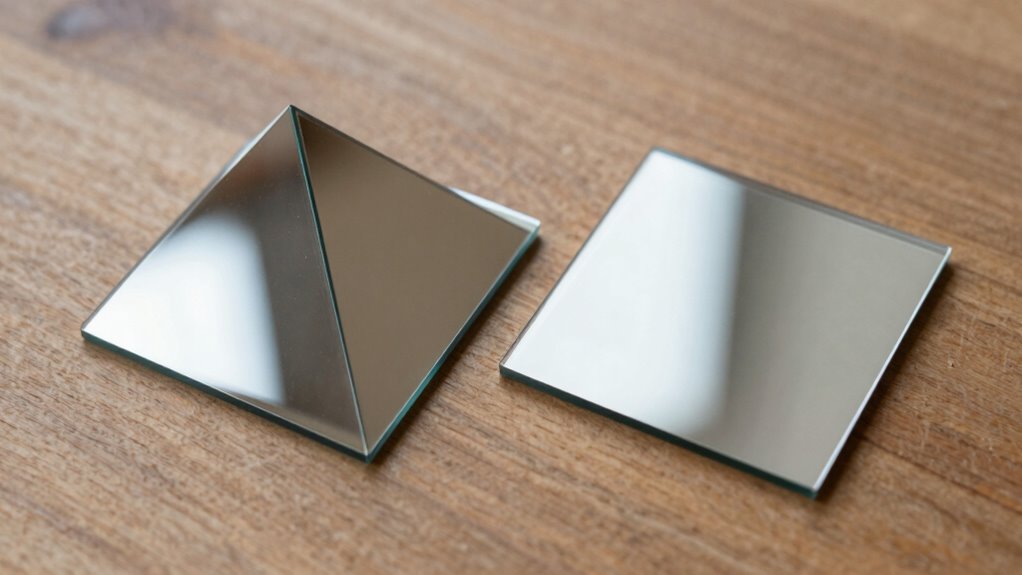
Rotations feel harder than reflections at first because they involve more complex mathematical steps, like using sine and cosine formulas. You also need to actively visualize turning objects around a point, which isn’t as intuitive as flipping them across a line. Reflections are simpler and involve predictable changes in position, making them easier to picture initially. If you keep exploring, you’ll discover ways to make rotations more straightforward and develop better spatial understanding.
Listen free for 30 days with Audible
Thousands of audiobooks and originals — cancel anytime.
As an affiliate, we earn on qualifying purchases.
Key Takeaways
- Rotations involve complex formulas with sine and cosine, making their visualization more challenging than the simple flip of reflections.
- Reflecting objects across a line is a straightforward, predictable process, whereas rotations require active mental imagery of turning objects.
- Understanding coordinate transformations for rotations demands grasping more advanced mathematical concepts compared to reflections.
- Recognizing symmetry and performing reflections are intuitive, while rotations require active spatial reasoning and problem-solving skills.
- Practice and familiarity with transformations gradually reduce the perceived difficulty of visualizing rotations.
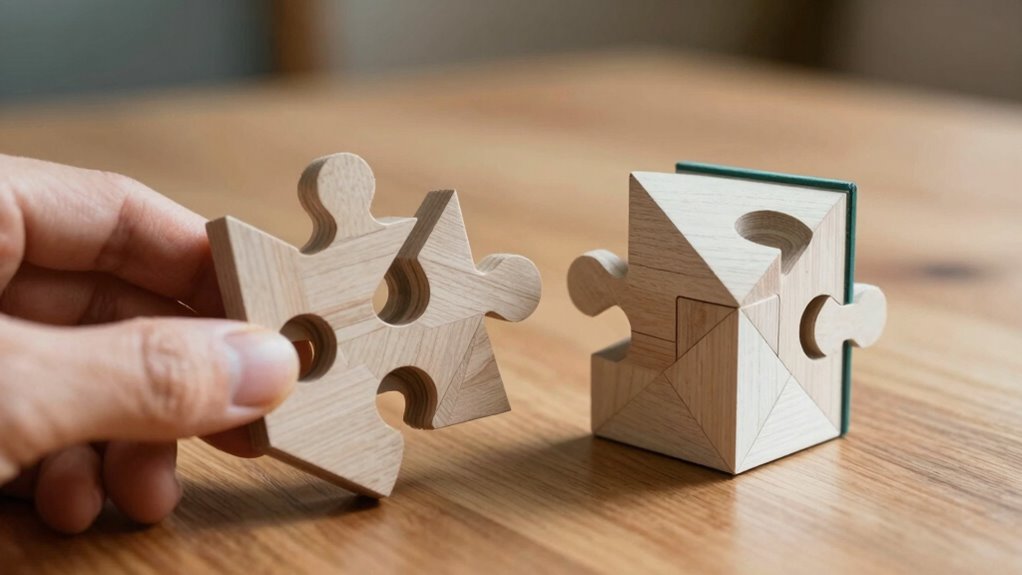
Have you ever noticed that rotations seem more challenging than reflections when you first learn them? It’s a common experience, and it often comes down to how your mind visualizes these transformations. Reflections tend to feel more straightforward because they involve flipping an object across a line of symmetry, which is easy to picture. You simply imagine mirroring the shape over a line, and the process is quite intuitive. Rotations, on the other hand, require you to turn an object around a point, often a center of rotation, which can be less immediately obvious. This difference is rooted in how these transformations relate to coordinate systems and symmetry types.
Rotations are harder than reflections because they involve turning around a point, which is less intuitive to visualize.
When you’re working with coordinate systems, reflections are usually easier to grasp because they involve simple, predictable changes in coordinates. For example, reflecting across a vertical line involves negating the x-coordinate, which is straightforward. Rotations, however, require you to apply more complex formulas—like using sine and cosine functions—to find the new coordinates after turning the object. This added complexity can make rotations seem more abstract, especially if you’re not yet comfortable with the math involved. The coordinate system acts as a mental map, and while reflections keep your mental map simple, rotations demand more mental calculation and visualization. Developing a clear understanding of these coordinate transformations can significantly improve your ability to visualize and perform rotations more easily. Additionally, practicing visualization techniques can help your brain become more adept at imagining these spatial changes. Recognizing different symmetry types can also make understanding rotations more intuitive as you become familiar with how objects can exhibit multiple forms of symmetry. Some studies suggest that actively engaging with these concepts through hands-on activities can further enhance your spatial reasoning skills, making rotations feel less intimidating over time.
Symmetry types also play a role in why rotations seem harder at first. Reflection symmetry is often the first type of symmetry you encounter because it’s visible and easy to recognize. You see a mirror image and understand immediately that the object is symmetric across a line. Rotational symmetry, however, involves turning an object until it looks exactly the same as it did initially, which requires you to think about the degree of rotation and the specific point around which it turns. This makes rotational symmetry less intuitive initially, especially because it involves multiple symmetry types—like identifying the order of rotation or the smallest angle that maps the object onto itself.
Your initial difficulty with rotations also stems from the fact that they involve a more active mental process. Reflections are passive flips; rotations require you to actively imagine turning the object step-by-step. As you practice, your brain gradually becomes more comfortable with this process, and the transformations start to feel more natural. Until then, it’s normal to find rotations more challenging, especially as you work to understand how coordinate systems and symmetry types interact to create these visual effects. Understanding the math behind rotations can significantly improve your ability to visualize these transformations more easily.
geometry rotation and reflection models
As an affiliate, we earn on qualifying purchases.
As an affiliate, we earn on qualifying purchases.
Frequently Asked Questions
How Do Rotations Differ From Reflections Mathematically?
Rotations differ from reflections mathematically because they involve turning a figure around a fixed point by a specific angle measurement, preserving the shape’s size and geometric symmetry. Reflections, on the other hand, flip a figure across a line, creating a mirror image. While rotations change the figure’s position, reflections produce a symmetrical image across a line, making rotations generally more complex due to the angle measurement involved.
Are Rotations More Complex to Visualize Than Reflections?
Think of visualizing rotations as trying to turn a complex puzzle piece, while reflections are like flipping a coin. Rotations often pose more visualization challenges because of their inherent cognitive differences—mentally tracking angles and axes can be tougher. You might find rotations harder to picture initially because they demand more spatial reasoning, unlike reflections, which are more straightforward to imagine as a simple mirror flip.
Do Rotations Require More Steps Than Reflections?
Rotations generally require more steps than reflections in geometric transformations. With rotations, you need to identify the center, angle, and direction, then perform the rotation carefully, which involves multiple steps. Reflections are simpler, often just flipping across a line to achieve symmetry. This difference in process makes rotations seem more complex initially, as they involve understanding more about symmetry operations and how each step impacts the figure’s position.
Why Do Some People Find Rotations More Intuitive?
You find rotations more intuitive because you naturally interpret angles and understand axes. With rotations, you visualize turning around a specific line, making it easier to grasp the concept. You see the angle of rotation clearly, and understanding the axis helps you picture the movement. This clarity in angle interpretation and axis understanding makes rotations feel more straightforward, whereas reflections often seem less familiar and harder to conceptualize initially.
Can Practice Make Rotations Easier Than Reflections?
Yes, practice can make rotations easier than reflections in advanced geometry. As you repeatedly work through rotation problems, your brain adapts to the cognitive challenges involved, making the process more intuitive over time. You’ll develop a better understanding of angles and movement, which helps you visualize and execute rotations more confidently. Consistent practice reduces the initial difficulty, turning complex rotations into more manageable and familiar tasks.
As an affiliate, we earn on qualifying purchases.
Conclusion
So, don’t despair if rotations feel rough right now. With patience and practice, your perception will shift, and you’ll swiftly see the similarities between rotations and reflections. Remember, persistence is the key—persevering through the perplexity will produce progress. Soon, rotations will seem simpler, and reflections will feel familiar. Keep practicing, and you’ll conquer the confusion, creating a clear, confident compass for geometric challenges ahead.
As an affiliate, we earn on qualifying purchases.
visualization tools for math transformations
As an affiliate, we earn on qualifying purchases.
As an affiliate, we earn on qualifying purchases.
Flea & tick season Picks
flea and tick prevention
As an affiliate, we earn on qualifying purchases.