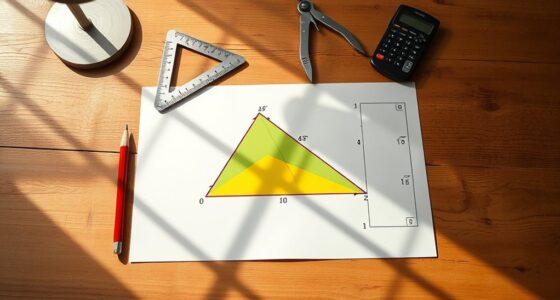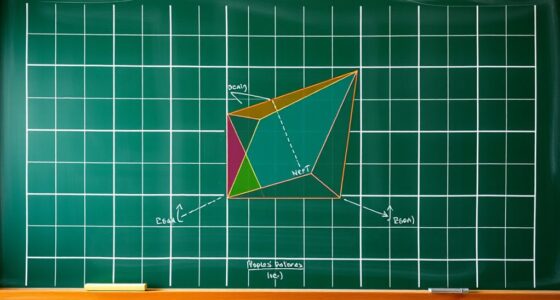

The Law of Cosines is a natural extension of the Pythagorean theorem, allowing you to find unknown sides or angles in any triangle, not just right triangles. It relates all three sides and an included angle, using the formula c² = a² + b² – 2ab cos C. Before applying it, make sure your measurements form a valid triangle through the triangle inequalities. Keep exploring if you want to master how this versatile rule works in various situations.
Key Takeaways
- The Law of Cosines extends the Pythagorean theorem to all triangles, including obtuse and acute types.
- It relates all three sides of a triangle to the cosine of an included angle, enabling side or angle calculations.
- When the angle is a right angle, the Law of Cosines simplifies to the Pythagorean theorem.
- It is useful for solving non-right triangles where traditional methods are insufficient.
- The formula helps verify triangle validity through inequalities before applying calculations.
Have you ever wondered how to find the length of a side in a triangle when you know the other two sides and the included angle? This is where the Law of Cosines comes into play, serving as a powerful tool that generalizes the Pythagorean theorem to all types of triangles, not just right-angled ones. When you’re working with triangles that aren’t perfect right triangles, relying solely on the Pythagorean theorem isn’t enough. Instead, you need the Law of Cosines, which relates the lengths of all three sides to the cosine of one of its angles. This law is especially useful in real-world scenarios, such as navigation, engineering, and physics, where the angles and sides are often unknown or need precise calculation.
To understand how the Law of Cosines works, consider a triangle with sides labeled (a), (b), and (c), with the angle (C) opposite side (c). The Law states that (c^2 = a^2 + b^2 – 2ab cos C). This formula allows you to find an unknown side if you know the other two sides and the included angle, which is a common situation called cosine rule applications. It’s particularly handy when the triangle doesn’t meet the criteria for the Pythagorean theorem, like in obtuse or acute triangles.
Before applying the Law of Cosines, it’s good to take into account the triangle inequalities. These are rules that ensure your measurements are physically possible: the sum of any two sides must be greater than the third. These inequalities help you verify if your given data forms a valid triangle before diving into calculations. Once confirmed, you can confidently use the cosine rule to find the missing side or angle. For example, if you know sides (a) and (b), and the included angle (C), you can directly compute side (c). Conversely, if you know all three sides, you can rearrange the formula to find an angle using the inverse cosine function.
Applying the Law of Cosines isn’t limited to just calculating sides; it also helps in solving for angles when sides are known, making it versatile. It’s an essential extension of the Pythagorean theorem, covering cases where angles are not right angles. Mastering this law means you can tackle a broad range of problems involving triangles, ensuring you have the right tools for any situation. Whether you’re working with real-world data or exploring geometric proofs, understanding how to use the Law of Cosines and recognizing when to apply it is key to solving many complex triangle problems efficiently. Additionally, understanding the triangle inequalities ensures your calculations are based on valid geometric figures.
Frequently Asked Questions
How Does the Law of Cosines Relate to the Law of Sines?
You can see that the Law of Cosines helps with triangle relationships by relating sides and an included angle, which is especially useful for angle calculations in non-right triangles. Meanwhile, the Law of Sines focuses on ratios involving angles and sides across the triangle. Together, they complement each other, allowing you to solve various triangle problems by providing different methods for calculating missing angles or sides.
Can the Law of Cosines Be Applied in Non-Euclidean Geometry?
You can’t directly apply the law of cosines in non-Euclidean geometry because the rules differ from Euclidean space. In non-Euclidean geometry, the relationships between angles and sides change, so formulas like the law of cosines need to be modified or replaced. While the law of cosines helps in Euclidean triangles, you’ll need specialized versions or entirely different approaches to solve triangles in hyperbolic or spherical geometries.
What Are Common Real-World Applications of the Law of Cosines?
Think of the law of cosines as your navigation compass in the world of geometry. You use it for triangulation, helping you determine distances when direct measurement isn’t possible. It’s crucial in navigation, GPS technology, and surveying. Whether you’re mapping out a new route or pinpointing locations, this law allows you to solve for unknown sides or angles, making it a indispensable tool for real-world applications involving triangles and spatial positioning.
How Do You Derive the Law of Cosines From the Pythagorean Theorem?
You derive the law of cosines from the triangle derivation by starting with a triangle that isn’t right-angled. You drop an altitude, creating two right triangles. Using the cosine application, you relate the side lengths and the angle, leading to the formula: ( c^2 = a^2 + b^2 – 2ab cos C ). This process extends Pythagoras’ theorem to all triangles, not just right-angled ones.
Are There Any Limitations or Special Cases for Using the Law of Cosines?
It’s no coincidence that the law of cosines has limitations with certain triangle types. You can’t rely on it for right triangles, where the Pythagorean theorem suffices, or for triangles with very small or very large angles. Specifically, it’s less straightforward with obtuse angles, as the cosine value becomes negative, which can sometimes lead to confusion or calculation errors. Always check your triangle’s limitations before applying the law.
Conclusion
Now that you understand the Law of Cosines, you can see how it unites various triangle types under one formula. Imagine measuring a triangle’s sides and angles, like a 60-degree corner in a bustling city, where every measurement tells a part of the story. notably, in a triangle with sides of 10, 15, and an included angle of 60°, the Law of Cosines reveals the third side’s length as approximately 8.66 units—showing how math brings order to chaos.