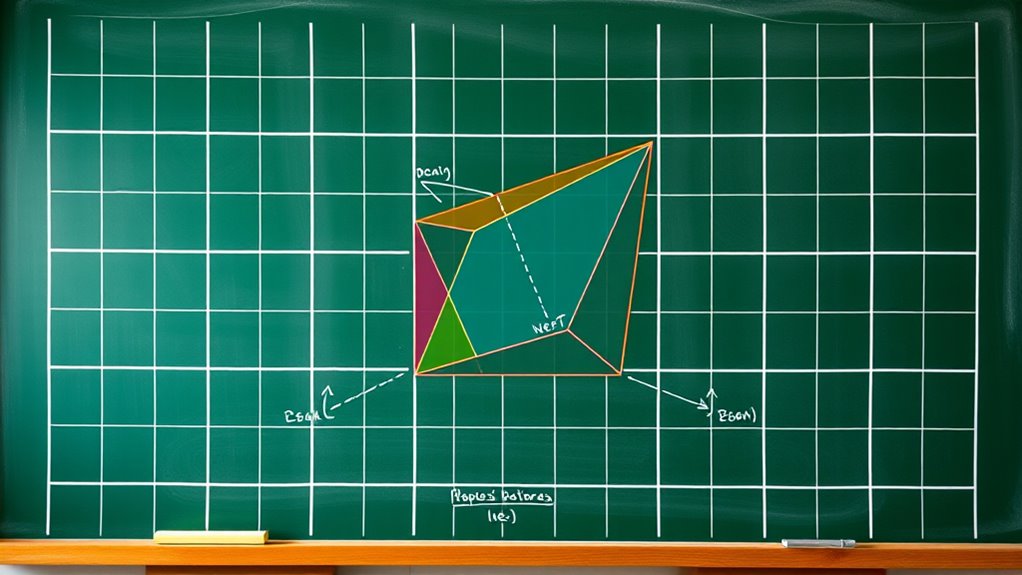

Pick’s Theorem simplifies calculating the area of lattice polygons by counting boundary and interior points on a grid. You find the boundary points along the edges and count the interior points inside the shape. Then, just apply the formula: area equals interior points plus boundary points divided by two minus one. This method turns complex geometry into an easy counting game. Keep exploring to discover how this approach makes geometric calculations much simpler.

Prime made for students and young adults
- Fast, free delivery for dorm and study essentials
- Prime Video and Amazon Music included
- Member-only deals
Key Takeaways
- Pick’s Theorem calculates polygon area using simple counts of interior (I) and boundary (B) lattice points.
- Boundary points are counted along edges, including vertices, often using GCD-based methods.
- Interior points are those strictly inside the polygon, found through counting techniques or line algorithms.
- The formula: Area = I + B/2 – 1, simplifies area calculation without complex geometry.
- This theorem makes determining lattice polygon areas quick, easy, and ideal for grid-based problems.

Have you ever wondered how to easily find the area of a polygon with lattice points? If you’re dealing with a shape drawn on a grid where all the vertices land exactly on the intersection points, you’re working with what’s called a lattice polygon. In such cases, traditional formulas like the shoelace method can be effective, but they can also be cumbersome for complex shapes. That’s where Pick’s Theorem comes in — a straightforward way to determine the polygon area just by counting lattice points.
Pick’s Theorem states that the area of a lattice polygon is equal to the number of interior lattice points, multiplied by one-half, plus the number of boundary lattice points, minus one-half. In formula form, it looks like this: Area = I + B/2 – 1, where I is the count of interior lattice points, and B is the count of boundary points. This simple relationship turns what might seem like complicated geometry into a problem of counting points on a grid.
To use Pick’s Theorem effectively, you need to identify and count the lattice points inside the polygon and along its boundary. The boundary points are those that lie exactly on the edges, while interior points are strictly inside the shape. Counting boundary points can be as simple as examining each edge and tallying the lattice points it contains, including vertices. For interior points, you can use methods like drawing lines within the shape or applying the greatest common divisor (GCD) trick for each edge to determine the number of lattice points on it. Additionally, understanding the properties of lattice points can help streamline this counting process.
Once you’ve tallied your boundary points (B) and interior points (I), plugging them into the formula is straightforward. It’s a quick calculation that gives you the polygon’s area without needing to resort to coordinate geometry formulas or calculus. This makes Pick’s Theorem especially handy in educational settings or when working with computer algorithms that process grid-based data.
As an affiliate, we earn on qualifying purchases.
Frequently Asked Questions
How Do I Identify Lattice Points on a Polygon?
To identify lattice points on a polygon, look at its vertices and check their coordinates on the coordinate grid. Lattice points are where both the x and y coordinates are integers. During vertex identification, verify each vertex’s coordinates are whole numbers, indicating it lies exactly on a lattice point. Mark these points clearly; they form the foundation for applying the theorem and calculating the polygon’s area accurately.
Can Pick’s Theorem Be Applied to Non-Convex Polygons?
Yes, you can apply Pick’s Theorem to non-convex shapes, as long as the polygon’s vertices are lattice points. The key is to precisely identify the lattice point patterns, including those on the boundary and inside the shape. Non-convex shapes may have indentations, but the theorem still works if you count boundary points and interior points correctly. Just guarantee the polygon is simple and all vertices are lattice points.
What Are Common Mistakes When Applying Pick’s Theorem?
You might misapply Pick’s theorem by miscounting vertices or boundary points. For example, if you forget to include all boundary points when counting, your area calculation will be off. Always double-check your vertex count and boundary points, especially for complex polygons, to avoid mistakes. A common error is overlooking boundary miscount, which leads to incorrect area estimates. Accurate counting is key to applying Pick’s theorem correctly.
How Does Pick’s Theorem Relate to Other Area Formulas?
Pick’s theorem relates to coordinate geometry by providing a straightforward way to find the area of lattice polygons. Unlike other area formulas like the shoelace method, it specifically uses the count of interior and boundary lattice points for area calculation. This makes it easier in some cases, especially for polygons with many vertices, because you don’t need to perform complex coordinate calculations—just count points to determine the area quickly.
Are There Limitations to Using Pick’s Theorem?
Think of Pick’s Theorem as a reliable compass, but it struggles in uncharted waters. Its limitations lie in geometric constraints—it’s only accurate for polygons with vertices on lattice points. When polygons become complex, with holes or non-convex shapes, the theorem falters, like a compass losing its true north. So, for intricate shapes or those outside lattice boundaries, you’ll need other methods to find the area accurately.
As an affiliate, we earn on qualifying purchases.
Conclusion
Now that you understand Pick’s Theorem, you can easily find the area of any lattice polygon. Imagine you’re designing a garden with a fence along grid points; knowing the area helps plan your planting layout efficiently. For instance, if your garden has 10 interior points and 24 boundary points, the theorem shows its area is 17 square units. With this simple tool, you save time and avoid complex calculations in your next project!
As an affiliate, we earn on qualifying purchases.
As an affiliate, we earn on qualifying purchases.
Halloween Picks
halloween
As an affiliate, we earn on qualifying purchases.





![Terence Tao: Math 2.0 [Pdf]](https://geometr.info/wp-content/uploads/2026/10/terence-tao-math-2-0-pdf-featured-260x140.jpg)
