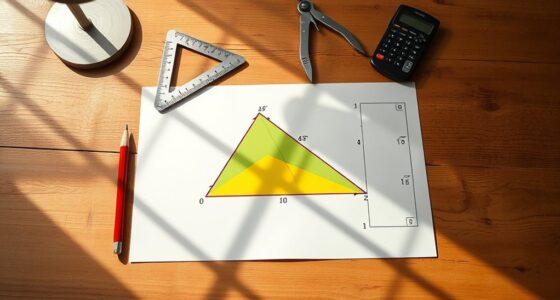
The Pythagorean Theorem, rooted in ancient cultures, is proven through various methods, including geometric dissections, algebra, and calculus. It’s widely used in construction, design, and technology to verify right angles, calculate distances, and create accurate models. Visual proofs and dissection techniques make it easier to understand and teach. Exploring these proofs and applications reveals how this essential principle shapes the world around you—discover more to see how it all connects.
Key Takeaways
- The Pythagorean theorem relates the squares of the triangle’s sides, with numerous geometric proofs like shape dissection and rearrangement.
- Algebraic and calculus-based methods rigorously demonstrate the theorem using coordinate geometry and area analysis.
- Dissection techniques visually reinforce the relationship between the areas of squares on sides and the hypotenuse.
- Practical applications include construction, engineering, computer graphics, and navigation, ensuring accuracy and safety.
- Modern tools and visualizations enhance understanding, teaching, and innovative uses in technology and education.

Pythagorean Theorem Learning Game, Classroom Experiment Set, Birthday Gift for 3
- Complete Experiment Kit: Includes all necessary materials for experiments
- Engaging Learning Tool: Makes learning Pythagorean theorem fun
- Promotes Critical Thinking: Encourages problem-solving and analysis skills
As an affiliate, we earn on qualifying purchases.
As an affiliate, we earn on qualifying purchases.
Historical Perspectives on the Pythagorean Theorem
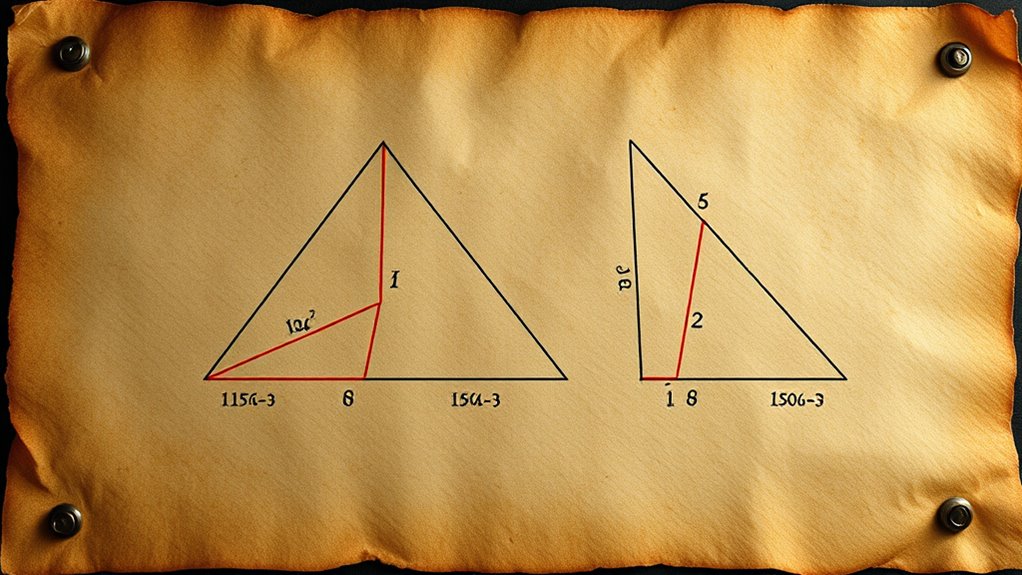
Have you ever wondered how the Pythagorean theorem came to be? Ancient civilizations, like the Babylonians and Chinese, understood relationships between right triangles long before Pythagoras. These early mathematicians recorded their observations on clay tablets and in ancient texts, demonstrating practical uses in construction and astronomy. Although Pythagoras is often credited as a mathematical legend, the theorem’s roots extend much further back. The Greeks formalized and proved it around 500 BCE, but evidence shows that knowledge of the relationship between the sides of right triangles existed in various cultures. This cross-cultural recognition highlights the theorem’s importance throughout history. Additionally, the theorem is a fundamental principle in geometry and has numerous applications in modern mathematics, engineering, and computer science. Today, we see it as a fundamental principle, with origins that reflect a rich tradition of mathematical discovery across ancient civilizations.

SWANSON Tool Co S0101 7 Inch Speed Square, Blue
- Multiple Gradations: Includes markings for various rafters and angles
- Comprehensive Guide: Pocket-sized Blue Book for accurate angle cuts
- Multi-Tool Functionality: Serves as try square, miter square, saw guide, scriber, protractor
As an affiliate, we earn on qualifying purchases.
As an affiliate, we earn on qualifying purchases.
Geometric Proofs of the Theorem
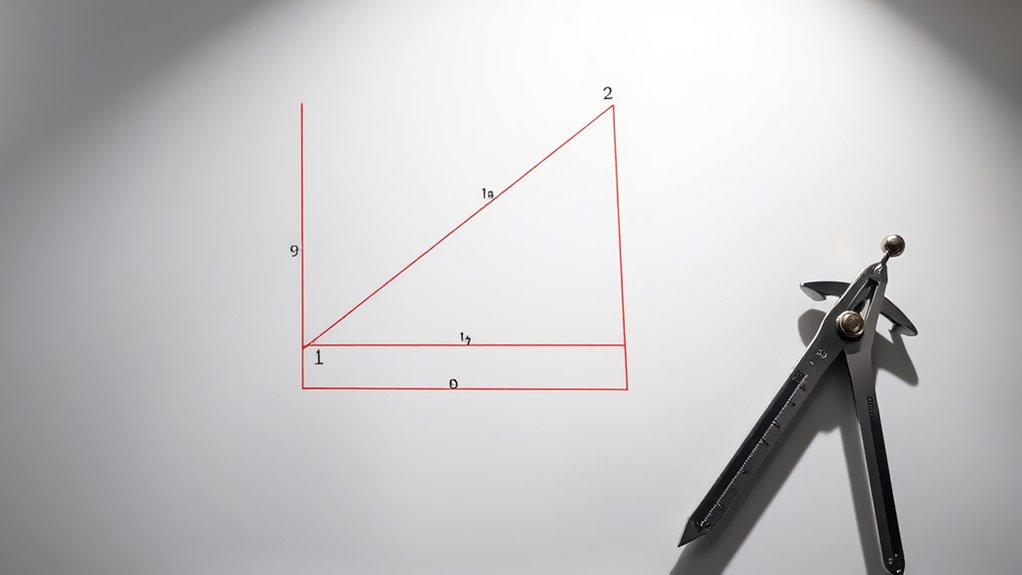
You can understand the Pythagorean Theorem through geometric proofs that involve rearranging shapes. These methods compare areas to show how the squares on the legs relate to the square on the hypotenuse. By exploring these techniques, you’ll see the theorem come to life visually and intuitively. Additionally, understanding support hours can help when seeking assistance with related mathematical tools or resources.
Rearrangement of Shapes
Rearranging shapes provides a visual and intuitive way to understand the Pythagorean Theorem, making the abstract relationship between the sides of a right triangle more concrete. Through shape rearrangement, you can see how geometric transformation allows you to cut and reposition parts without altering their area. This process involves dividing a large square or triangle into smaller shapes and then rearranging them to form a perfect square or rectangle. By doing so, you directly compare areas and observe how the sum of the squares on the legs equals the square on the hypotenuse. Incorporating principles from geometric proofs, this geometric transformation clarifies the theorem’s truth, transforming algebraic formulas into a visual proof that’s easy to grasp and remember.
Area Comparison Techniques
Area comparison techniques offer a powerful way to prove the Pythagorean Theorem through visual means. By comparing the areas of similar triangles, you observe that the area ratio reflects the squares of corresponding sides. This method often involves constructing squares on each side of the right triangle and demonstrating their areas relate through triangle similarity. Additionally, understanding the relationship between area and similarity deepens comprehension of why these proofs work.
| Triangle Similarity | Area Ratio |
|---|---|
| Smaller triangles similar | Area ratios equal the squares of side ratios |
| Larger triangles similar | Area ratios reflect the sum of smaller areas |
| Corresponding sides | Proportional in similar triangles |
| Area relationships | Key to visual proof of the theorem |
This approach makes the relationship between the legs and hypotenuse clear through area comparisons and similarity principles.

Babylonian Theorem: The Mathematical Journey to Pythagoras and Euclid
- Condition: Used Book in Good Condition
As an affiliate, we earn on qualifying purchases.
As an affiliate, we earn on qualifying purchases.
Algebraic and Calculus-Based Demonstrations
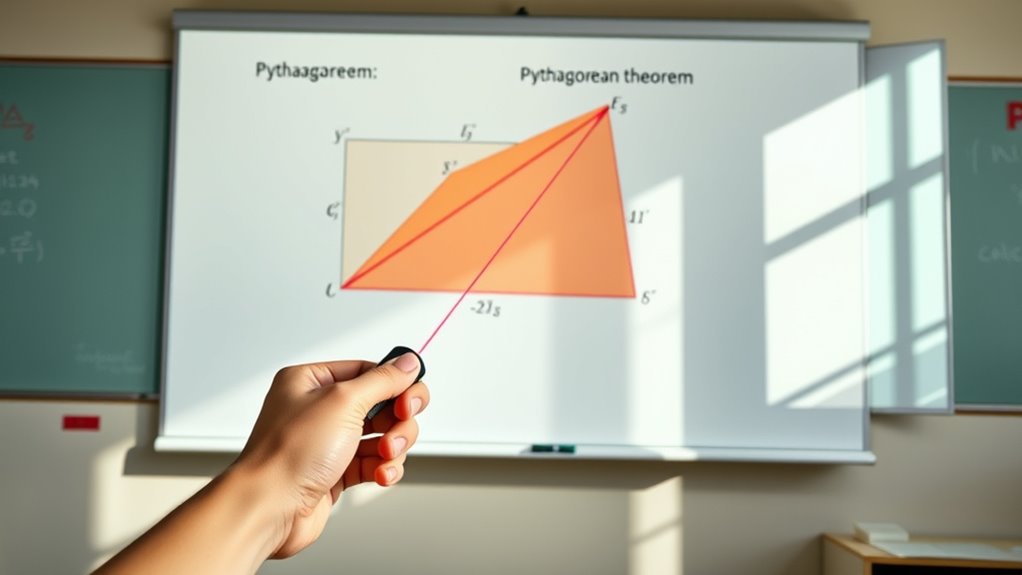
You can explore the Pythagorean Theorem through algebraic proof techniques, such as rearranging equations or using coordinate geometry. Calculus offers tools like derivatives to analyze the relationships between sides of right triangles, providing deeper insights. Polynomial expansion methods also help demonstrate the theorem by breaking down algebraic expressions into familiar forms. Additionally, understanding remote hackathons can inspire innovative problem-solving approaches in mathematical proofs.
Algebraic Proof Techniques
Algebraic proof techniques provide a systematic way to verify the Pythagorean theorem using equations and algebraic manipulations. You leverage coordinate geometry and algebraic identities to construct elegant proofs. By placing right triangles on a coordinate plane, you can derive relationships between side lengths algebraically. Using identities like the distributive property or difference of squares helps simplify expressions. This approach often involves algebraic manipulation of equations representing geometric figures, making the proof transparent and rigorous. You can also manipulate algebraic equations to express the hypotenuse in terms of the legs, confirming the theorem’s validity. Additionally, retail hours can influence when and how you perform these calculations or study sessions. These methods reinforce your understanding of how algebraic structures underpin geometric principles and showcase the power of algebraic reasoning in geometric proofs.
Calculus Derivative Applications
Calculus derivatives offer powerful tools for analyzing how geometric quantities change, bridging algebraic and geometric perspectives. In vector calculus, derivatives help you understand how vectors evolve in space, revealing rates of change in multidimensional contexts. You can apply derivatives to solve differential equations that model physical phenomena, such as motion along a curve or surface. For example, by differentiating a function representing the hypotenuse in a right triangle, you can determine how its length varies as the legs change, illustrating real-world applications of the Pythagorean theorem. These techniques allow you to connect algebraic relationships with dynamic systems, providing insights into the behavior of geometric quantities over time or space. Mastering these applications enhances your ability to analyze complex problems involving changing geometric properties, especially as market growth in AI technology continues to influence innovative computational methods.
Polynomial Expansion Methods
Polynomial expansion methods serve as essential tools for simplifying complex expressions and solving equations by breaking them down into manageable terms. Using algebraic identities, you can expand binomials, trinomials, and higher-degree polynomials efficiently. These methods rely heavily on polynomial factorization, transforming difficult expressions into products of simpler factors. By applying calculus-based techniques, you can analyze the behavior of expanded polynomials, such as derivatives and integrals, to understand their properties better. Mastering these methods enables you to streamline proofs and calculations, especially when exploring geometric relationships like the Pythagorean theorem. Additionally, understanding the role of AI in Education can facilitate the development of intelligent tutoring systems that support these mathematical techniques.
SWANSON Tool Co S0101 7 Inch Speed Square, Blue
- Multiple Gradations: Includes markings for various rafters and angles
- Comprehensive Guide: Pocket-sized Blue Book for accurate angle cuts
- Multi-Tool Functionality: Serves as try square, miter square, saw guide, scriber, protractor
As an affiliate, we earn on qualifying purchases.
As an affiliate, we earn on qualifying purchases.
Visual and Dissection Methods

Visual and dissection methods help you understand the Pythagorean theorem by providing tangible, concrete evidence of the relationship between the sides of a right triangle. Using angle bisectors, you can create smaller similar triangles within the original, revealing the similarity ratios that underpin the theorem. For example, dissecting a right triangle with an angle bisector divides it into two smaller triangles, each similar to the original, making the Pythagorean relationship visually apparent. These methods allow you to see how the squares of the legs relate to the square of the hypotenuse through geometric dissection. Additionally, water parks often utilize similar geometric principles in their design and layout, demonstrating real-world applications of mathematical relationships. By actively engaging in these visualizations, you develop an intuitive understanding of why the theorem holds, grounded in the proportions and similarities established through dissection.
Practical Uses in Construction and Design

The Pythagorean theorem plays a vital role in construction and design by providing a reliable method to guarantee structures are accurately aligned and square. It helps you verify right angles, ensuring walls and foundations are correctly positioned. Using the theorem, you can determine proper dimensions, aiding in material selection to optimize strength and durability. Safety considerations are enhanced when measurements are precise, reducing the risk of structural failure. It also allows for efficient layout planning, saving time and resources. Additionally, understanding how to apply the Pythagorean theorem can facilitate the creation of balanced and harmonious designs by ensuring proportional relationships between different elements in design principles.
Applications in Computer Science and Technology

The Pythagorean theorem is fundamental in computer science and technology, especially in areas involving geometry and spatial calculations. You use it to enhance algorithm optimization, ensuring calculations involving distances are accurate and efficient. For instance, in graphics programming, calculating the shortest path or pixel distances relies on this theorem. It also plays a key role in data structure design, particularly in spatial data structures like k-d trees and quad-trees, which organize multidimensional data for faster retrieval. By applying the Pythagorean theorem, you can efficiently handle 3D modeling, collision detection, and navigation algorithms. Its principles help improve performance and precision in various software applications, making it an essential tool for developers working with spatial data and geometric computations in technology. Understanding geometric principles can further enhance your ability to develop optimized algorithms.
Frequently Asked Questions
How Does the Pythagorean Theorem Relate to Non-Euclidean Geometries?
You might wonder how the Pythagorean theorem relates to non-Euclidean geometries. In hyperbolic geometry, a type of non-Euclidean model, the theorem doesn’t hold as it does in Euclidean space. Instead, the relationship between side lengths of right triangles changes. While it’s fundamental in Euclidean geometry, in non-Euclidean models like hyperbolic geometry, you need modified formulas to describe distances accurately.
Can the Theorem Be Extended to Higher Dimensions?
You might wonder if the theorem extends to higher dimensional spaces. The answer is yes; it generalizes as the distance formula in multi-dimensional spaces, where you calculate the square root of the sum of squared coordinate differences. However, this generalization faces challenges like defining consistent metrics across different geometries. Despite these challenges, the core idea remains useful in fields like physics and computer science, where higher dimensions are common.
What Are the Limitations of the Pythagorean Theorem?
When considering the limitations of the Pythagorean theorem, you should recognize its practical limitations and theoretical constraints. While it works perfectly for right-angled triangles in Euclidean geometry, it doesn’t apply to non-Euclidean spaces, curved surfaces, or irregular shapes. You can’t extend it directly to higher dimensions without modifications, and it doesn’t account for real-world factors like measurement errors or non-linear relationships, limiting its universal use.
How Was the Theorem Historically Misunderstood or Misapplied?
You might think the Pythagorean theorem was always clear, but historical misconceptions led to misapplication in architecture. People once believed it only worked for right triangles with whole-number sides, causing errors in construction. Misunderstandings about its scope and limitations caused faulty designs, risking structural integrity. These mistakes highlight how misapplication, driven by incomplete knowledge, can lead to serious consequences in practical fields like architecture.
Are There Real-World Scenarios Where the Theorem Fails?
You might wonder if the Pythagorean theorem ever fails in real-world situations. It generally doesn’t in standard Euclidean geometry, but measurement inaccuracies can cause errors. In non-Euclidean contexts, like curved surfaces or spacetime, the theorem doesn’t always hold true because space isn’t flat. So, while it’s reliable in many cases, be cautious when applying it in complex or irregular environments where assumptions don’t fit reality.
Conclusion
Now that you’ve explored the Pythagorean theorem’s proofs and applications, you see how it’s the backbone of countless fields. Whether in construction, technology, or everyday problem-solving, this ancient rule proves time and again that it’s more powerful than a superhero’s cape. Keep practicing and applying it, and you’ll reveal secrets that can transform your understanding of the world—truly a mathematical marvel that’s stood the test of millennia!