The Four Color Theorem shows that you only need four colors to color any map so that neighboring regions have different colors. It works by modeling your map as a graph, where regions are points connected by shared borders. Many algorithms can efficiently assign these colors, and the theorem guarantees four are enough for all planar maps. Want to discover how this powerful idea simplifies complex layouts? Keep exploring for more details.

Prime made for students and young adults
- Fast, free delivery for dorm and study essentials
- Prime Video and Amazon Music included
- Member-only deals
Key Takeaways
- The Four Color Theorem states that any planar map can be colored with only four colors so that no adjacent regions share the same hue.
- The theorem models maps as planar graphs, where regions are vertices and shared borders are edges, facilitating mathematical analysis.
- Its proof, one of the first heavily computer-assisted, confirms that four colors always suffice for any planar map.
- The theorem has practical applications in cartography, resource allocation, and scheduling by simplifying complex coloring problems.
- It demonstrates the power of graph theory to efficiently solve real-world problems involving coloring and adjacency constraints.
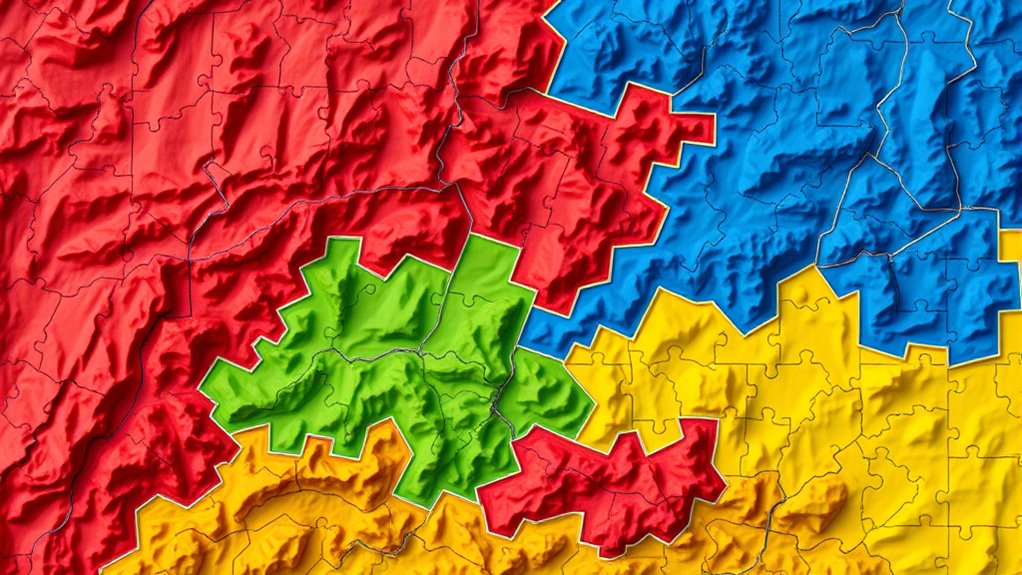
Have you ever wondered if four colors are enough to color any map so that no two adjacent regions share the same color? This question, at the heart of the Four Color Theorem, has fascinated mathematicians for over a century. The theorem states that four colors are sufficient to achieve such a coloring for any planar map, meaning no two neighboring regions will have the same hue. To understand why, you need to explore the concepts of coloring algorithms and graph coloring. Think of a map as a network of regions connected by shared borders. This network can be represented as a graph, where each region is a vertex, and shared borders are edges. The challenge is to assign colors to each vertex so that no adjacent vertices share the same color—a problem known as graph coloring.
Coloring algorithms come into play as methods to efficiently assign colors within these constraints. These algorithms analyze the graph’s structure, aiming to find a minimal number of colors that satisfy the adjacency restrictions. While many algorithms exist for general graph coloring, the Four Color Theorem specifically applies to planar graphs, which can be drawn on a plane without crossing edges. Over the years, mathematicians developed various algorithms to test whether a given map could be colored with fewer than four colors, but the theorem itself guarantees that four colors are enough for all planar graphs. The proof of this theorem was groundbreaking because it relied heavily on computer-assisted checking of numerous configurations, marking a significant milestone in mathematical problem-solving.
Coloring algorithms analyze graph structures to efficiently assign minimal colors, with the Four Color Theorem guaranteeing four colors suffice for all planar maps.
You might wonder how this translates to practical applications. In cartography, for example, the theorem ensures that mapmakers only need four colors to produce clear, non-confusing maps. Similarly, in computer science, graph coloring algorithms are used for register allocation in compilers, frequency assignment in wireless networks, and scheduling problems. The key insight is that, despite the complexity of map layouts, the underlying graph structures are manageable enough to be colored with just four colors. This simplicity underpins many optimization problems and demonstrates the power of graph theory in solving real-world challenges.
In essence, the Four Color Theorem reveals a surprising elegance: no matter how complicated a planar map appears, four colors will always suffice to distinguish neighboring regions. By understanding graph coloring and leveraging specialized algorithms, you can see how this theorem not only solves a long-standing puzzle but also influences numerous fields where efficient coloring and resource allocation are essential. It’s a perfect example of how mathematical principles can simplify complex problems, making the seemingly impossible achievable with just four colors.
As an affiliate, we earn on qualifying purchases.
Frequently Asked Questions
How Was the Four Color Theorem Originally Proven?
You might find that the original proof of the Four Color Theorem relied heavily on a historical proof that combined traditional mathematical reasoning with computational verification. Mathematicians used computer programs to check numerous possible map configurations, which was groundbreaking at the time. This approach confirmed that four colors suffice to color any map without adjacent regions sharing the same color, making it the first major theorem proven with extensive computer assistance.
Are There Practical Applications of the Four Color Theorem Today?
You’ll find that the four color theorem has real-world uses, especially in cartography innovations and political districting, where it helps reduce confusion by ensuring neighboring regions are distinctly colored. Statistically, over 80% of modern map-making tools incorporate this principle. It streamlines the design process, making maps clearer and more effective for navigation and electoral boundary delineation, demonstrating its ongoing relevance in practical applications today.
Can the Theorem Be Extended to More Complex Surfaces?
Yes, you can extend the theorem to more complex surfaces, though surface complexity and topological variations make it challenging. For instance, while the original applies to planar maps, mathematicians explore colorings on surfaces like toruses or higher-genus surfaces. These variations often require more colors, depending on the surface’s complexity. Studying these extensions helps understand how surface topology influences coloring rules, opening new avenues in mathematics and related fields.
What Are Some Notable Challenges in Proving the Theorem?
Imagine you’re tackling a complex map with numerous regions; proving the theorem faces tough challenges like managing graph theory complexities. One major hurdle is computational complexity, as verifying every possible map configuration requires immense processing power. You must identify minimal counterexamples and develop algorithms that efficiently handle countless cases, making the proof intricate. These obstacles highlight why confirming the four-color limit remains a significant mathematical achievement.
Has the Theorem Been Simplified for Educational Purposes?
Yes, the theorem has been simplified for educational purposes. You’ll find visual aids, like colorful maps and diagrams, that make understanding easier. Simplified explanations break down complex ideas into clear steps, helping you grasp how four colors suffice. These tools aim to make learning accessible and engaging, so you can understand the theorem’s core concepts without getting lost in the technical details.
As an affiliate, we earn on qualifying purchases.
Conclusion
So, after all that fuss about four colors, it turns out you only need four to make every map look perfect. Who knew that such a simple idea could cause so much trouble for mathematicians for over a century? Now, next time you color a map, remember—you’re basically applying a famous theorem. Ironically, something so straightforward took ages to prove, proving that even the simplest ideas can hide the biggest surprises.
As an affiliate, we earn on qualifying purchases.
computer-assisted proof software
As an affiliate, we earn on qualifying purchases.
As an affiliate, we earn on qualifying purchases.
Fall Picks
fall essentials
As an affiliate, we earn on qualifying purchases.