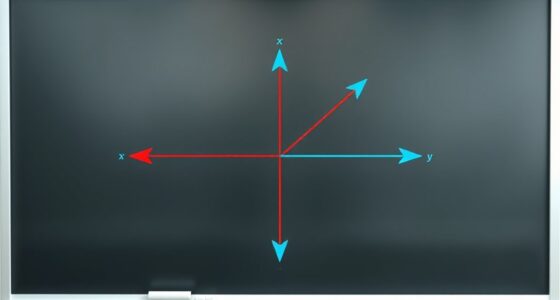
Parametric lines make describing 3D geometry easier by giving you a simple algebraic way to represent lines with a single equation involving a parameter, like t. This approach lets you generate points along the line, shift its position easily, and visualize complex shapes effortlessly. Plus, you can switch between coordinate systems or perform transformations without losing the line’s properties. Keep exploring, and you’ll discover how this method streamlines understanding and solving 3D problems.

Prime made for students and young adults
- Fast, free delivery for dorm and study essentials
- Prime Video and Amazon Music included
- Member-only deals
Key Takeaways
- Parametric lines provide a simple algebraic way to represent points along a 3D line using a single parameter.
- They facilitate easy visualization and manipulation of lines by adjusting the parameter value.
- Coordinate transformations preserve line properties, making descriptions consistent across different systems.
- Parametric equations simplify calculations involving line intersections, distances, and projections.
- They enable dynamic exploration of line behavior and shape in 3D space through parameter adjustments.
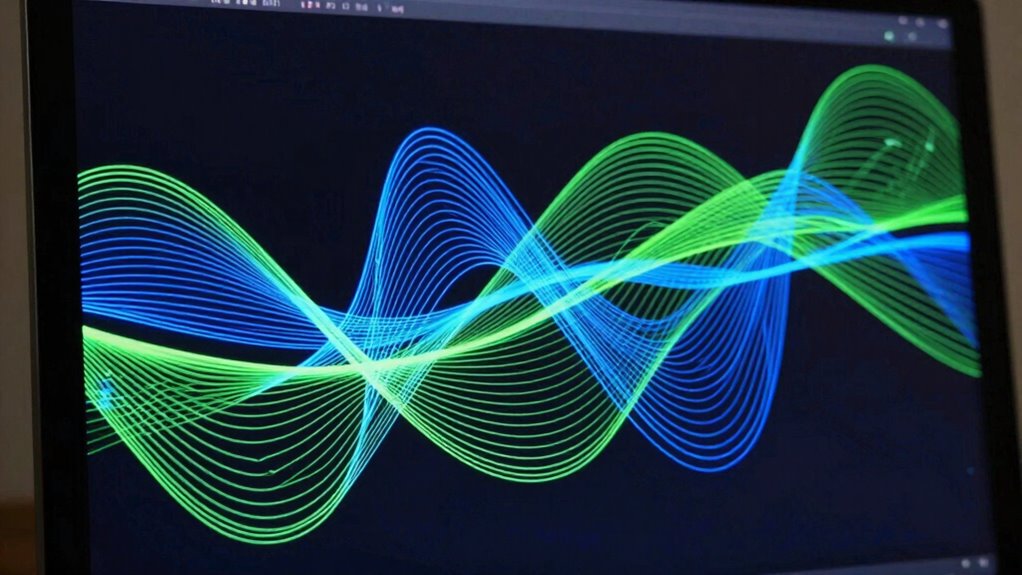
Have you ever wondered how to precisely describe a line in three-dimensional space? If so, you’re probably aware that simply stating the endpoints or using traditional geometric notation can sometimes be cumbersome. That’s where parametric lines come into play. They provide a straightforward way to represent a line using a set of equations that incorporate a parameter, often denoted as ( t ). This approach makes understanding and manipulating lines in 3D much more manageable. Instead of relying solely on geometric intuition, you can describe a line algebraically through curve parametrization, which assigns each point on the line a specific value of ( t ). This parametric form is not only intuitive but also flexible, allowing you to easily analyze lines in different contexts and coordinate systems.
When working with parametric lines, coordinate transformations become essential. They enable you to switch between different coordinate systems—like Cartesian, cylindrical, or spherical—without losing the essence of the line’s description. For example, if you know a line in Cartesian coordinates, coordinate transformations let you convert it into a spherical system to better understand its relation to other objects or phenomena. This flexibility simplifies complex calculations, especially when dealing with rotations or translations of the line within space. The parametric equations adapt smoothly under these transformations, preserving the line’s properties while making it easier to analyze in the new coordinate framework.
Curve parametrization also plays a crucial role in visualizing and manipulating lines. By expressing a line through a set of equations involving a parameter, you can easily generate points along the line for plotting or analysis. Adjusting the parameter ( t ) shifts you along the line, giving a dynamic way to explore its shape and position. This is especially useful in computer graphics, physics simulations, or engineering problems where you need to understand how a line behaves under different conditions. The parametric form offers a clear, concise way to describe the entire line with just a few equations, rather than cumbersome geometric descriptions or multiple point calculations. Moreover, the use of coordinate transformations ensures that these descriptions remain consistent across various frameworks and applications. Recognizing the importance of line equations can help you optimize calculations in practical scenarios. Understanding parameter ranges can also aid in limiting the analysis to relevant segments of the line, making computations more efficient. Additionally, the concept of vector representations provides a more comprehensive way to visualize and analyze lines in space, further enhancing your understanding of 3D geometry.
In essence, parametric lines simplify the complexities of 3D geometry by combining curve parametrization with coordinate transformations. They give you a powerful tool to describe, analyze, and manipulate lines in space with precision and ease. Whether you’re working on theoretical problems or practical applications, understanding how to use parametric equations can significantly streamline your approach to 3D geometry.
Frequently Asked Questions
How Do Parametric Lines Differ From Standard Lines in 3D?
Parametric lines differ from standard lines in 3D because they use a vector representation that incorporates parameters, making it easier to describe complex paths. Instead of just a simple equation, you work within coordinate systems that allow you to define points along the line with parameters, giving more flexibility. This approach simplifies calculating intersections, tangents, and other geometric properties, especially in dynamic or intricate 3D environments.
Can Parametric Equations Represent Complex 3D Shapes?
Yes, parametric equations can represent complex 3D shapes, unlike simple lines. You can model implicit surfaces and intricate geometries through these equations, making them powerful tools. By applying geometric transformations—scaling, rotation, or translation—you transform basic parameters into elaborate forms. This flexibility allows you to describe everything from organic curves to detailed mechanical parts, turning mathematics into a canvas for creating complex 3D shapes.
What Are the Limitations of Using Parametric Lines?
You’ll find that parametric lines have limitations due to dimensional constraints and parametric flexibility. They can struggle with representing shapes that have complex topologies or require intricate surface details. Additionally, setting up equations for highly irregular forms can become complicated, making it hard to accurately model or manipulate the geometry. These constraints mean parametric lines are best suited for simpler, well-defined shapes rather than highly detailed or unconventional forms.
How Do You Convert Between Parametric and Cartesian Equations?
You can convert between parametric and Cartesian equations with a straightforward parameter transformation. First, isolate the parameter in the parametric equations, then substitute these expressions into the Cartesian form. This process involves understanding coordinate systems and how the parameters relate to x, y, and z. By doing this, you bridge the gap between the two forms, making complex 3D geometry as easy as flipping a switch.
Are Parametric Lines Useful in Computer Graphics Applications?
Yes, parametric lines are highly useful in computer graphics applications. They help you achieve smooth curve continuity, which guarantees seamless shifts between shapes and animations. Additionally, using parametric lines improves rendering efficiency because they allow precise control over complex curves and surfaces, reducing computational load. This makes modeling, animation, and rendering more streamlined, enabling you to create detailed, dynamic visuals with greater ease and accuracy.
Conclusion
Now that you see how parametric lines simplify describing 3D geometry, imagine what other complex shapes they could reveal. The possibilities are vast, and as you explore deeper, you’ll realize there’s more to discover—hidden patterns, unexpected connections, and innovative designs. The journey isn’t over; it’s just beginning. Keep exploring, because with parametric lines, the boundaries of what you can create are only expanding—and the next breakthrough might be just around the corner.
Fall Picks
fall essentials
As an affiliate, we earn on qualifying purchases.