TL;DR

Prime made for students and young adults
- Fast, free delivery for dorm and study essentials
- Prime Video and Amazon Music included
- Member-only deals
Science-themed Halloween decorations combine spooky aesthetics with educational appeal, making them favorites among teachers, STEM professionals, and parents. The easiest high-impact effects use real chemistry: tonic water glows under blacklight thanks to quinine, dry ice creates genuine fog, and oobleck demonstrates non-Newtonian physics. You can build a convincing mad scientist lab from dollar-store jars, food coloring, and a few glow sticks.
Skip the plastic skeletons from the big-box store. The creepiest Halloween decorations on the block are sitting in your kitchen right now — tonic water that glows electric blue, cornstarch that behaves like a living creature, and a printer that can put your head in a jar.
Science-themed Halloween decorations blend spooky aesthetics with educational appeal, and they’ve exploded in popularity as geek culture went mainstream and STEM education pushed into classrooms. Teachers, museum educators, and parents who want Halloween fun with intellectual flair have turned the mad scientist lab into one of the most recognizable October aesthetics there is.
Here’s what you’ll get: decoration ideas that actually work, the real science behind each effect, budget breakdowns, and safety notes so nobody ends the night in an actual emergency room.
Tonic water glows bright blue under 365 nm blacklight thanks to quinine — a $2 bottle is the cheapest high-impact glowing effect you can buy.
A full mad scientist lab costs under $30: dollar-store jars, food coloring, glycerin, one blacklight bulb, and dry ice added just before guests arrive.
Skip organic matter in specimen jars — sealed fake items prevent rot and smell while looking more convincing anyway.
Oobleck (2 parts cornstarch to 1 part water) is both decoration and a real non-Newtonian fluid demo that guests can touch.
Thingiverse offers free 3D-printable science Halloween files, including articulated skeletons and the ever-popular caffeine molecule ornament.
5 Science Decorations That Steal the Show (And What They Teach)
The most effective science-themed Halloween decorations fall into five categories: anatomy and biology, chemistry, space and physics, paleontology, and earth science. Each one looks genuinely eerie while quietly demonstrating something real. That’s the trick — the decor is the lesson.
For instance, a shelf of specimen jars costs about $12 total: dollar-store jars, water, a few drops of food coloring, a splash of glycerin for that formaldehyde-suspended look, and whatever creepy items you have on hand. A cauliflower becomes a brain. A hard-boiled egg becomes something you don’t want to think about too hard.
Here’s the rundown of what works best:
- Anatomy: Vintage-style anatomical charts as wall art, skeleton models, and plush pathogens — Giant Microbes sells a brain-eating amoeba that’s equal parts adorable and horrifying
- Chemistry: Beakers with colored liquid, bubbling dry ice, and “radioactive” displays
- Space: Glow-in-the-dark constellations, hanging planets, UFO crash sites
- Paleontology: Dinosaur skeleton dig displays and cracked geodes with crystal interiors
- Earth science: A tornado in a jar — just water, dish soap, and a pinch of glitter, swirled hard
According to educators who run museum “Spooky Science” nights, biology displays consistently draw the most questions from kids — which means your decor is doing double duty as a conversation starter.
The Chemistry Behind the Glow: Tonic Water, Quinine, and Blacklight
Tonic water glows under blacklight because it contains quinine, a compound that absorbs invisible UV light and re-emits it as bright blue light. Point a 365 nm UV flashlight at a glass of tonic and it looks like radioactive waste — for about two dollars a bottle. It’s the cheapest showstopper in Halloween chemistry.
Fill punch bowls, test tubes, or ice cubes (freeze tonic ahead of time) and set a blacklight nearby. The effect is instant and frankly uncanny — like something glowing from a lab that should be locked.
A few things glow almost as well, and you probably own them:
- Highlighter fluid — crack open a yellow marker, soak the felt in water, and get glowing liquid for jars
- Riboflavin (vitamin B2) — crushed into water, it fluoresces yellow-green
- Laundry detergent — optical brighteners make it glow under UV; paint it on walkway edges
One safety note: tonic-water punch is safe to drink, but never make glowing drinks with highlighter fluid — display only.
This is the rare decoration that doubles as a genuine chemistry demonstration. Quinine’s fluorescence is the same principle used in lab analysis — you’re literally running a spectroscopy demo on your snack table.
Build a Mad Scientist Lab for Under $30: The Step-by-Step
You can build a convincing mad scientist corner for about $30 using jars, food coloring, glow sticks, and a blacklight bulb. The whole setup takes under an hour. Here’s the exact sequence:
- Stage the jars. Collect 6–8 glass jars (dollar store, roughly $1 each), fill with water, add 2–3 drops of food coloring per jar, and a teaspoon of glycerin to slow the drift of your “specimens”
- Add the specimens. Plastic bugs, rubber fingers, cauliflower “brains,” a doll’s eye — keep it fake to avoid rot and smell
- Label everything. Print labels in a creepy serif font: “SPECIMEN 47 — DO NOT OPEN.” Laminated paper survives the condensation
- Light it. Swap one bulb for a blacklight ($8–12) and drop glow sticks into two or three jars for the “radioactive” ones
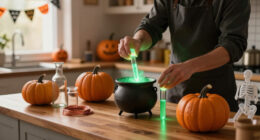
- Add the fog. A small bowl of warm water with dry ice, added just before guests arrive, gives you that rolling-mist villain lab for about $3 per pound
For the “head in a jar” prank — a guaranteed scream — print a photo of a face, laminate it, curl it inside a large jar of tinted water, and place it in the fridge. Someone will find it. Someone will yell.
Dry ice safety: never handle it with bare skin (it’s −78.5°C), never let kids or pets ingest it, and use it in ventilated rooms. Want fog without it? Ultrasonic mist makers create the same effect with plain water and zero risk.
Decorations That Are Secretly Physics Demos
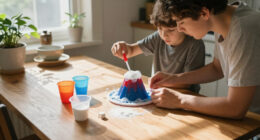
Some of the best science Halloween decorations aren’t static props — they’re working experiments guests can touch. Oobleck, the cornstarch-and-water mix, is the champion: punch it and it’s solid; sink your hand in slowly and it’s liquid. It’s named after the Dr. Seuss book Bartholomew and the Oobleck, and it demonstrates non-Newtonian fluid behavior that genuinely confuses first-time observers.
Set out a tray of oobleck labeled “ALIEN SLIME — TOUCH AT YOUR OWN RISK” and watch every guest, adult or child, spend five minutes poking it. The recipe is dead simple: roughly two parts cornstarch to one part water.
Other demos that double as decor:
- Slime station: Elmer’s glue plus borate solution — a real polymer cross-linking reaction (borax is safe in small amounts; contact-lens-solution slime is the gentler alternative for young kids)
- Balloons and static: Rub balloons on hair and stick them to walls as floating “eyes” — Van de Graaff-style hair-raising optional
- Glow-stick atoms: Drop activated glow sticks into white balloons, inflate, and arrange as electron orbitals
- Pepper’s Ghost: The Victorian illusion from 1862 — a angled pane of glass reflecting a hidden figure — still powers modern “hologram ghosts” with nothing more than a tablet and a sheet of acrylic
Science YouTubers like Mark Rober have built entire haunted-house franchises on effects like these, which is why physics-based scares keep trending upward every October.
3D Printing, Etsy, and Where to Buy What You Won’t Build
You don’t have to build everything yourself. 3D printing has exploded DIY options — sites like Thingiverse host whole Halloween science collections, including printable articulated skeletons, anatomical models, and molecule ornaments. The caffeine molecule is a perennial favorite as wall art or a garland, because its ring structure happens to look fantastic in neon acrylic.
Etsy sellers specialize in laser-cut acrylic versions of the same designs — molecule structures, constellation patterns, Darwin’s tree of life. And real anatomical models from the 19th and early 20th centuries have become genuine collector’s items, if your budget runs toward the eccentric.
| Source | Best For | Price Range |
|---|---|---|
| Dollar store | Jars, food coloring, plastic specimens | $1–3 per item |
| Thingiverse (3D print) | Skeletons, molecules, anatomy models | Free files + filament |
| Etsy | Laser-cut acrylic molecules, constellations | $15–60 |
| Giant Microbes | Plush pathogens (E. coli, amoeba) | $12–30 |
| Museum gift shops | Curated science decor, anatomical charts | $20–80 |
Teacher supply stores round out the list — they stock periodic table posters and model kits that work beautifully as themed Halloween decorations and then stay useful in November.
Teacher-Approved: Classroom Ideas That Survive 30 Kids
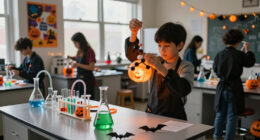
Teachers search heavily for classroom-safe science Halloween decor, and the winners share three traits: no open flames, no dangerous chemicals, and nothing a first-grader can destroy in ten seconds. Periodic table pumpkin carvings, petri dish garlands, and paper constellation displays top the list.
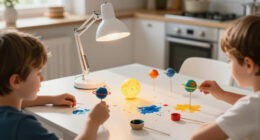
For a classroom door or bulletin board, print oversized petri dishes — circles filled with colored dot “bacterial colonies” — and string them as a garland. Kids can name their invented species, which sneaks in a little microbiology vocabulary.
A few proven classroom picks:
- Periodic table pumpkin: Carve or paint element symbols — “Boo” becomes B-O (boron, oxygen)
- Oobleck corner: One tray, plenty of paper towels, instant engagement
- DIY lava lamps: Oil, water, food coloring, effervescent tablets — mesmerizing and safe
- Tornado in a jar: Water, dish soap, glitter, and a vigorous swirl
For outdoor weatherproofing, seal printed labels with packing tape or lamination, and bring anything paper or electronic inside if rain is forecast. Specimen jars actually look better after a drizzle — condensation adds realism.
Frequently Asked Questions
Is dry ice safe to use around kids and pets?
Yes, with supervision. Dry ice is −78.5°C, so never handle it with bare skin — use tongs or insulated gloves. Never let anyone ingest it, and use it only in ventilated rooms. For a kid-proof alternative, ultrasonic mist makers produce fog with plain water and no risk at all.
How do I make specimen jars that won’t rot or smell?
Use only fake or sealed items: plastic toys, rubber props, or sturdy vegetables displayed for the night only. Real organic matter in water will cloud, smell, and grow mold within days. Add a teaspoon of glycerin to the water for that slow-drift formaldehyde look, and laminate your labels so condensation doesn’t destroy them.
What common items glow under a blacklight?
Tonic water (quinine) glows bright blue, highlighter fluid glows yellow, riboflavin vitamins glow yellow-green, and laundry detergent glows due to optical brighteners. A 365 nm UV light gives the strongest results across all of them.
Is borax slime safe for kids?
Generally yes in small, supervised amounts — borate cross-linking is the classic PVA glue slime reaction. For younger children or sensitive skin, contact-lens-solution slime (using boric acid at lower concentration) is the gentler alternative. Either way, remind kids not to eat it.
Where can I buy science-themed Halloween decorations instead of making them?
Etsy for laser-cut acrylic molecules and constellations, Giant Microbes for plush pathogens, museum gift shops for anatomical charts and models, and Thingiverse for free 3D-printable files if you have access to a printer. Teacher supply stores are an underrated source for periodic table and anatomy decor that stays useful year-round.
Conclusion
Start with one effect, not ten. A single blacklit shelf of glowing tonic-water jars will do more for your Halloween reputation than a yard full of mass-produced plastic — and it comes with a real chemistry explanation when someone asks how it works.
The best science-themed Halloween decorations aren’t pretending to be magic. They’re real phenomena wearing a costume — which, when you think about it, is exactly what Halloween should be.
Fall Picks
fall essentials
As an affiliate, we earn on qualifying purchases.