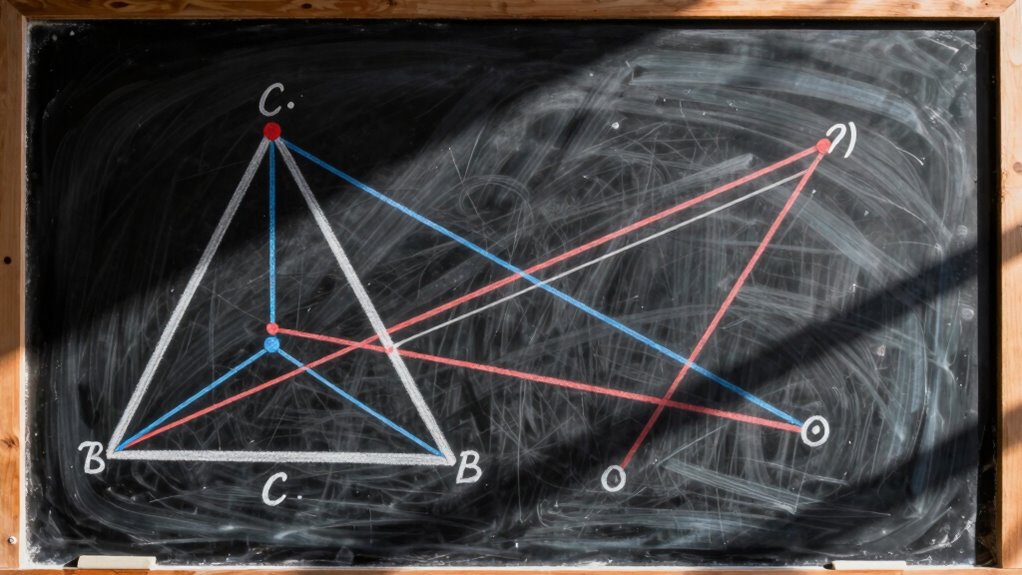

Ceva and Menelaus reveal hidden triangle structures by analyzing ratios, collinearity, and concurrency. Ceva’s theorem helps you find when cevians meet at a single point, exposing internal relationships between segments. Menelaus’ theorem uncovers collinear points on sides or extensions, highlighting external divisions. Together, they offer a deeper understanding of internal and external structures, making complex configurations clearer. If you explore further, you’ll uncover even more fascinating geometric patterns.
Key Takeaways
- Ceva and Menelaus establish ratio and collinearity conditions that uncover internal and external relationships within a triangle.
- They help identify hidden concurrency points and collinear points not immediately visible in the triangle’s structure.
- By analyzing segment ratios and alignments, these theorems reveal symmetrical and harmonic properties.
- Combining both theorems provides a comprehensive view of internal divisions and external extensions.
- They simplify complex geometric configurations, exposing underlying patterns and relationships.
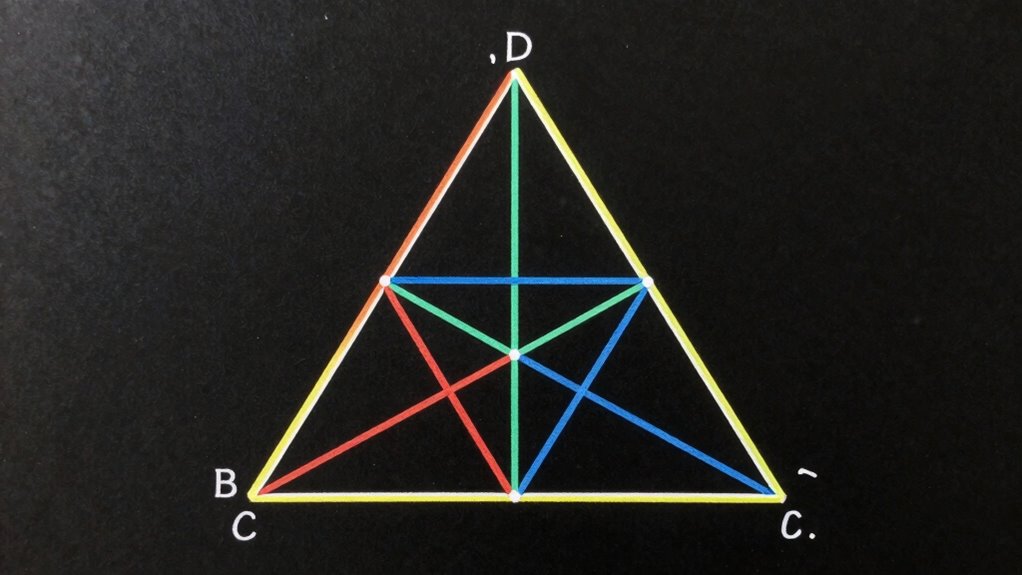
The Ceva and Menelaus theorems are fundamental tools in geometry for analyzing the relationships within triangles. When you use these theorems, you uncover hidden structures that often go unnoticed, revealing the intricate balance within a triangle’s internal and external segments. Ceva’s theorem focuses on concurrent cevians—lines drawn from each vertex that meet at a single point inside the triangle. It tells you that if these cevians are concurrent, then the ratios of the divided segments on each side follow a specific product rule. This insight helps you understand how internal segments relate to the overall triangle, providing a powerful way to prove concurrency or to establish ratios without guesswork. Recognizing these relationships can lead to discovering hidden geometric patterns that clarify complex configurations.
Menelaus’ theorem, on the other hand, deals with points lying on the sides or extensions of a triangle. When you apply Menelaus’ theorem, you examine a transversal line intersecting the sides or their extensions, and it reveals whether points are in a certain harmonic relationship. This theorem allows you to analyze external segments and their ratios, revealing the hidden symmetry between the points and the triangle’s sides. It’s especially useful when you want to understand how external points relate to internal segments, giving you a deeper grasp of external division and collinearity.
By using Ceva’s theorem, you can determine if certain cevians are concurrent by simply checking the ratios on the sides. This makes it easier to solve problems involving triangle centers like the centroid, incenter, or orthocenter. Menelaus’ theorem complements this by helping you analyze collinear points that lie outside the triangle but are connected through lines crossing the sides. It’s a valuable tool for solving problems involving external divisions, transversals, and collinearity outside the confines of the triangle.
When you combine these theorems, you discover a broad understanding of the internal and external structures of triangles. They serve as powerful lenses, letting you see beyond the obvious and into the underlying relationships that govern geometric configurations. Recognizing these geometric relationships can help you identify patterns and structures that are not immediately visible, enabling more elegant solutions to complex problems. You’ll find that many classical problems become more approachable once you recognize the underlying ratios and collinearities these theorems expose. Whether you’re proving a point of concurrency or understanding external division, Ceva and Menelaus give you the tools to reveal the hidden harmony within triangle structures, making your geometric investigations much more insightful and elegant.

Mr. Pen- Geometry Set, 15 Piece Set with 6 Inch Swing Arm Protractor
Geometry Set For All Levels Designed in USA
As an affiliate, we earn on qualifying purchases.
As an affiliate, we earn on qualifying purchases.
Frequently Asked Questions
How Do Ceva and Menelaus Relate to Triangle Similarity?
You see, Ceva’s theorem and Menelaus’ theorem help you understand triangle similarity by showing how certain lines intersect and divide sides proportionally. When you apply Ceva’s theorem, you verify if cevians are concurrent, revealing similar triangles. Menelaus’ theorem helps you confirm collinearity and proportionality of points on sides. Both theorems expose hidden relationships in the triangle, making it easier for you to identify similar angles and sides.
Can These Theorems Be Applied to Non-Euclidean Geometry?
Did you know that only about 10% of Euclidean theorems directly translate to non-Euclidean geometries? Applying Ceva and Menelaus in hyperbolic geometry or spherical models isn’t straightforward. These theorems rely on Euclidean assumptions, so in curved spaces, their versions differ or don’t hold. Nonetheless, understanding their principles can inspire analogous theorems in non-Euclidean settings, revealing fascinating geometric structures beyond flat triangles.
What Are Common Real-World Applications of These Theorems?
You can see Ceva’s and Menelaus’ theorems in practical engineering and architectural design. They help you guarantee the stability of structures by analyzing force and tension in triangles, such as trusses and frameworks. These theorems guide you in creating safe bridges, towers, and buildings by revealing hidden geometric relationships. Applying them improves precision in construction, making sure your designs are both functional and resilient against stresses.
How Do These Theorems Connect to Other Triangle Centers?
Like keys opening a door, Ceva and Menelaus connect to other triangle centers through triangle ratios and geometric transformations. They reveal relationships between points like the centroid, incenter, and orthocenter, showing how these centers align or transform within the triangle. By understanding these connections, you can explore the triangle’s hidden symmetry and structure, making complex relationships clearer and more intuitive in geometric analysis.
Are There Visual Tools to Better Understand These Theorems?
You can better understand Ceva and Menelaus theorems through dynamic visualization and interactive models. These tools let you manipulate points and see how lines intersect or become concurrent, revealing the hidden triangle structure in real-time. Interactive models help you grasp the theorems’ geometric relationships more intuitively, making complex concepts clearer. Using these visual aids enhances your comprehension and allows you to experiment with different configurations easily.
Mr. Pen Triangle Ruler, Protractor, Math Set – 3 Pack, Square Ruler
Package Includes: One 12-Inch Straight Ruler, One 45 Degree Set Square, And One 30/60 Set Square
As an affiliate, we earn on qualifying purchases.
As an affiliate, we earn on qualifying purchases.
Conclusion
You’ve seen how Ceva and Menelaus masterfully manipulate lines and points, revealing the hidden harmony within triangles. Their techniques turn complex conundrums into clear configurations, showcasing the stunning structure silently supporting every shape. By blending bold geometry with brilliant insight, they bring balance to the baffling, bridging gaps between theory and understanding. Embrace the elegance of their methods, and you’ll find that geometry’s greatest secrets are simply waiting to be uncovered beneath the surface.
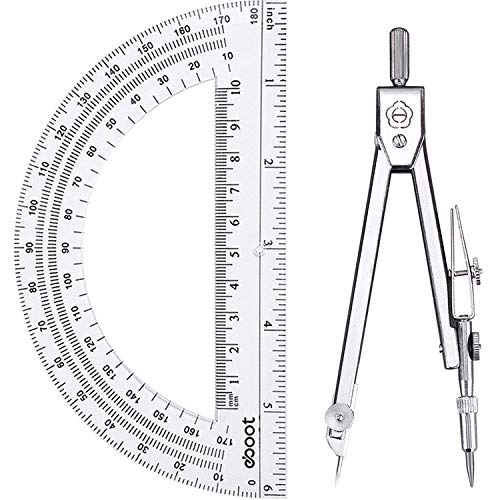
Drawing Compass and 6 Inch Protractor, Student Geometry Math Set
Integrated compass package: compass comes with a clear box, contain 1 piece geometry compass and 1 box refill…
As an affiliate, we earn on qualifying purchases.
As an affiliate, we earn on qualifying purchases.
Mr. Pen- Geometry Set, 15 Piece Set with 6 Inch Swing Arm Protractor
Geometry Set For All Levels Designed in USA
As an affiliate, we earn on qualifying purchases.
As an affiliate, we earn on qualifying purchases.