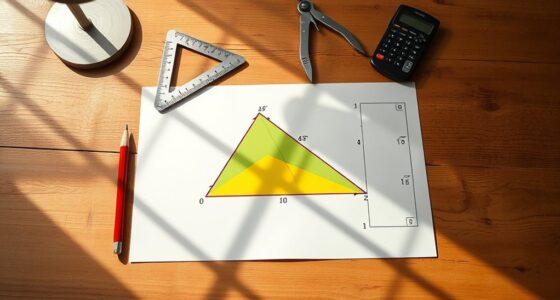

Ceva’s theorem offers a simple way to check if three cevians in a triangle are concurrent. It states that when lines from each vertex to the opposite side intersect at a single point, the product of three segment ratios equals one. To use it, compare the ratios on each side and multiply them. If the result is one, the cevians meet at a common point. Keep exploring to discover how these ratios reveal deeper triangle properties.

Prime made for students and young adults
- Fast, free delivery for dorm and study essentials
- Prime Video and Amazon Music included
- Member-only deals
Key Takeaways
- Ceva’s theorem states that three cevians are concurrent if the product of certain segment ratios equals one.
- It relates ratios like AD/DC, BE/EA, and CF/FB in a triangle to determine concurrency.
- The theorem provides an algebraic condition for lines from vertices to opposite sides to meet at a single point.
- Applying Ceva’s theorem simplifies checking whether cevians intersect inside the triangle without measuring angles.
- It is fundamental for understanding triangle centers and analyzing segment division properties.

Have you ever wondered how to determine if three cevians in a triangle are concurrent? It’s a fundamental question in geometry that leads you straight to Ceva’s theorem. This theorem provides a simple yet powerful relation that helps you decide whether the cevians meet at a single point inside the triangle. When you explore triangle concurrency points, Ceva’s theorem becomes an essential tool, allowing you to analyze the ratios of divided segments on the sides. Essentially, it states that if you have three cevians—lines from each vertex to the opposite side—they are concurrent if and only if a specific product of ratios equals one. This relation is incredibly useful because it translates a geometric condition into an algebraic equation, making it easier to verify concurrency without needing to measure angles or construct auxiliary lines.
When applying Ceva’s theorem, you focus on the segments created on each side by the cevians. Suppose you draw lines from vertices A, B, and C to points D, E, and F on the opposite sides, respectively. To check for concurrency, you’ll compare ratios like AD/DC, BE/EA, and CF/FB. The theorem states that the product of these three ratios must be exactly one for the cevians to meet at a single point inside the triangle. If the product isn’t one, then the lines either don’t intersect at all or intersect outside the triangle, which is equally interesting from a geometric perspective. This criterion simplifies many problems involving triangle centers, such as the centroid, incenter, or orthocenter, which are all special cases of triangle concurrency points.
Ceva’s theorem applications extend beyond simply confirming whether lines are concurrent. It serves as a foundation for proving other geometric properties and solving complex problems involving ratios and segment divisions. For example, understanding the relationships among various triangle centers often relies on this theorem. When you analyze the incenter, centroid, or circumcenter, you’re essentially exploring how certain cevians relate and intersect, all guided by the principles of Ceva’s theorem. It’s a versatile tool that transforms seemingly complicated geometric configurations into manageable algebraic expressions, making it easier to visualize, prove, and understand the relationships within a triangle. Additionally, the integration of AI in geometry is increasingly enhancing the way mathematicians analyze and solve such problems, providing new insights and computational tools. Whether you’re a student learning the basics or a mathematician exploring advanced properties, Ceva’s theorem remains a cornerstone for understanding and solving triangle concurrency problems efficiently.
As an affiliate, we earn on qualifying purchases.
Frequently Asked Questions
How Is Ceva’s Theorem Applied in Real-World Engineering Projects?
You apply Ceva’s Theorem in engineering projects to guarantee structural stability and optimize architectural design. By analyzing how load-bearing elements intersect within triangular frameworks, you can determine the precise ratios needed for balanced support. This helps in designing bridges, roofs, and trusses, preventing collapse or deformation. Using the theorem assures your structures are both safe and efficient, guiding you to make informed decisions about the placement and connection of key components.
Can Ceva’s Theorem Be Extended to Three-Dimensional Geometries?
Sure, Ceva’s theorem can be extended into three-dimensional geometries, but don’t expect it to solve your spaceship’s navigation system. You see, the triangular ratios get a bit more complicated in geometric extensions like tetrahedra. While mathematicians attempt to generalize, the rules become less elegant and more tangled. So, if you’re dreaming of a 3D version, prepare for a wild ride through the complex world of spatial ratios.
What Are Common Mistakes When Using Ceva’s Theorem in Proofs?
You should watch out for misapplication errors when using Ceva’s Theorem, such as applying it to non-concurrent cevians or incorrect segments. Assumption pitfalls often lead you to presume lines are cevians without proof, which can invalidate your proof. Always verify that lines are concurrent and segments are properly divided. By carefully examining these details, you prevent common mistakes and guarantee your use of Ceva’s Theorem is accurate and reliable.
How Does Ceva’s Theorem Relate to Menelaus’ Theorem?
You see, Ceva’s and Menelaus’ theorems both explore triangle concurrency, but they approach it differently. Ceva’s relates to geometric ratios when cevians intersect at a common point, while Menelaus’ deals with ratios along a transversal crossing a triangle’s sides. Together, they form a fascinating pair, linking line segments and ratios, revealing symmetries, and showcasing how lines traverse through triangles to produce proportional, perfectly poised points of concurrency.
Are There Any Historical Figures Who Contributed to the Development of Ceva’s Theorem?
You’ll find that Ceva’s theorem was developed by the Italian mathematician Giovanni Ceva in 1678, contributing considerably to Euclidean geometry. His work involved creating rigorous mathematical proofs to establish relationships within triangles, which helped formalize the theorem. Ceva’s insights built upon earlier ideas, advancing the understanding of concurrent lines and ratios, and his contributions are still fundamental in studying geometric properties today.
As an affiliate, we earn on qualifying purchases.
Conclusion
So, remember, Ceva’s Theorem is like a delicate dance of lines inside a triangle, guiding you through its hidden harmony. When the ratios align, it’s as if the triangle whispers its secrets, revealing balance and connection. Think of it as a bridge that unites the sides, just like trust links hearts. Embrace this simple relation, and you’ll discover the silent language of geometry, where every part plays a crucial role in the grand symphony of shapes.
As an affiliate, we earn on qualifying purchases.
As an affiliate, we earn on qualifying purchases.
Fall Picks
fall essentials
As an affiliate, we earn on qualifying purchases.