Pascal’s Theorem shows a fascinating pattern: when six points lie on a chorded conic, the intersections of pairs of extended sides of the inscribed hexagon align on a single line called the Pascal line. This reveals a surprising geometric relationship, highlighting the harmony and symmetry in conic sections. If you explore further, you’ll uncover even more hidden connections and the deep principles behind these elegant geometric properties.
Key Takeaways
- Pascal’s theorem states that for a hexagon inscribed in a conic, the intersections of pairs of extended opposite sides are collinear.
- The three intersection points form a straight line called the Pascal line, revealing a hidden geometric pattern.
- The theorem showcases a fundamental property of conic sections in projective geometry, emphasizing their symmetrical relationships.
- It demonstrates how seemingly unrelated points and lines on a conic are connected through a consistent collinearity pattern.
- Pascal’s theorem uncovers deep, invariant geometric relationships that extend beyond Euclidean distances, highlighting the elegance of projective geometry.

Pascal’s Theorem is a fundamental result in projective geometry that reveals a surprising relationship among the points on a conic section. When you draw a hexagon inscribed in a conic, such as an ellipse, parabola, or hyperbola, the theorem states that certain pairs of extended sides will always meet at points lying on a straight line. This elegant connection isn’t just a coincidence; it’s a deep property rooted in the nature of conic sections and the principles of projective geometry.
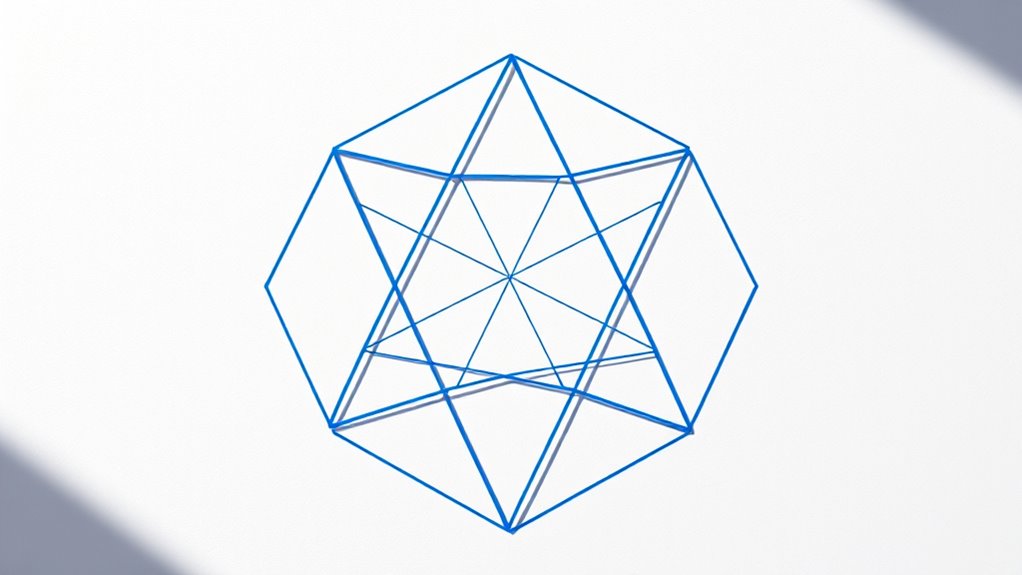
Pascal’s Theorem reveals that extended sides of a hexagon inscribed in a conic intersect on a straight line.
In simple terms, you start with six points on a conic and connect them to form a hexagon. Unlike regular polygons, the sides of this hexagon don’t need to be straight or evenly spaced. The key lies in extending the sides beyond the vertices. When you do this, Pascal’s Theorem predicts that the pairs of extended sides—specifically, the sides connecting vertices 1 and 2 with 4 and 5, 2 and 3 with 5 and 6, and 3 and 4 with 6 and 1—intersect at three points. Remarkably, these three intersection points are collinear, meaning they all lie on a single straight line known as the Pascal line.
Understanding why this happens involves appreciating the nature of conic sections within projective geometry. Conic sections are special curves that can be derived by slicing a cone at different angles. They possess unique properties that distinguish them from other curves, making them central objects of study in projective geometry. Pascal’s theorem reveals a hidden harmony among points on these curves, showcasing the inherent symmetry and structure of conic sections. Moreover, this theorem demonstrates how geometric relationships are preserved under projection, emphasizing the universality of these patterns across different geometric contexts.
The theorem’s beauty is that it exposes a hidden pattern that’s not immediately obvious. When you inscribe a hexagon in a conic, the intersections of extended sides align in a predictable way. It’s a powerful illustration of how projective geometry extends our understanding of perspective, points, and lines. Instead of focusing solely on Euclidean notions of distance and angles, it emphasizes the relationships and intersections that persist under projection.
As an affiliate, we earn on qualifying purchases.
Frequently Asked Questions
How Is Pascal’s Theorem Applied in Modern Geometry?
You apply Pascal’s Theorem in modern geometry by exploring projective geometry principles and developing computational algorithms. It helps you analyze complex geometric configurations, verify properties of hexagons, and solve problems involving conic sections. By leveraging algorithms, you can automate the detection of the theorem’s patterns, making it valuable in computer-aided design, robotics, and image processing, where understanding geometric relationships is essential for precision and innovation.
Are There Real-World Problems Where Pascal’s Theorem Is Useful?
You’ll be amazed how Pascal’s theorem transforms real-world problems! In engineering applications, it helps optimize structural designs by ensuring perfect alignments. In computer graphics, it’s the secret behind creating stunning, mathematically precise visuals. Without Pascal’s insight, these fields would lack their incredible accuracy and beauty. So, yes, your daily tech and engineering marvels owe a debt to this hidden geometric pattern—making everything from bridges to digital art possible!
What Are the Historical Origins of Pascal’s Theorem?
You might find that Pascal’s Theorem has roots in the work of ancient mathematicians who explored geometric discoveries. It was formally discovered by Blaise Pascal in the 17th century, but its ideas build on centuries of earlier mathematical thought. Pascal’s deep interest in projective geometry led him to identify this remarkable pattern in hexagons inscribed in conic sections, linking his work to a long tradition of exploring the hidden relationships within geometric figures.
Can Pascal’s Theorem Be Extended to Non-Hexagons?
Did you know only about 10% of mathematicians believe Pascal’s theorem easily extends to polygons beyond hexagons? You can, but generalization challenges arise with polygon extensions, making it complex to find similar collinearity patterns. While some properties apply to specific polygons, a universal extension remains elusive due to geometric intricacies. So, exploring these extensions tests your understanding of projective geometry and the unique properties of polygons.
What Are the Limitations of Pascal’s Theorem?
You should know that Pascal’s theorem has limitations, especially with degenerate cases where points coincide or line up in trivial ways, making the theorem less meaningful. Collinearity issues also arise when multiple points fall on the same line, disrupting the theorem’s assumptions. These situations can invalidate the theorem’s conclusions or require special handling, so you need to be cautious when applying Pascal’s theorem to various polygons or configurations.
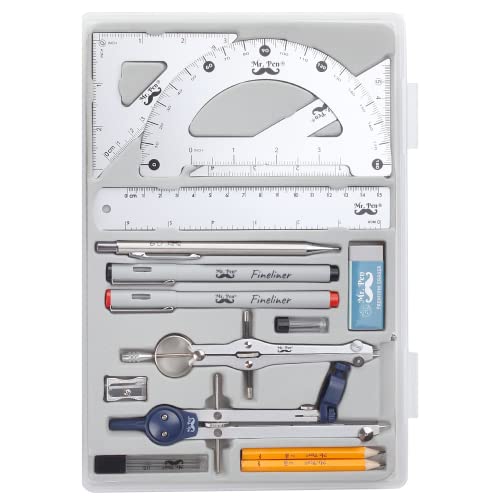
Mr. Pen- Professional Geometry Set, 15 pcs, Drafting Tools with Protractor
- Complete Drawing Tools Set: Includes compasses, triangles, rulers, and more
- Durable Plastic Storage Case: Protects tools and easy to carry
- Versatile for All Users: Suitable for students, teachers, architects, and artists
As an affiliate, we earn on qualifying purchases.
As an affiliate, we earn on qualifying purchases.
Conclusion
As you explore Pascal’s Theorem, you uncover a secret woven into the fabric of hexagons, like a hidden melody waiting to be heard. This elegant pattern reveals that even in complexity, there’s harmony. Like a gentle wave whispering its timeless song, the theorem reminds you that mathematics isn’t just numbers—it’s a beautiful dance of order and chaos, inviting you to see the universe’s hidden symphony behind every shape.

Big Fat High School Geometry Workbook: 400+ Geometry Practice Exercises (Big Fat Notebooks)
As an affiliate, we earn on qualifying purchases.
As an affiliate, we earn on qualifying purchases.
hexagon inscribed in conic diagram
As an affiliate, we earn on qualifying purchases.
As an affiliate, we earn on qualifying purchases.