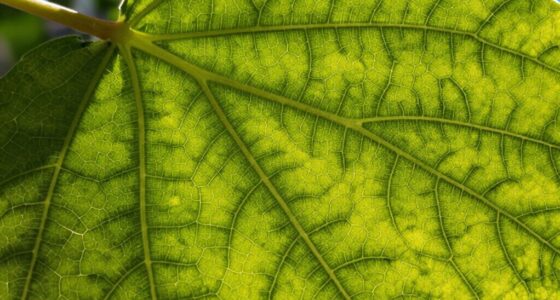
Fractal compression was a big idea because it used mathematical patterns and self-similarity to store images more efficiently. Instead of saving every pixel, it captures recurring textures and structures, resulting in higher compression ratios and better preservation of details. Its innovative approach allowed images to be reconstructed with fewer data, especially in natural scenes. If you want to understand why it’s considered a game changer, there’s much more to uncover about its impact and potential.
Open a free Amazon Business account
Business pricing, bulk buying and tax-exempt orders.
As an affiliate, we earn on qualifying purchases.
Key Takeaways
- It introduced a novel approach by using mathematical self-similarity to represent images efficiently.
- Enabled high compression ratios while preserving fine image details better than traditional methods.
- Leveraged natural redundancies in images, especially in complex natural scenes.
- Highlighted the importance of mathematical transformations like scaling and rotation in image encoding.
- Opened new possibilities for scalable, high-quality image storage and processing.

Have you ever wondered how complex images can be stored efficiently without losing detail? That’s where fractal compression comes into play, revolutionizing the way we think about image encoding. Unlike traditional methods that rely on pixel-by-pixel storage, fractal compression uses mathematical patterns to represent images through self-similarity. This approach means that instead of saving every pixel, you encode the image by capturing the recurring patterns within it. The key advantage is that these patterns can be stored using far less data, making it a highly efficient way to compress images.
The core idea behind fractal compression is to take advantage of the natural redundancies found in many images. Many images, especially natural scenes, contain repetitive textures and structures. Fractal algorithms analyze these repetitions and encode them as transformations—like scaling, rotation, and brightness adjustments—that can recreate the original image when applied repeatedly. This process enhances algorithm efficiency because it reduces the amount of information needed to reconstruct the image. The result is a compact representation that captures the essence of the image’s detail and complexity without storing every minute element.
One of the most compelling reasons why fractal compression was such a big idea is its potential for high compression ratios, especially for images with lots of self-similarity. Traditional compression methods like JPEG work well but often introduce artifacts at high compression levels, losing fine details. Fractal algorithms, however, aim to preserve these details by leveraging mathematical transformations that mimic the original image’s structure. Additionally, once an image is encoded using fractals, it can be decompressed relatively quickly, making the technique practical for various applications.
Despite its advantages, fractal compression also faced challenges that limited widespread adoption. The encoding process is computationally intensive because it requires extensive searching for matching patterns within the image. However, the benefits—such as high compression ratios and the ability to scale images without quality loss—kept researchers interested. They saw the potential for fractal compression to outperform conventional methods, especially in applications where storage space and image quality are critical.
In essence, fractal compression was such a big idea because it offered a fundamentally different way of thinking about image storage—one rooted in mathematical elegance and efficiency. By focusing on the intrinsic self-similarity of images, it opened new possibilities for data compression and set the stage for future innovations in how we encode visual information. Additionally, self-similarity is a key concept that underpins the entire process, enabling the algorithm to achieve its impressive results.
As an affiliate, we earn on qualifying purchases.
Frequently Asked Questions
How Does Fractal Compression Compare to Modern Image Compression Methods?
Fractal compression offers unique advantages over modern methods like JPEG or PNG, especially in handling digital art with complex patterns. You benefit from its ability to exploit data redundancy by encoding self-similar structures, leading to potentially smaller file sizes for detailed images. However, it’s slower and less widely used today. While it’s innovative, current techniques often prioritize speed and versatility, making fractal compression less practical for everyday digital art storage.
What Are the Main Limitations of Fractal Compression Technology?
Think of fractal compression as a beautiful puzzle that’s hard to solve quickly. Its main limitations are algorithm complexity and patent restrictions, which slow down processing and limit accessibility. You might find it difficult to implement efficiently, especially for real-time applications. These hurdles make fractal compression less practical today, despite its innovative approach. The complexity and legal barriers ultimately hold back its widespread adoption.
Can Fractal Compression Be Applied to Real-Time Video Processing?
Fractal compression isn’t ideal for real-time video processing due to significant computational challenges. You’d face hurdles in real-time encoding because fractal algorithms require intensive calculations, slowing down processing speeds. While the concept is promising, current technology struggles with the speed needed for live video. Unless computational power advances substantially, applying fractal compression for real-time video remains impractical, limiting its use to pre-recorded content or specialized applications.
How Has Fractal Compression Influenced Current Image Encoding Standards?
Fractal compression has left its mark on current image encoding standards like JPEG2000, acting as a trailblazer in the field. You can see how fractal patterns inspire algorithms that reduce file sizes while preserving detail. Yet, it’s not perfect—compression artifacts sometimes appear, reminiscent of distorted fractal images. This influence pushes developers to refine techniques, blending the beauty of fractals with practical needs for sharper, more efficient image storage.
What Industries Initially Adopted Fractal Compression Techniques?
You’ll find that industries like medical imaging, satellite imaging, and digital photography initially adopted fractal compression techniques. They valued its ability to exploit fractal patterning and geometric self-similarity within images, which allowed for high compression ratios without significant quality loss. These sectors appreciated the method’s efficiency, especially for complex images with natural textures, making fractal compression a promising approach during its early development stages.
As an affiliate, we earn on qualifying purchases.
Conclusion
You see, fractal compression wasn’t just a technical breakthrough; it was a revolution in the way we see and store images, like capturing an endless echo in a tiny shell. It’s a dance of patterns and self-similarity, weaving complexity into simplicity. As you embrace this idea, remember it’s like revealing a secret code hidden within nature’s own artwork—an elegant symphony of mathematics and art that forever changed the way images breathe and grow.
high resolution image storage device
As an affiliate, we earn on qualifying purchases.
As an affiliate, we earn on qualifying purchases.
As an affiliate, we earn on qualifying purchases.
Fall Picks
fall essentials
As an affiliate, we earn on qualifying purchases.