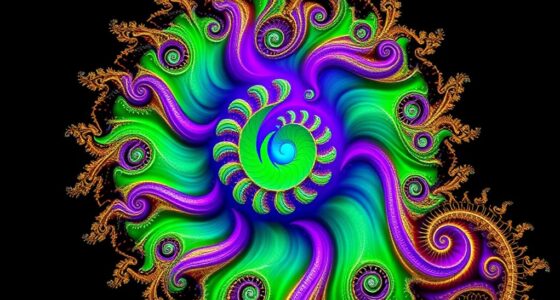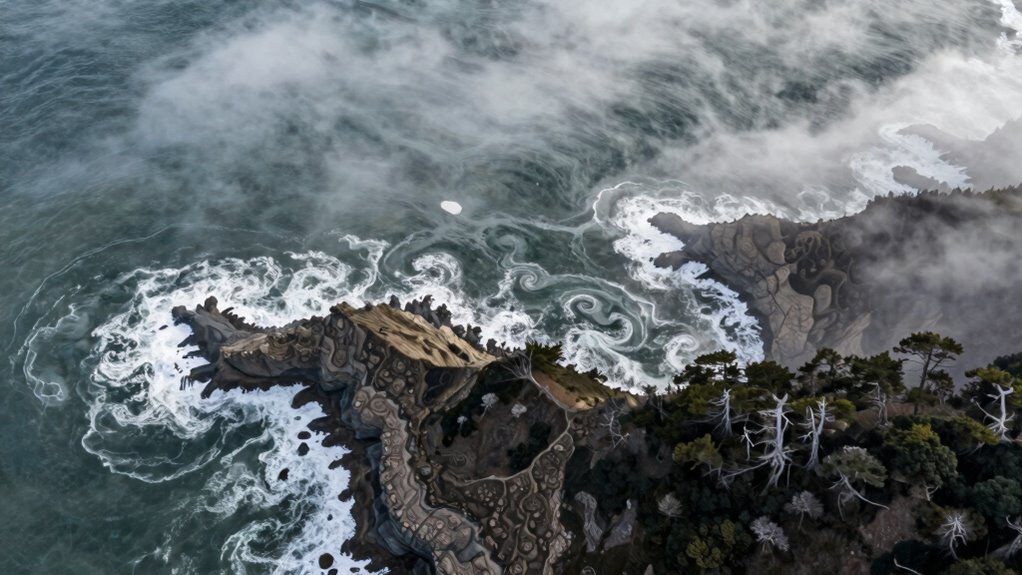

Coastlines, clouds, and trees all exhibit self-similar patterns that reveal fractal thinking. When you zoom in on a coastline, the jagged edges look similar at different scales, showing an underlying fractal process. Clouds form in shapes that repeat at various sizes, and trees grow branches that mimic the whole tree’s pattern. These natural forms follow simple rules that create complex, beautiful structures. Keep exploring to uncover more about the fascinating principles behind nature’s endless patterns.
Key Takeaways
- Coastlines, clouds, and trees all display self-similar patterns that repeat at different scales, characteristic of fractal structures.
- Their complex forms arise from simple, recursive growth processes governed by fractal principles.
- The shapes of these natural features remain consistent when zoomed in, demonstrating inherent fractal geometry.
- Recognizing these patterns reveals how natural complexity emerges from straightforward rules.
- Fractal thinking explains the universal presence of similar patterns across diverse natural forms.
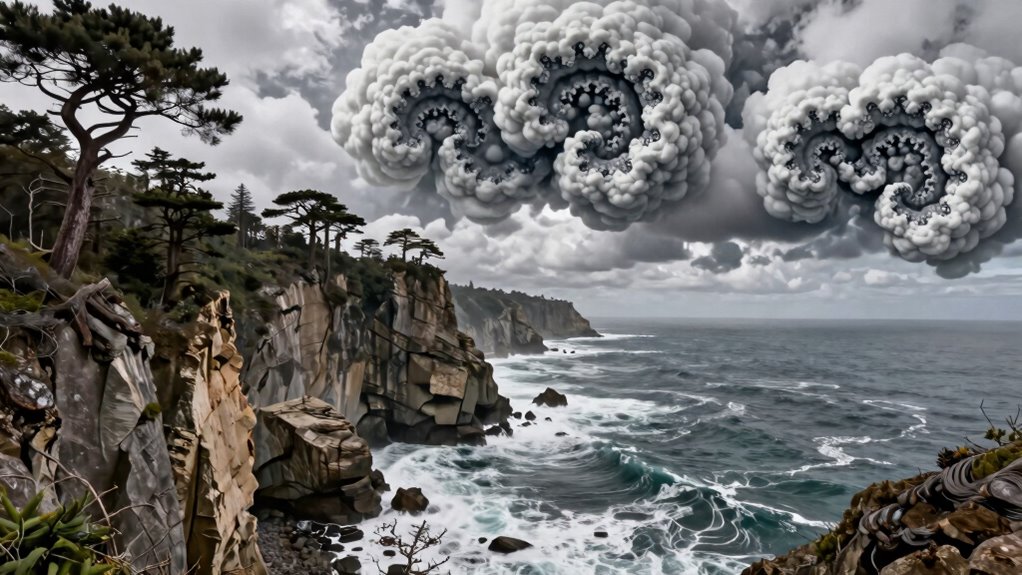
Fractal thinking isn’t just about complex patterns in nature; it’s a way of seeing the world that reveals how simple rules can produce endlessly intricate results. When you observe coastlines, clouds, or trees, you notice that they exhibit self-similarity patterns—smaller parts resemble the whole—and recursive structures, where the same process repeats at different scales. This perspective helps you understand that complexity often stems from straightforward, repeating principles.
Take coastlines, for example. Their jagged, irregular edges aren’t random but follow a fractal pattern. As you zoom in, the coastline’s shape remains similarly complex, showing that tiny segments mirror larger ones. This self similarity pattern means that no matter how close you look, the coastline’s irregularity persists. It’s a visual reminder that natural forms are governed by recursive structures—rules that repeat over and over—creating the intricate contours we see. Recognizing this, you start to see coastlines not just as random landforms but as manifestations of underlying fractal processes.
Coastlines reveal fractal patterns—smaller segments mirror larger shapes, illustrating recursive structures shaping natural forms.
Cloud formations follow a similar pattern. Their fluffy, ever-changing shapes display self similarity patterns; a small cloud puff looks like a miniature version of a larger cloud. When you examine these clouds at different scales, the recursive structures become obvious. The processes that form clouds—air currents, moisture, temperature changes—operate repeatedly, generating fractal patterns at every level. This recursive nature allows clouds to constantly evolve, maintaining a fractal consistency that makes them visually fascinating and scientifically predictable.
Trees, too, reveal fractal thinking through their branching structures. Each branch splits into smaller branches, which in turn split again, creating a recursive structure that’s self similar across scales. When you look closely at a tree, you see that the pattern of a large branch mimics the shape of the whole tree. This self similarity pattern isn’t coincidental; it results from simple growth rules that repeat as the tree develops. Recognizing this, you understand that the complexity of a tree’s form arises from the repetition of basic structural rules, embodying the essence of fractal thinking.
In all these natural examples, the key lies in appreciating how simple, recursive structures generate complexity. By understanding the self similarity patterns and recursive processes behind coastlines, clouds, and trees, you gain a deeper insight into how nature’s complexity emerges from straightforward rules. This perspective not only helps you see the world differently but also reveals the elegant simplicity underlying seemingly chaotic forms. Notably, these principles of self-similarity are foundational in many fields, from mathematics to computer science, demonstrating how universal fractal patterns are across disciplines.

The Fractal Geometry of Nature
As an affiliate, we earn on qualifying purchases.
As an affiliate, we earn on qualifying purchases.
Frequently Asked Questions
How Do Fractals Apply to Urban Planning and Architecture?
You see how fractals influence urban planning and architecture by promoting urban symmetry and architectural complexity. By mimicking natural fractal patterns, you create buildings and city layouts that feel more organic, efficient, and visually appealing. Fractals help you design spaces that adapt to human needs, improve navigation, and blend seamlessly with natural surroundings, ultimately fostering environments that are both functional and aesthetically harmonious.
Can Fractal Patterns Be Used to Improve Computer Graphics?
Yes, fractal patterns can substantially improve computer graphics through advanced fractal algorithms and rendering techniques. You can generate more realistic textures, landscapes, and natural scenes by applying these algorithms, which mimic the self-similar patterns found in nature. Fractal algorithms allow you to create complex, detailed visuals efficiently, while innovative rendering techniques enhance their realism, making virtual environments look more natural and immersive.
Are There Health Benefits Associated With Viewing Fractal Patterns?
Viewing fractal patterns can boost your mental health by reducing stress and enhancing visual perception. For example, a study found that people who spend time observing fractal art experience lower anxiety levels. These patterns mimic natural forms, enabling your brain to process visuals more easily, promoting relaxation. So, regularly engaging with fractals may help you feel calmer and improve your overall mental well-being through their soothing, complex structures.
How Do Fractals Relate to Chaos Theory in Nature?
Fractals relate to chaos theory in nature because they display self-similar structures, meaning patterns repeat at different scales. This reflects natural complexity, where small changes can lead to unpredictable outcomes. You see this in coastlines, clouds, and trees, where intricate, repeating patterns emerge from simple rules. Understanding this connection helps explain how chaotic systems maintain order through fractal patterns, revealing the underlying structure in seemingly random natural phenomena.
What Instruments or Methods Are Used to Measure Fractal Dimensions?
You use fractal analysis tools like the box-counting method or the sandbox method to measure fractal dimensions. These techniques involve counting how many boxes or spheres of different sizes cover the fractal pattern, then plotting the data to calculate the dimension measurement. Software programs often automate this process, providing precise measurements that reveal the complexity of natural structures like coastlines, clouds, and trees, helping you understand their fractal nature.

Fractals #3 – NEW Math and Science Poster
As an affiliate, we earn on qualifying purchases.
As an affiliate, we earn on qualifying purchases.
Conclusion
Imagine walking along a coastline, each curve echoing the next, like a whisper from nature’s own blueprint. Clouds drift in familiar patterns, and trees branch out in endless repetitions. These natural forms are like a secret language, inviting you to see the world through a fractal lens. When you embrace this way of thinking, you realize life’s complexity isn’t chaos but a beautiful, repeating dance—an intricate mosaic waiting for you to decode.

cjkhgdoi Flower of Life Wall Art, Vibrant Canvas Print, Sacred Geometry Abstract Fractal Art, Intricate Patterns, Ancient Wisdom Wall Art Ready To Hang (Unframed,24×36 inch)
Decor: This Flower of Life Skull Wall Art brings beauty and colorfly to your wall or room. It's…
As an affiliate, we earn on qualifying purchases.
As an affiliate, we earn on qualifying purchases.

ArtExpert Natural Fractals I by Grayscale – 12×16 Art Print Poster
High Quality Print
As an affiliate, we earn on qualifying purchases.
As an affiliate, we earn on qualifying purchases.