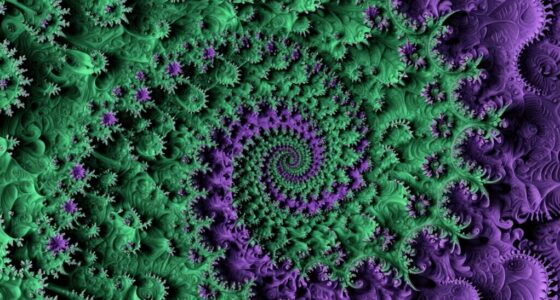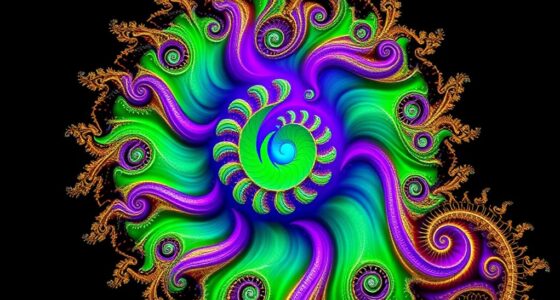

Fractal thinking shifts your perspective by showing that natural complexity comes from simple, repetitive rules. Instead of seeing chaos, you’ll notice patterns that repeat across scales, revealing order in seemingly unpredictable systems. This approach helps you understand ecosystems, weather, and formations more profoundly. By recognizing self-similarity and underlying principles, you see nature’s beauty and harmony. Keep exploring, and you’ll discover how these fundamental patterns influence everything around you.
Key Takeaways
- Fractal thinking reveals self-similar patterns, helping us recognize order within seemingly chaotic natural systems.
- It shifts focus from isolated events to interconnected, recursive processes underlying natural phenomena.
- Understanding simple, repetitive rules behind complexity fosters appreciation of nature’s elegant design.
- It enhances our ability to model, predict, and sustainably interact with complex ecosystems and geological formations.
- Fractal thinking promotes a systems-oriented perspective, deepening respect for universal laws governing natural patterns.

Many natural systems, from coastlines to cloud formations, exhibit intricate patterns that repeat at different scales, a phenomenon known as fractal geometry. When you embrace fractal thinking, you begin to see the world through a new lens—one that recognizes these repeating patterns and the underlying order within apparent chaos. Chaos theory plays a vital role here, revealing that what seems unpredictable at first glance often follows specific rules. Instead of dismissing complexity as randomness, you understand it as part of an interconnected system, where small changes can lead to large effects, yet these effects follow discernible patterns.
Embracing fractal thinking reveals the hidden order in natural patterns and interconnected systems.
Understanding self-similarity helps you see how small-scale patterns mirror larger structures, emphasizing the recursive nature of fractals. Self similarity is a key concept that makes fractal thinking so powerful. It describes how a small part of a pattern resembles the whole, regardless of scale. When you observe a coastline, for example, its jagged edges mirror the irregularities seen in larger sections. This recursive similarity helps you realize that natural forms aren’t just haphazard arrangements but are governed by underlying principles that repeat across scales. Recognizing self similarity allows you to analyze complex systems more effectively. You see that the same basic geometric rules shape everything from mountain ranges to river networks, providing a unifying framework for understanding seemingly disparate phenomena. Additionally, this insight can inform sustainable design practices that mimic nature’s efficiency.
By applying fractal thinking, your perspective shifts from viewing nature as a collection of isolated events to appreciating it as an interconnected web of patterns. This approach helps you better grasp the inherent complexity of ecosystems, weather patterns, and geological formations. Instead of oversimplifying or overcomplicating, you learn to identify the repeating motifs that underpin natural structures. This insight can enhance your ability to predict behaviors, model environmental changes, or even design systems inspired by nature’s efficiency. Recognizing these patterns further deepens your understanding of how natural systems operate under universal principles.
Moreover, fractal thinking encourages you to see beyond surface appearances. When you recognize the fractal patterns of self similarity, you understand that complexity arises from simple rules repeated over and over. You no longer need to be overwhelmed by the apparent chaos—rather, you appreciate the elegant simplicity underlying it all. This mindset fosters a deeper respect for nature’s design and helps you approach problems with a more nuanced, systems-oriented view. Ultimately, fractal thinking transforms your perception of natural complexity from chaos to order, revealing that the universe’s most intricate patterns are governed by the same fundamental principles. Recognizing universal principles can inspire more harmonious interactions with the environment and foster innovative solutions rooted in natural laws.

The Fractal Geometry of Nature
As an affiliate, we earn on qualifying purchases.
As an affiliate, we earn on qualifying purchases.
Frequently Asked Questions
How Does Fractal Thinking Differ From Traditional Scientific Approaches?
You’ll find fractal thinking differs from traditional scientific approaches by emphasizing patterns and self-similarity across scales, unlike linear models. It aligns with concepts from chaos theory, recognizing how small changes lead to complex outcomes. In quantum mechanics, it helps you see underlying structures in randomness. This perspective allows you to understand natural complexity holistically, rather than breaking it into isolated parts, offering a more interconnected view of the universe’s intricate systems.
Can Fractal Patterns Be Applied to Urban Planning or Architecture?
Yes, you can apply fractal patterns to urban planning and architecture. By embracing fractal principles, you enhance urban aesthetics and create architectural harmony that resonates naturally with human perception. These patterns help design cities that feel more organic, cohesive, and visually appealing. Integrating fractal thinking allows you to develop spaces that are both functional and beautiful, fostering environments that echo the complexity and beauty of natural forms.
Are There Any Biological Examples of Fractal Structures in Nature?
You’ll be fascinated to know that biological symmetry and cellular complexity often display fractal structures in nature. For example, the branching of blood vessels, tree limbs, and bronchial tubes mirror fractal patterns, revealing a harmony in natural design. These structures optimize function and resource distribution, demonstrating how fractal thinking illuminates nature’s elegant simplicity amid apparent complexity. Such patterns help us appreciate the intricate beauty woven into life’s fundamental structures.
How Can Fractal Thinking Improve Problem-Solving in Complex Systems?
You can improve problem-solving in complex systems through fractal thinking by applying recursive modeling and iterative analysis. This approach helps you recognize patterns at different scales, allowing you to break down problems into manageable parts. By viewing systems recursively, you gain deeper insights into their behavior, which enables you to develop more effective solutions and adapt strategies as new information emerges, making your problem-solving more flexible and accurate.
What Tools or Software Assist in Visualizing Fractal Patterns?
You’ll find that fractal software and visualization tools are your ultimate allies in exploring complex patterns. Programs like Mandelbulb 3D, Apophysis, and Fractal Explorer allow you to generate stunning, intricate visuals with ease. These tools help you see natural complexity from new angles, making patterns clearer and more mesmerizing. With the right software, your understanding deepens, turning chaos into breathtaking art and insight, almost like revealing a universe within a leaf or mountain.

Copkim 9 Pcs Fashion Designer's Tools Kit Fashion Sewing Ruler Set Essential Pattern Making Tools for Sewing, Tailoring & DIY Garment Creation
Comprehensive Design Tool kit: The set includes a 12 inch aluminum curve ruler, a 24-inch aluminum hip curve…
As an affiliate, we earn on qualifying purchases.
As an affiliate, we earn on qualifying purchases.
Conclusion
By embracing fractal thinking, you open a lens that reveals the intricate dance of nature’s patterns. It’s like seeing a vast, woven tapestry where each thread mirrors the whole, inviting you to understand the universe’s hidden harmony. As you shift your perspective, you realize complexity isn’t chaos but a beautiful fractal symphony—each part echoing the larger design. In this way, fractal thinking transforms your view, turning the world into a living, breathing masterpiece.

Introduction to scikit-learn and Its Ecosystem: Volume 2: Applied Modeling, Pipelines, and Evaluation
As an affiliate, we earn on qualifying purchases.
As an affiliate, we earn on qualifying purchases.

Fractals #3 – NEW Math and Science Poster
As an affiliate, we earn on qualifying purchases.
As an affiliate, we earn on qualifying purchases.