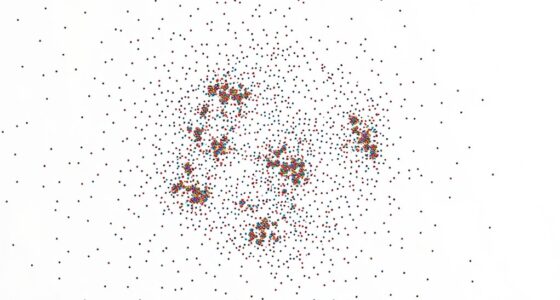

Spatial data structures make your geometry apps feel fast by organizing data efficiently and allowing quick access to information. They break down complex spatial information into manageable parts, reducing search times and avoiding full dataset scans. This means your app can quickly perform tasks like collision detection or proximity searches. As data grows, these structures help maintain smooth performance. Keep exploring to discover how these tools optimize your app’s responsiveness even further.

Prime made for students and young adults
- Fast, free delivery for dorm and study essentials
- Prime Video and Amazon Music included
- Member-only deals
Key Takeaways
- Spatial data structures organize geometric data for quick retrieval, reducing search times and enhancing app responsiveness.
- They partition space efficiently, enabling faster collision detection and proximity queries in geometry applications.
- Indexing structures minimize the need for exhaustive scans, allowing instant access to relevant spatial elements.
- These structures scale with data volume, maintaining speed and performance even with large datasets.
- Optimized data management through spatial structures prevents performance drops during data growth, ensuring smooth user experiences.

Spatial data structures play an essential role in managing and analyzing geometric information efficiently. They help you handle complex spatial data by organizing it in ways that make retrieval and processing faster. When you’re working with geometry apps, whether for mapping, 3D modeling, or spatial analysis, quick data access is indispensable. That’s where data indexing comes into play. Instead of scanning through every point or shape in your dataset, spatial data structures create an organized index that allows you to locate specific elements rapidly. This reduces the time spent searching, making your app more responsive and fluid.
Spatial data structures optimize retrieval and analysis, making geometry apps faster and more responsive.
By cleverly structuring your data, these systems markedly boost algorithm optimization. When algorithms know exactly where to look, they don’t waste cycles examining irrelevant portions of the dataset. For example, when you want to find all objects within a certain area, spatial data structures enable you to do this with minimal effort. You get instant results instead of waiting for lengthy computations or full scans. This efficiency is essential, especially when dealing with large datasets or real-time applications, where delays can hinder user experience.
The most common spatial data structures, like quadtrees, octrees, and R-trees, are designed specifically to enhance data indexing. They partition space into manageable sections, which means your app can quickly zero in on the relevant data points. With these structures, you can perform collision detection, nearest neighbor searches, or visibility analysis much faster than if you relied on naive algorithms. The optimized indexing reduces the number of comparisons your app needs to make, which directly translates into faster, smoother interactions. Additionally, these structures are particularly effective in handling large datasets, ensuring scalability as your project grows. Proper implementation of these structures can also improve response times and overall efficiency. Moreover, these structures are adaptable to different data types, further enhancing their versatility in various applications.
Furthermore, these structures help in maintaining the overall performance of your geometry apps as data scales up. As your datasets grow, the importance of efficient data indexing becomes even more apparent. Efficient data management within these structures helps to minimize memory usage and streamline data access, which is crucial for high-performance applications. These data structures are designed with scalability in mind, ensuring that your app remains fast and responsive even as the dataset expands. Spatial data structures adapt to this growth, ensuring that your app doesn’t slow down under the weight of larger data. This scalability is key to delivering a seamless experience, whether you’re working with millions of data points or complex 3D models.
spatial data structures for geometry apps
As an affiliate, we earn on qualifying purchases.
As an affiliate, we earn on qualifying purchases.
Frequently Asked Questions
How Do Spatial Data Structures Impact User Experience in Geometry Apps?
Spatial data structures improve your experience in geometry apps by enhancing visualization accuracy and speeding up data access. They organize complex data efficiently, allowing you to interact with models smoothly and without lag. As a result, you get real-time updates, precise visuals, and quick responses to your actions. This seamless interaction keeps you immersed, making the app feel more responsive and reliable, ultimately boosting your confidence and productivity while working on geometrical tasks.
Are There Specific Spatial Data Structures Best Suited for Mobile Devices?
Yes, for mobile devices, you should consider spatial data structures like quadtrees or R-trees, which optimize mobile performance through data compression and efficient querying. These structures reduce the amount of data processed, making your geometry app faster and more responsive. By prioritizing mobile optimization, you guarantee smoother interactions, even on devices with limited resources, delivering a better user experience with minimal lag or delays.
How Does Data Structure Choice Affect App Development Complexity?
Choosing the right data structure directly impacts your app development complexity by influencing algorithm efficiency and memory management. If you pick a structure that’s too complex, you’ll spend more time coding and debugging, increasing development effort. Conversely, simpler structures improve efficiency, making algorithms run faster and easier to manage memory. This balance guarantees your app performs well without overcomplicating development, streamlining your process and enhancing user experience.
Can Spatial Data Structures Improve Real-Time Rendering Performance?
Yes, spatial data structures can substantially improve real-time rendering performance. They optimize visualization techniques by efficiently managing complex geometric data and enable quick data indexing, reducing rendering times. By organizing spatial information hierarchically, these structures allow your app to quickly cull unnecessary details and focus on visible elements. This results in smoother interactions, faster updates, and a more responsive experience, especially when handling large or intricate datasets.
What Are Common Challenges When Implementing Spatial Data Structures?
Implementing spatial data structures can feel like steering through a maze—challenging but rewarding. Common issues include balancing spatial indexing for quick queries and managing data partitioning to prevent bottlenecks. You might struggle with choosing the right structure or optimizing updates. These challenges demand careful planning and testing, but overcoming them guarantees your geometry app runs smoothly, providing fast, responsive experiences for users.
As an affiliate, we earn on qualifying purchases.
Conclusion
By now, you see how spatial data structures truly transform geometry apps by speeding up computations and making interactions smoother. This isn’t just a theory—research shows that these structures, like trees and grids, drastically reduce processing time, proving their effectiveness. So, next time you’re using a geometry app and it feels snappy, remember it’s likely thanks to these clever data structures working behind the scenes, making your experience seamless and efficient.
As an affiliate, we earn on qualifying purchases.
As an affiliate, we earn on qualifying purchases.
Evergreen bestsellers Picks
bestsellers
As an affiliate, we earn on qualifying purchases.