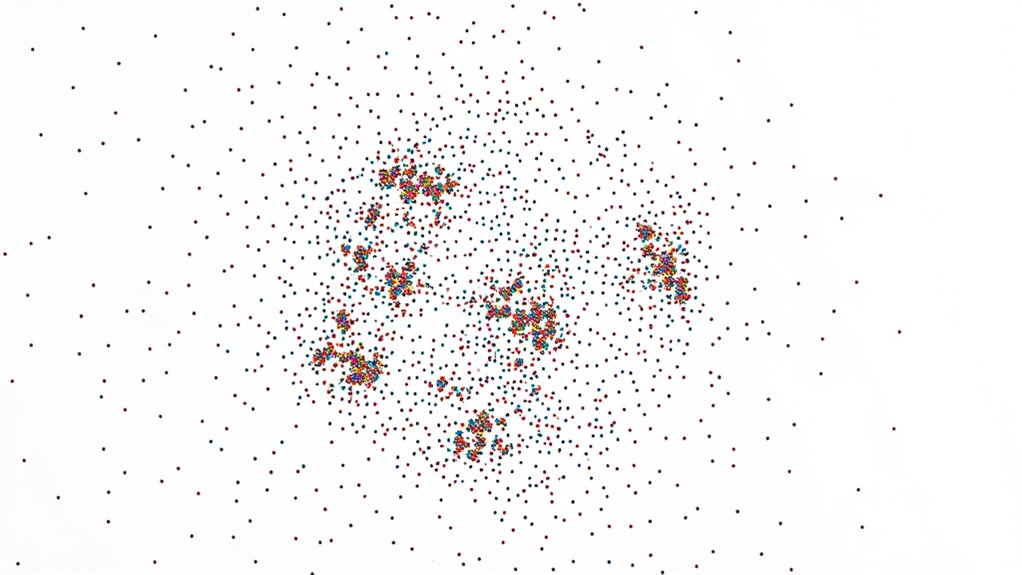

Convex hull algorithms help you find the smallest convex polygon that encloses a set of points. You can choose simple methods like Gift Wrapping for small datasets or more efficient algorithms like Graham Scan and Andrew’s monotone chain for larger collections. These algorithms sort points and perform quick inclusion tests, often using cross products, to build the hull efficiently. If you keep exploring, you’ll discover how to optimize these techniques further.
Key Takeaways
- Convex hull algorithms identify the minimal convex polygon enclosing all given points, essential for shape analysis and data simplification.
- Popular algorithms include Graham Scan, Andrew’s Monotone Chain, and Gift Wrapping (Jarvis March), chosen based on dataset size.
- These algorithms typically sort points initially, then construct the hull efficiently, often in O(n log n) time.
- Point inclusion tests using geometric properties like cross products streamline hull construction and handle edge cases.
- Proper handling of collinear and duplicate points ensures robustness and accuracy of the convex hull result.

A convex hull is the smallest convex shape that completely encloses a set of points in a plane. When you’re working with multiple points, finding this hull involves identifying the outermost points that form a polygon with no indentations. This process is fundamental in computational geometry because it simplifies complex datasets, making tasks like shape analysis, collision detection, and pattern recognition more manageable.
One critical aspect of constructing a convex hull is performing point inclusion tests efficiently. These tests determine whether a specific point lies inside or outside the current hull as you build or refine it. Effective algorithms leverage geometric properties—like cross products—to quickly ascertain a point’s position relative to the hull’s edges. This approach minimizes unnecessary calculations, especially when handling large point sets, ensuring that each test is executed swiftly. The goal is to avoid redundant checks and to quickly discard points that are clearly outside the hull, *therefore* streamlining the process.
Algorithm efficiency plays a pivotal role in choosing the right convex hull method. For small datasets, simple algorithms like the gift wrapping (Jarvis March) are straightforward and easy to implement. However, as your dataset grows, more efficient algorithms such as Graham Scan or Andrew’s monotone chain algorithm become preferable. These algorithms typically operate in O(n log n) time, primarily due to the initial sorting step, but then construct the hull efficiently through a single pass or a few passes over the data. Their efficiency stems from minimizing the number of point inclusion tests required and avoiding unnecessary computations, *consequently* cutting down processing time for large datasets.
When implementing these algorithms, you need to pay attention to how they handle various edge cases—such as collinear points or duplicate points—to ensure robustness. Proper sorting and careful management of the hull construction process help maintain algorithm efficiency and accuracy. Also, optimizing point inclusion tests by using vector cross products allows you to quickly determine whether a point should be part of the hull or excluded, further enhancing performance.
As an affiliate, we earn on qualifying purchases.
Frequently Asked Questions
How Do Convex Hull Algorithms Perform With Large Datasets?
When working with large datasets, convex hull algorithms can face scalability challenges that slow down performance. You should focus on algorithm optimization, such as using more efficient methods like Graham scan or Andrew’s monotone chain algorithm, which handle bigger data more effectively. These improvements help reduce computation time and memory usage, ensuring your convex hull calculations remain practical and accurate even as your dataset grows larger.
Are There Real-World Applications Beyond Computational Geometry?
A stitch in time saves nine, and convex hull algorithms extend beyond geometry into industry applications and artistic design. You use them to optimize routes, analyze spatial data, or create intricate patterns. These algorithms help you efficiently define boundaries, making them invaluable in fields like robotics, urban planning, or digital art. Their versatility proves that mathematical tools can shape both practical solutions and creative expressions in everyday life.
Which Convex Hull Algorithm Is Fastest for Dynamic Point Sets?
You should use the incremental algorithm for dynamic point sets because it updates the convex hull efficiently as new points arrive. While gift wrapping is simple and works well for static sets, it’s less suitable for dynamic data due to its higher computational cost. The incremental algorithm adapts quickly, making it the fastest choice for maintaining the convex hull in real-time applications with changing point sets.
How Do Concave Hulls Differ From Convex Hulls?
Concave hulls differ from convex hulls by allowing more complex shapes with indentations, giving you greater control over shape complexity. Unlike convex hulls, which create a smooth, outward boundary, concave hulls can better fit the actual distribution of points, providing higher boundary precision. This flexibility makes them ideal when you need a more accurate outline of a dataset, especially in cases where the shape isn’t strictly convex.
Can Convex Hull Algorithms Handle 3D Point Clouds?
Think of 3D point clouds as a starry sky you want to map. Yes, convex hull algorithms can handle 3D data, creating convex polyhedra that enclose points in space. They determine 3D point inclusion efficiently, wrapping around the cloud’s outermost points. While more complex than 2D, these algorithms help you visualize the shape and boundaries of three-dimensional data, like forming a protective shell around a celestial body.
As an affiliate, we earn on qualifying purchases.
Conclusion
Now that you’ve uncovered the secrets behind convex hull algorithms, you’re like a master sculptor shaping a masterpiece from scattered points. With these tools, you can carve out the smallest, strongest boundary that holds everything together—your digital fortress. Remember, just as a lighthouse guides ships safely home, these algorithms lead you through complex data landscapes, revealing the core shape beneath chaos. Embrace them, and let your geometric journey continue with confidence and clarity.
computational geometry programming kit
As an affiliate, we earn on qualifying purchases.
As an affiliate, we earn on qualifying purchases.
As an affiliate, we earn on qualifying purchases.