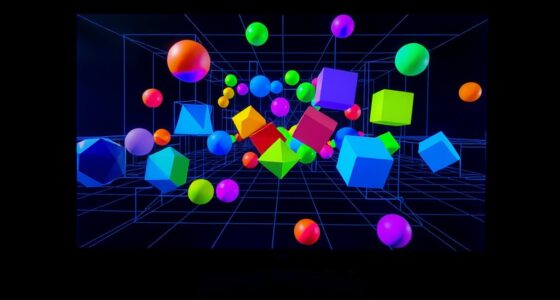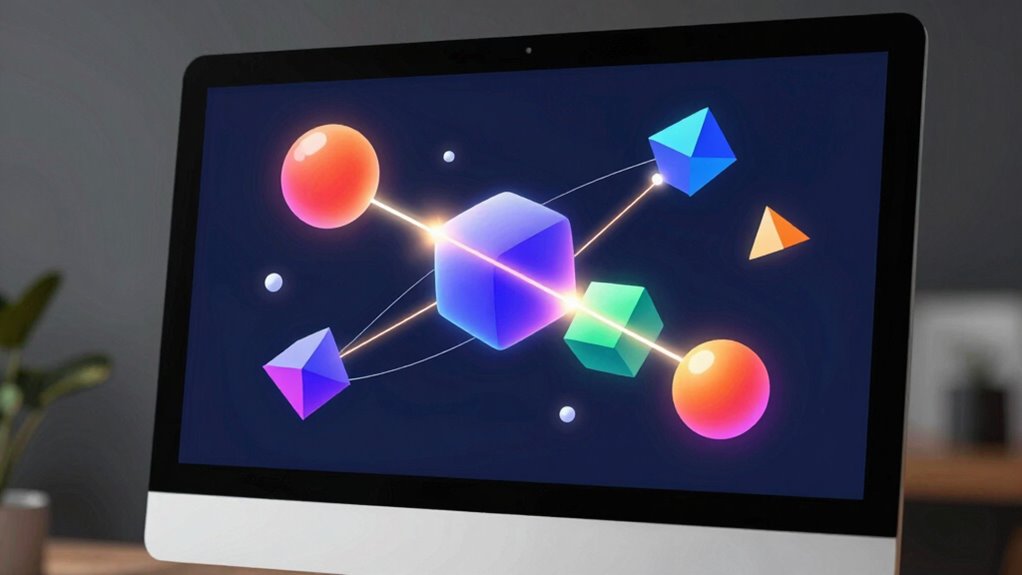

Collision detection is what helps your game recognize when objects touch or overlap, making interactions feel natural. Think of it as the game’s way of “touch,” preventing things from passing through each other or behaving oddly. It uses simple shapes like boxes or circles to check for collisions quickly, balancing accuracy with speed. Good collision detection makes your game more realistic and responsive. Keep exploring, and you’ll discover how these concepts work together to create smooth game mechanics.

Prime made for students and young adults
- Fast, free delivery for dorm and study essentials
- Prime Video and Amazon Music included
- Member-only deals
Key Takeaways
- Think of collision detection as the game’s way of sensing when objects touch or overlap, like a touch sensor.
- Use simple shapes like rectangles or circles around objects to quickly check for possible collisions.
- Basic algorithms help efficiently determine if objects are intersecting, balancing speed and accuracy.
- Physics simulation makes object reactions realistic, such as bouncing or stacking, after a collision is detected.
- Optimizing collision checks ensures smooth gameplay without sacrificing responsiveness or detail.

Understanding how objects interact in a digital space doesn’t have to be complicated. When you’re delving into game development, especially, grasping the basics of collision detection can seem overwhelming at first. But at its core, it’s about figuring out when two objects in a game environment touch or overlap. This process is essential because it determines how characters move, how objects react, and how the game world responds to player actions. To make this happen efficiently, developers often rely on physics simulation techniques that handle the calculations behind the scenes. These simulations ensure that objects behave realistically, whether they’re bouncing, sliding, or stopping upon collision.
Understanding object interactions in digital spaces is key to creating realistic, engaging game experiences.
In game development, collision detection acts like the game’s sense of touch. It’s what allows your game to recognize when a character bumps into a wall or when a projectile hits a target. Without it, movement would feel unnatural, and gameplay could become frustrating. The key is to simplify these interactions into manageable checks that computers can process quickly. Think of it as a game of digital tag—if two objects come close enough, the system recognizes the contact and triggers the appropriate response. This requires algorithms that can quickly determine whether objects intersect, which is often achieved through bounding boxes or shapes like circles and rectangles. These shapes act as the first line of detection, providing a quick way to rule out unlikely collisions before performing more precise checks. Employing efficient collision detection algorithms helps optimize game performance, especially in complex scenes with many objects. Additionally, understanding the geometry behind these algorithms can help developers fine-tune collision checks for better accuracy and speed. Knowing how to balance performance and accuracy is crucial in creating a smooth gaming experience, especially in real-time applications.
You don’t need to be a math whiz to understand the basics of collision detection, but knowing its role in physics simulation helps you appreciate its importance. Physics simulation adds realism by not just detecting collisions but also calculating what happens afterward—like bouncing off surfaces or stacking objects. When you’re designing a game, you’ll find that implementing collision detection using simple geometric checks keeps gameplay smooth and responsive. It’s about balancing accuracy with performance, especially in fast-paced games where every frame counts. Through clever use of algorithms and shapes, collision detection becomes a seamless part of your game’s mechanics, creating an immersive experience for players without the need for complex jargon.
A solid understanding of collision detection techniques can significantly improve your game’s responsiveness and overall feel, making interactions more believable and satisfying for players.
collision detection game development kit
As an affiliate, we earn on qualifying purchases.
As an affiliate, we earn on qualifying purchases.
Frequently Asked Questions
How Does Collision Detection Improve Game Performance?
Collision detection improves game performance by reducing unnecessary calculations through collision optimization, which guarantees only relevant objects are checked. It also maintains accuracy balancing, so detections are precise without overburdening the system. By streamlining how and when collisions are processed, you minimize lag and enhance gameplay fluidity. This efficient approach allows your game to run smoother, providing a better experience for players without sacrificing detection quality.
Can Collision Detection Be Used in Real-Time Applications?
Think of collision detection algorithms as a high-speed traffic monitor, keeping everything moving smoothly. Yes, they can be used in real-time applications, but you’ll face real-time challenges like processing speed and accuracy. To succeed, you need efficient algorithms that quickly identify interactions without slowing down the system. When you optimize these algorithms, you can create seamless experiences, whether in games, simulations, or virtual reality, even under demanding real-time conditions.
What Are Common Mistakes Beginners Make in Collision Detection?
A common mistake you might make is not prioritizing collision accuracy, which can lead to missed detections or false positives. You often rely solely on bounding volumes without adjusting their size or shape appropriately, causing imprecise results. To improve, guarantee your bounding volumes tightly fit objects and refine detection algorithms as needed. This balance helps maintain performance while keeping collision detection reliable and accurate.
How Do Different Shapes Affect Collision Detection Methods?
Your collision detection journey is as epic as a hero’s quest! Different shapes drastically influence detection methods—simple circles or rectangles are quick but less accurate, while complex polygons or irregular shapes require advanced algorithms. Shape complexities can challenge detection accuracy, making it harder to pinpoint collisions precisely. You’ll need to choose methods suited to your shapes—simpler shapes for speed, intricate ones for precision—to guarantee your game runs smoothly and accurately.
Is There Software Available to Simplify Collision Detection Implementation?
Yes, plenty of collision detection software solutions are available to simplify implementation. Tools like Unity, Unreal Engine, and Godot come with built-in collision detection tools that handle various shapes and interactions, saving you time and effort. These collision detection tools are user-friendly, offering visual editors and scripting options, making it easier for you to incorporate accurate collision detection into your projects without diving deep into complex algorithms.
physics simulation for game engines
As an affiliate, we earn on qualifying purchases.
As an affiliate, we earn on qualifying purchases.
Conclusion
Now that you understand the basics, imagine the world around you as a busy street filled with bouncing balls, sliding cars, and darting pedestrians—all effortlessly avoiding one another. Collision detection is your invisible traffic cop, guiding these interactions smoothly. With this knowledge, you’re like a conductor of an intricate dance, ensuring everything moves harmoniously without crashes. Keep practicing, and soon you’ll master this silent guardian that keeps digital worlds safe and seamless, just like a well-orchestrated symphony.
bounding box collision detection software
As an affiliate, we earn on qualifying purchases.
As an affiliate, we earn on qualifying purchases.
As an affiliate, we earn on qualifying purchases.
Fall Picks
fall essentials
As an affiliate, we earn on qualifying purchases.