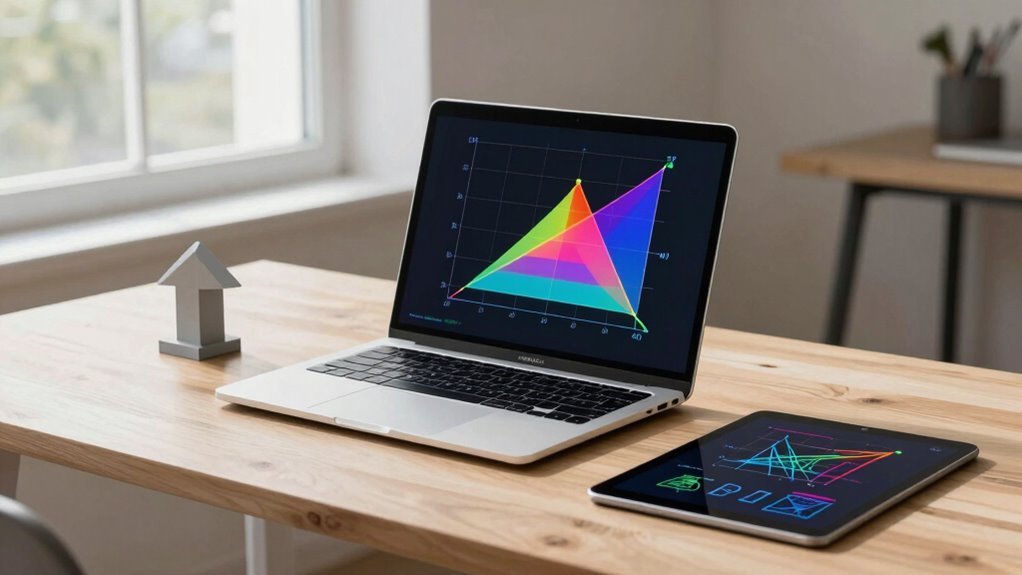

You should include vectors in your modern geometry toolkit because they give you a clear way to represent magnitude and direction in a single entity, making complex shapes easier to analyze. Vectors help you perform transformations, solve spatial problems, and understand relationships between objects with precision. They also extend to advanced areas like vector calculus and coordinate changes. Keep exploring, and you’ll see how vectors reveal deeper insights into geometric concepts.

Prime made for students and young adults
- Fast, free delivery for dorm and study essentials
- Prime Video and Amazon Music included
- Member-only deals
Key Takeaways
- Vectors provide a unified way to represent magnitude and direction, essential for precise geometric modeling.
- They simplify calculations and reveal relationships between geometric objects.
- Vectors are fundamental in advanced concepts like vector calculus and coordinate transformations.
- They enable accurate modeling of real-world phenomena such as fields and fluid flows.
- Vectors facilitate flexible geometric analysis across different coordinate systems and spaces.
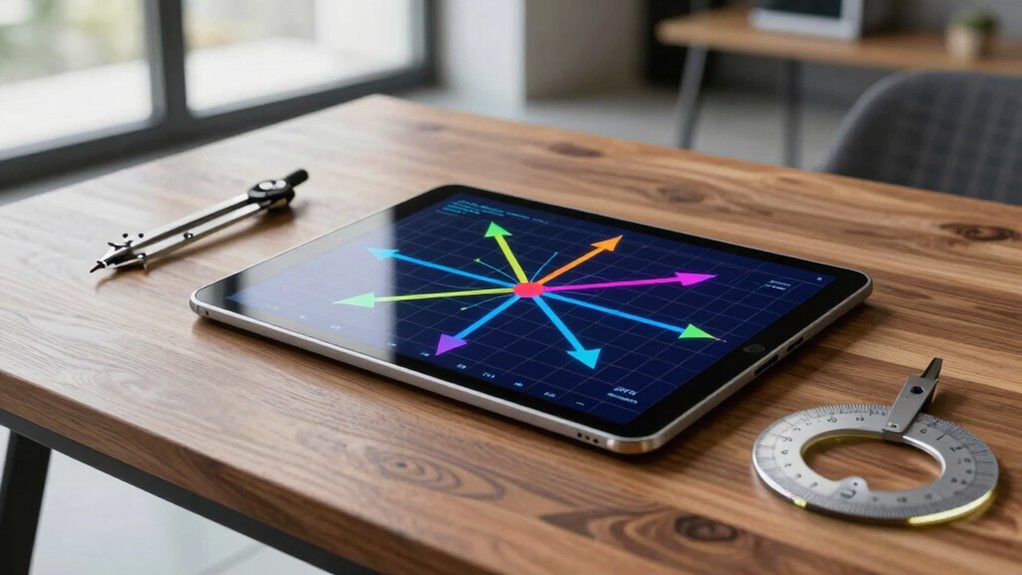
Have you ever wondered how mathematicians describe directions and positions in space with such precision? It’s because they rely on vectors. Vectors are fundamental tools in modern geometry, providing a way to represent both magnitude and direction in a single entity. They allow you to navigate complex spaces seamlessly, and understanding their role is crucial for grasping advanced concepts like vector calculus and coordinate transformations. These tools help simplify calculations, reveal relationships between objects, and transform problems into more manageable forms. Without vectors, modern geometry would lack the clarity and efficiency it offers today. Understanding their applications is essential for appreciating how vectors serve as versatile tools across various fields. Moreover, their ability to encode information about (direction and magnitude) makes them indispensable for modeling real-world phenomena accurately. Vector calculus extends the basic idea of vectors into a broader framework, enabling you to analyze how quantities change over space. It’s essential for describing fields such as electromagnetism and fluid flow, where the behavior of a system depends on position and direction. Through operations like divergence and curl, vector calculus helps you understand how these fields behave and interact. It’s a powerful language for translating physical phenomena into mathematical expressions, making it possible to solve real-world problems with precision. When working with vector calculus, you’re essentially manipulating vectors to uncover deeper insights about the spatial relationships within a system. Additionally, the concept of vector spaces further extends the utility of vectors by allowing for the study of their properties in more abstract settings. Recognizing the importance of vector operations is fundamental to mastering the manipulation and application of vectors in various mathematical contexts.
Vectors are essential for representing direction and magnitude, enabling precise navigation and simplifying complex geometric calculations.
Coordinate transformations are another critical aspect where vectors shine. They allow you to change from one coordinate system to another—say, from Cartesian to polar coordinates—without losing the essence of the problem. This flexibility is key in modern geometry, especially when dealing with complex shapes or curved spaces. By applying coordinate transformations, you can simplify equations, analyze geometric objects from different perspectives, and solve problems that would otherwise be intractable. Vectors are the backbone of these transformations, providing a consistent way to move between coordinate systems while preserving the geometric relationships. This makes it easier to visualize and manipulate objects in diverse settings. Coordinate transformations further demonstrate how vectors enable seamless adaptation to different mathematical frameworks, enhancing problem-solving versatility.
Frequently Asked Questions
How Do Vectors Differ From Scalars in Geometry?
Vectors differ from scalars because they have both magnitude and direction, unlike scalar quantities, which only have size. In geometry, you interpret vectors through their components, which define their direction and length. Scalars are useful for measuring magnitude alone, but vectors give you a complete picture of position, movement, or force. This makes vectors essential in modern geometry, offering a detailed understanding of spatial relationships.
Can Vectors Represent Curved or Non-Euclidean Geometries?
Imagine using a GPS to navigate a curved space like Earth’s surface; vectors help you map directions even in non-Euclidean models. Yes, vectors can represent curved or non-Euclidean geometries by adapting their components to account for curvature. In curved space, vectors describe local directions and magnitudes, making them essential tools. They enable you to analyze complex geometries, just like a compass helps you find your way on uneven terrain.
What Are the Limitations of Using Vectors in Complex Geometries?
Vector limitations in complex geometries include difficulty representing curvature and non-linear transformations accurately. You might find vectors insufficient for capturing the intricacies of curved surfaces or non-Euclidean spaces, as they excel mainly in linear, flat environments. In such cases, you need advanced tools like tensor calculus or differential geometry. Relying solely on vectors can oversimplify complex geometries, limiting your understanding and precise modeling of these advanced structures.
How Do Vectors Relate to Other Mathematical Tools Like Matrices?
You can see that vectors relate closely to matrices through vector transformations, where matrices act on vectors to change their position or scale. In vector calculus, matrices help describe derivatives and linear transformations of vector fields. This connection allows you to perform complex operations efficiently, making vectors and matrices essential tools in modern geometry, especially when analyzing transformations, rotations, and other geometric properties in a compact, manageable way.
Are Vectors Applicable in Artistic or Visual Representations of Geometry?
You can definitely use vectors in artistic and visual representations of geometry. They’re essential for creating vector art, where smooth, scalable images rely on mathematical precision. Vectors enable effective visual modeling by illustrating directions, magnitudes, and transformations clearly. When you harness vectors, your geometric designs become more dynamic and accurate, making complex visuals easier to manipulate and more visually appealing. This fusion of math and art enhances creativity and technical precision simultaneously.
Conclusion
You see, vectors are the backbone of modern geometry, weaving through every theorem and transformation like an unbreakable thread. They’re your trusty compass, guiding you through complex spaces and abstract ideas with ease. Without them, geometry would be like a ship without a sail—adrift and directionless. Embrace vectors, and you’ll find your mathematical journey becomes a dance across the canvas of space, where every step is precise and full of purpose.
Fall Picks
fall essentials
As an affiliate, we earn on qualifying purchases.