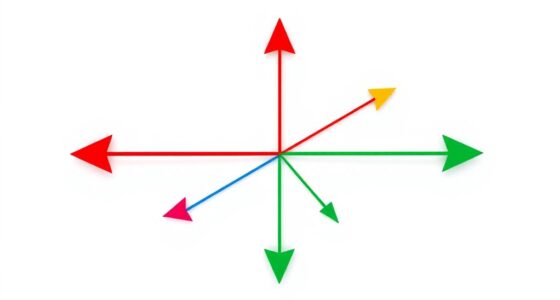

Unit vectors are essential because they give you a clear, consistent way to represent directions in physics, graphics, and design. They make calculations easier by focusing only on orientation, removing confusion caused by magnitude. Whether you’re aligning objects, controlling movement, or analyzing forces, using unit vectors ensures accuracy and efficiency. Mastering these tools helps you handle complex tasks with confidence, and exploring further reveals even more about their powerful applications.

Prime made for students and young adults
- Fast, free delivery for dorm and study essentials
- Prime Video and Amazon Music included
- Member-only deals
Key Takeaways
- Unit vectors provide a clear, standardized way to represent directions across various fields.
- They simplify calculations involving force, motion, and orientation in physics and graphics.
- Normalized vectors focus solely on direction, enhancing accuracy and interpretability.
- They enable consistent scaling, rotation, and transformation of objects in design and visualization.
- Using unit vectors improves communication of directional data and supports complex vector operations.

Have you ever wondered how directions are precisely represented in physics, graphics, and design? It’s all about vectors, and more specifically, unit vectors. These tiny but powerful entities help you describe direction with clarity and consistency. When working with vectors, you’ll often perform vector addition to combine multiple directions or effects. For example, if you’re calculating forces acting on an object, you add their vectors to find the net force. Vector addition becomes straightforward and intuitive when you normalize vectors into unit vectors first, since each one then points in a specific direction without magnitude confusion. This normalization simplifies calculations and makes your work more transparent. Understanding the importance of vector normalization is essential for accurate and efficient computations. Scalar multiplication plays an integral role here too. It allows you to scale a vector’s magnitude without changing its direction. When you multiply a vector by a scalar, you’re adjusting how long or strong that vector is, which is especially useful in physics for representing varying forces or velocities. When you multiply a vector by a scalar to produce a unit vector, you essentially normalize it, turning it into a direction-only indicator. This process guarantees that the vector’s length becomes one, removing any ambiguity about its size, so the focus remains purely on the direction. Using scalar multiplication to create unit vectors helps you keep your calculations consistent and easy to interpret, especially when you want to compare directions or combine multiple vectors. Additionally, vector operations are fundamental in ensuring accurate transformations and manipulations across different applications. In graphics and design, unit vectors are invaluable tools for defining orientations and directions. Whether you’re creating 3D models, animating objects, or designing vector graphics, these tiny direction indicators help you control how objects move or face. When you need to rotate an object or determine its orientation, you often rely on unit vectors because they keep the focus on the direction rather than magnitude. They also make calculations more manageable because, with unit vectors, you can easily perform vector addition to combine directions or use scalar multiplication to adjust the influence of one vector relative to another. This combination of mathematical operations ensures your graphics stay accurate and visually cohesive. Moreover, vector magnitude is a crucial aspect to understand when working with vectors, as it complements the directional focus of unit vectors and influences how they are applied in various contexts. Recognizing the importance of standardization in vector representations helps maintain consistency across different calculations and applications. A solid grasp of vector concepts can enhance your ability to work efficiently across fields that rely heavily on precise directional data. Ultimately, unit vectors matter because they give you a reliable, standardized way to represent direction across various fields. They simplify complex calculations, improve clarity, and make your work more precise. Whether you’re adding forces, scaling velocities, or orienting objects, understanding how to use vector addition and scalar multiplication with unit vectors enables you to communicate directions clearly and work efficiently. These tiny vectors are the backbone of many advanced concepts in physics, graphics, and design, transforming abstract directions into tangible, manageable tools.
Frequently Asked Questions
How Do Unit Vectors Simplify Complex Calculations Across Fields?
Unit vectors simplify complex calculations by providing a standardized way to express directions through vector normalization. When you use them, you clearly define the direction without worrying about magnitude, which makes your calculations more straightforward. This clarity in direction helps you easily manipulate vectors across fields like physics, graphics, and design, reducing errors and making the math more manageable. Fundamentally, unit vectors keep your work precise and consistent.
Can Unit Vectors Change Over Time or With Transformations?
Unit vectors can change during transformations if the vector’s magnitude or direction shifts. Think of them as navigational compasses—vector normalization guarantees the direction stays consistent even when scaling or rotating. When you apply transformations, the unit vector adapts, maintaining direction consistency. So, yes, they can change over time or with transformations, but they always retain their core purpose: representing pure direction without magnitude influence.
Are There Limitations to Using Unit Vectors in Certain Applications?
Yes, there are limitations to using unit vectors in certain applications. When vector normalization isn’t feasible due to data inaccuracies or computational constraints, unit vectors may lose precision. Additionally, in different coordinate systems, converting or maintaining unit vectors can be complex, especially if transformations aren’t handled properly. These issues can impact applications like physics simulations, graphics rendering, or design work, where accurate directional information is essential.
How Do Unit Vectors Relate to Other Vector Representations?
Imagine vectors as arrows pointing in different directions; unit vectors are arrows with a fixed length of one, acting like a compass needle. They relate to other vectors through vector normalization, which scales any vector to a unit vector while preserving its direction. This process guarantees direction consistency, allowing you to compare, combine, or analyze vectors more easily across various applications, like physics, graphics, and design.
What Are Common Mistakes When Working With Unit Vectors?
When working with unit vectors, you often make mistakes with vector normalization, which is essential for maintaining their magnitude of one. Make certain you correctly convert vectors into coordinate systems before normalization; otherwise, calculations can become inaccurate. Avoid assuming all vectors are already normalized or forgetting to verify their length. Double-check your work to prevent errors that could impact physics simulations, graphics rendering, or design accuracy.
Conclusion
Unit vectors are your trusty compass in physics, graphics, and design, guiding you through complex directions with clarity and precision. Like a lighthouse illuminating the stormy seas, they help you navigate vectors effortlessly, ensuring your work stays on course. Embracing their simplicity reveals a world of accuracy and elegance, transforming chaos into harmony. So, next time you face a vector challenge, remember—unit vectors are the steady hand that keeps your creative ship sailing smoothly.
Halloween Picks
halloween
As an affiliate, we earn on qualifying purchases.