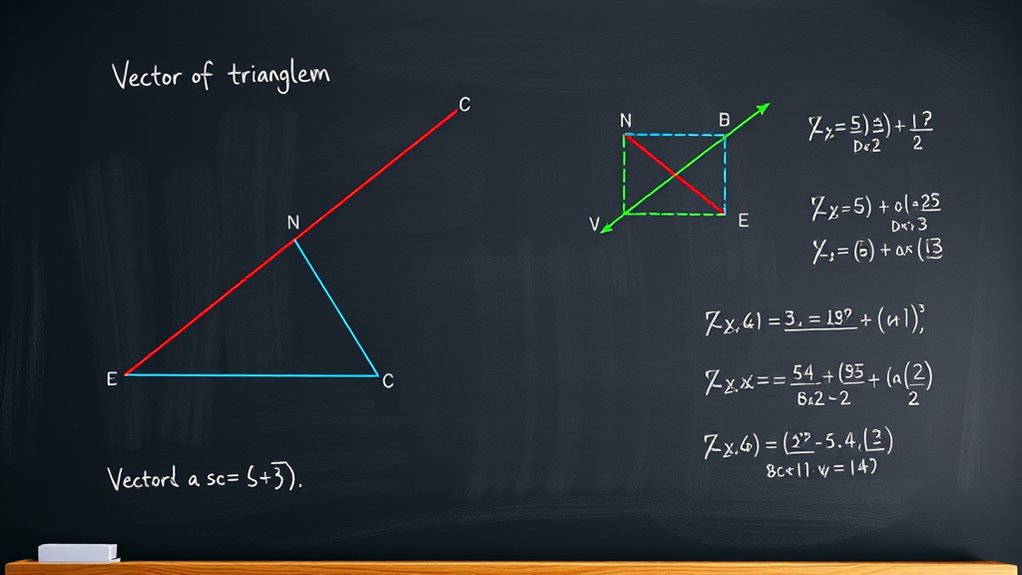
To solve a triangle problem using vectors, you assign vectors to the sides based on the triangle’s points. Use the cross product to find a vector perpendicular to the plane, which helps you calculate areas and angles. Properties like distributivity simplify calculations, turning geometric relationships into easy algebraic equations. By leveraging these vector operations, you can analyze angles, lengths, and areas efficiently. Keep exploring, and you’ll discover how these techniques can solve even complex triangles with ease.
Key Takeaways
- Assign vectors to triangle sides or vertices based on given points to translate the problem into algebraic form.
- Use the cross product to find the area of the triangle by calculating the magnitude of the vector.
- Apply vector addition properties to express unknown sides or angles in terms of known vectors.
- Calculate the angle between vectors using the dot product or cross product to find missing angles.
- Leverage the properties of the cross product to simplify calculations and solve for unknowns efficiently.
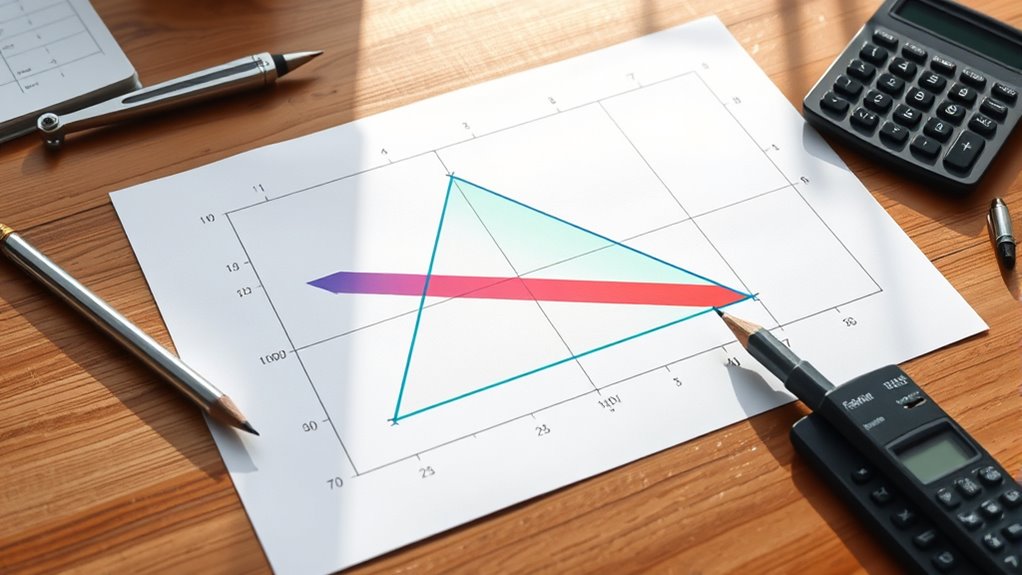
Another powerful tool in vector geometry is the cross product. The properties of the cross product allow you to find a vector perpendicular to the plane containing your original vectors, which is invaluable when dealing with areas or angles within the triangle. For instance, if you have two vectors representing two sides of the triangle, their cross product magnitude gives you twice the area of the triangle. This property is especially handy because it converts a geometric problem into a straightforward calculation involving the cross product’s magnitude. additionally, the cross product has properties like distributivity over addition, so you can expand and simplify calculations when dealing with multiple vectors.
In applying these concepts to solve a triangle problem, you often start by assigning vectors to the sides based on given points. Then, using vector addition, you can express unknown sides or angles, converting the problem into algebraic equations. The cross product properties come into play when you need to find angles between vectors or determine areas, providing a direct link between algebraic operations and geometric measures. The key is to carefully choose your vectors and leverage the properties of vector addition and the cross product. This approach streamlines the problem-solving process, making it easier to find solutions efficiently. With practice, you’ll see how these vector operations transform complex geometric problems into manageable algebraic calculations, giving you powerful tools to analyze and solve triangles in space.
Frequently Asked Questions
How Do Vectors Help in Solving Non-Triangle Geometry Problems?
Vectors help in solving non-triangle geometry problems by providing a clear way to perform geometric analysis. You can use vector applications to find distances, angles, and areas more efficiently than traditional methods. With vectors, you analyze shapes and spatial relationships directly, simplifying complex calculations. This approach makes it easier to understand and solve problems involving polygons, circles, or other geometric figures, enhancing your overall problem-solving toolkit.
Can Vector Methods Be Applied in Three-Dimensional Space?
Yes, vector methods absolutely apply in three-dimensional space. You can use vector cross products to find areas and angles, and vector projection to analyze components along different axes. These techniques help you tackle complex 3D problems by breaking them down into manageable parts. With vectors in 3D, you gain greater geometric guidance, guiding you through space, solving spatial puzzles, and simplifying sophisticated structures with precision and power.
What Are Common Mistakes to Avoid When Using Vectors in Geometry?
When using vectors in geometry, you should watch out for common pitfalls like vector misinterpretations, such as confusing magnitude with direction or misapplying vector addition. Avoid rushing through calculations, as small errors can lead to incorrect results. Always double-check your work, guarantee your vectors are correctly defined, and remember to verify the geometric meaning behind each operation. Staying attentive helps prevent these common mistakes and improves accuracy.
How Do Vectors Relate to Coordinate Transformations?
You relate vectors to coordinate transformations through basis transformation and coordinate rotation. When you perform a basis transformation, you change the coordinate system, allowing vectors to be expressed in a new basis. Similarly, coordinate rotation involves rotating the axes to simplify calculations or reveal geometric relationships. These processes help you understand how vectors behave under different coordinate systems, making it easier to analyze geometric problems and solve triangles efficiently.
Are There Software Tools That Facilitate Vector-Based Geometry Solutions?
Did you know that over 60% of engineers use software for vector visualization and plotting? Yes, there are great tools like GeoGebra, Desmos, and MATLAB that make vector-based geometry solutions easier. These programs help you visualize vectors, plot them accurately, and solve complex problems efficiently. They’re perfect for students and professionals alike, providing interactive interfaces to explore vector relationships and enhance your understanding of geometric concepts.
Conclusion
As you visualize the triangle unfolding before you, the power of vectors transforms complex angles into clear, manageable steps. You navigate through the problem like a skilled sailor steering through calm and stormy seas, each vector acting as your guiding compass. With this approach, you turn abstract numbers into vivid images, confidently solving the puzzle. Remember, with vectors, you’re not just crunching data—you’re mapping out the geometry of your understanding.