To shift and rotate graphs, you use coordinate transformations. Shifting involves adding specific values to the x and y coordinates to move the entire graph without changing its shape. Rotating turns the graph around a point, often the origin, by a certain angle, using formulas based on rotation rules. Combining these transformations allows precise control over the graph’s position and orientation. Keep exploring to discover more about these powerful geometric tools.
Key Takeaways
- Translations shift graphs by adding fixed values to x and y coordinates, moving the entire figure without altering its shape.
- Rotations turn graphs around a point (typically the origin) by a specific angle, using coordinate swapping and sign changes.
- To rotate around a non-origin point, translate the graph to the origin, rotate, then translate back.
- Combining translations and rotations enables complex graph transformations and precise coordinate system changes.
- Mastering these transformations simplifies analyzing and manipulating figures in different coordinate systems across various fields.
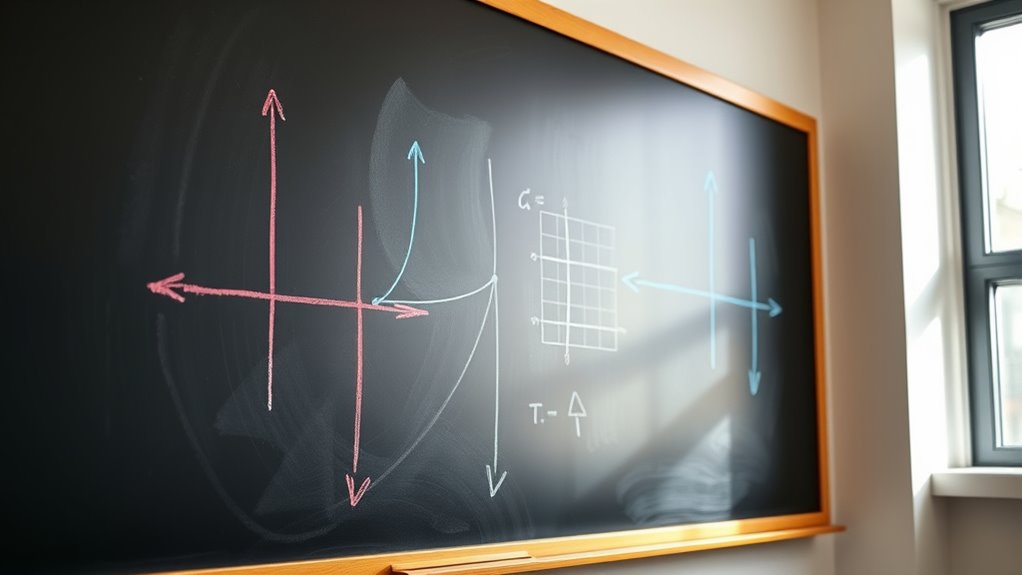
Have you ever wondered how to convert a point’s location from one coordinate system to another? When working with graphs or geometric figures, understanding coordinate system changes is essential. These changes often involve two fundamental operations: rotations and translations. By mastering these, you can shift and rotate graphs seamlessly, making complex problems much easier to handle.
Rotations and translations are the core tools for transforming coordinate systems. When you perform a translation, you shift every point in your figure by a specific distance along the x and y axes. Imagine sliding an object across a table without tilting it—its shape stays the same, but its position changes. Translations are straightforward: if you move a point 3 units to the right and 2 units up, you add 3 to its x-coordinate and 2 to its y-coordinate. This type of coordinate system change preserves the shape and size of the figure but alters its location, making it a simple yet powerful transformation.
Translations shift entire figures without changing their shape or size.
Rotations, on the other hand, involve turning the entire coordinate system or figure around a fixed point, usually the origin. When you rotate a graph, each point moves through a circular path, changing its position relative to the axes. To perform a rotation, you need to specify an angle, typically measured in degrees or radians. For example, rotating a point 90 degrees counterclockwise around the origin involves a specific rule: swapping the coordinates and changing the sign of one. If a point has coordinates (x, y), after a 90-degree counterclockwise rotation, it becomes (-y, x). This rule simplifies what might seem like a complex process, making it easier to understand and execute coordinate system changes involving rotations.
Understanding the importance of rotation angles and their effect on the position of points is crucial for precise transformations. Combining rotations and translations allows you to shift and reorient graphs in versatile ways. For instance, if you want to rotate a figure around a point other than the origin, you can first translate the figure so that this point becomes the origin, perform the rotation, and then translate it back. This process, known as a composite transformation, is central to manipulating geometric figures efficiently. Understanding how to apply these transformations helps you convert points and entire graphs between different coordinate systems with precision. Whether you’re working in math, engineering, or computer graphics, mastering rotations and translations enables you to adapt and analyze shapes in various contexts effortlessly.
Frequently Asked Questions
How Do Transformations Affect the Equation of a Graph?
Transformations change the equation of a graph by applying specific transformation rules that shift or rotate it on the coordinate grid. When you shift a graph, you adjust the x or y values, which modifies the equation accordingly. Rotations involve changing the orientation of the graph, often requiring the use of rotation formulas. These rules help you see how the graph moves or turns while maintaining its shape, making the equations reflect these changes precisely.
Can Transformations Be Combined for Complex Graphs?
Yes, you can combine transformations for complex graph manipulation. When you combine transformations, like shifting then rotating, you apply each one step-by-step, which changes the equation accordingly. This approach allows you to create more intricate graphs by stacking multiple transformations. Just remember, the order matters; applying them in a different sequence can produce different results, so plan your combined transformations carefully for the desired outcome.
What Is the Difference Between Shifting and Rotating Graphs?
Shifting graphs moves them horizontally or vertically, changing their position without altering shape or symmetry, often using simple addition or subtraction. Rotating graphs turns them around a point, usually the origin, which can change their symmetry and appearance. You can use transformation matrices to perform both shifts and rotations efficiently, understanding how each transformation affects the graph’s symmetry. Combining these transformations allows you to create complex, precise graph modifications.
Are There Transformations That Preserve the Shape of Graphs?
Imagine a mirror reflecting your image perfectly; that’s how some transformations preserve a graph’s shape. Yes, certain transformations, like those involving orthogonal transformation matrices, maintain graph symmetry and shape. These include rotations and reflections. When you apply them, the graph’s size and form stay intact, just like a reflection in a mirror. So, shape-preserving transformations help you manipulate graphs without distorting their fundamental structure.
How Do Transformations Impact the Graph’s Asymptotes?
Transformations can shift asymptotes, changing their position but not their shape, so the graph’s overall asymptote structure remains intact. Horizontal shifts move asymptote lines left or right, causing asymptote shifts, while vertical shifts move them up or down. Rotations and other transformations generally preserve graph symmetry and don’t alter the asymptote’s fundamental nature. You’ll see how these shifts influence where the graph approaches these lines without changing their core properties.
Conclusion
Now that you’ve learned how to shift and rotate graphs, you’re better equipped to handle complex coordinate transformations. Remember, these skills can turn a complicated picture into a clear view, making your math journey smoother. Don’t be afraid to experiment and see things from different angles — it’s all part of the learning process. With practice, you’ll find that mastering these transformations is a walk in the park, and suddenly everything will click into place.