Transformations like translation, rotation, reflection, and dilation help you understand how shapes move and change on a plane. Translation slides a shape using a vector, while rotation spins it around a point. Reflection flips it over a line of symmetry, and dilation resizes it while keeping the shape’s proportions. Mastering these concepts lets you see how figures transform smoothly, and exploring each one further will help you grasp more complex geometric ideas.

Prime made for students and young adults
- Fast, free delivery for dorm and study essentials
- Prime Video and Amazon Music included
- Member-only deals
Key Takeaways
- Translation shifts shapes along a plane using vectors without changing size or orientation.
- Rotation turns a shape around a fixed point by a specified angle and direction.
- Reflection flips a shape over a line of symmetry, creating a mirror image.
- Dilation resizes a shape proportionally based on a scale factor, either enlarging or shrinking.
- Understanding these transformations helps visualize shape movement, orientation, and size changes in geometry.
As an affiliate, we earn on qualifying purchases.
Understanding Translation: Moving Shapes Across a Plane
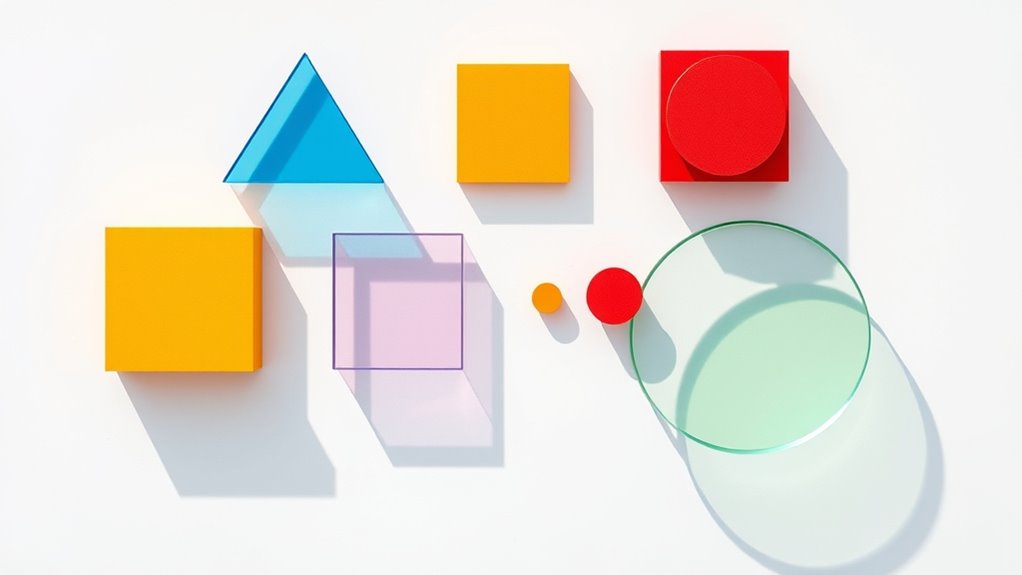
Understanding translation is key to grasping how shapes move across a plane. When you translate a shape, you’re shifting it along a coordinate grid without changing its size or orientation. This movement is described using translation vectors, which tell you how far and in which direction to move each point of the shape. Think of the translation vector as an arrow pointing from the original position to the new one. By applying this vector to every point on the shape, you can accurately move it across the plane. This process helps you visualize how shapes slide from one location to another, making it easier to understand more complex transformations later on. Mastering translation provides a solid foundation for exploring other geometric transformations. Understanding translation is essential for visualizing how shapes change position without altering their size or shape.
As an affiliate, we earn on qualifying purchases.
Exploring Rotation: Spinning Figures Around a Point

Have you ever rotated a paper shape to see how it turns around a specific point? When you do, you’re performing a rotation, which involves turning the shape by a certain angle of rotation. The angle of rotation measures how far the shape spins around the point, usually in degrees. The rotation direction determines whether the shape turns clockwise or counterclockwise. To rotate a shape, pick a point as the center, then turn it by your desired angle, following the rotation direction. This movement keeps the shape’s size intact while changing its position and orientation. By experimenting with different angles and directions, you’ll see how the shape’s position varies, helping you understand how rotation transforms figures in geometry. Understanding the center of rotation is essential for visualizing how the figure will move during the rotation.
As an affiliate, we earn on qualifying purchases.
Reflecting Shapes: Flipping Over Lines of Symmetry

When you reflect a shape over a line of symmetry, you flip it across that line so that the shape appears as a mirror image. This process relies on line symmetry, where each point on the original shape is mapped to a corresponding point on the opposite side. To understand flipping shapes better, focus on these key steps:
- Identify the line of symmetry where you want to reflect the shape.
- Imagine drawing a mirror along that line, with the shape on one side.
- Flip the shape across the line so that each point moves to its mirror position.
- Consider how different shape designs can be enhanced or altered through symmetry for more creative and appealing results.
As an affiliate, we earn on qualifying purchases.
Dilation and Its Effects: Resizing Figures in Space

Dilation changes the size of a figure while preserving its shape and angles. You use a scale factor to determine how much the figure enlarges or shrinks. If the scale factor is greater than 1, the figure enlarges; if it’s between 0 and 1, the figure shrinks. This process results in proportional resizing, meaning all dimensions are multiplied by the same scale factor. Dilation keeps the angles unchanged, so the shape remains similar, just larger or smaller. You can visualize dilation as zooming in or out while maintaining the figure’s proportions. By adjusting the scale factor, you control the degree of resizing. This transformation is useful in design, art, and modeling, where maintaining shape similarity during resizing is essential. Additionally, understanding how scaling factors influence the size helps in precise adjustments across various applications.
Frequently Asked Questions
How Do Transformations Affect the Area and Perimeter of Shapes?
Transformations can change the area and perimeter of shapes based on their scale factor. When a shape undergoes a transformation, its perimeter is multiplied by the scale factor, so it increases or decreases proportionally. For area, the change depends on the square of the scale factor, meaning the area change can be much more significant. Understanding these effects helps you predict how shapes will alter when transformed.
Can Transformations Be Combined for Complex Figure Modifications?
Think of your shapes as a puzzle being rearranged. Yes, you can combine transformations for complex figure modifications through composition techniques and transformation sequences. By applying multiple steps—like rotating then translating—you create intricate designs. This process is like layering brushstrokes in a painting, giving you precise control over how your figure changes. Combining transformations allows you to craft detailed, sophisticated modifications that aren’t possible with a single move.
Are All Transformations Reversible in Geometric Figures?
When considering the reversibility of transformations, you’ll find that most are reversible because each has a transformation inverse. This means you can undo a transformation and return a figure to its original position or shape. For example, translations and rotations have clear inverses. However, some transformations, like certain dilations, may not be perfectly reversible if they alter the figure’s size permanently. So, understanding transformation inverses is key to knowing which are reversible.
How Do Transformations Relate to Symmetry in Shapes?
You see, transformations help you understand symmetry types in shapes. When a shape maps onto itself through a transformation, it reveals an axis of reflection or center of rotation, highlighting its symmetry properties. These transformation properties show how parts of a shape relate to each other, emphasizing balance and harmony. Recognizing symmetry types makes it easier to analyze, classify, and appreciate the geometric beauty in various figures.
What Real-World Applications Utilize These Geometric Transformations?
You often use geometric transformations in real life through coordinate shifts and pattern recognition. For example, in computer graphics, you move images or objects around, creating animations or visual effects. Architects rely on these transformations to design buildings with symmetry and precise layouts. Additionally, in robotics, coordinate shifts help navigate and manipulate objects. These applications showcase how understanding transformations helps solve practical problems efficiently and creatively.
Conclusion
By exploring these transformations, you realize that shapes aren’t fixed—they can move, spin, flip, and resize with ease. It’s almost like uncovering a secret superpower within geometry. Think about it: what if these transformations prove that change is always possible? Embrace the idea that, just like in math, you can reshape your world and yourself. Transformations remind you that growth and adaptation are not only true but also beautifully within your reach.
Evergreen bestsellers Picks
bestsellers
As an affiliate, we earn on qualifying purchases.