
Zooming a microscope image makes objects look bigger, but it doesn’t give you the true size. Without proper calibration or measurement tools, estimates can be inaccurate because visual magnification alone isn’t reliable. To measure correctly, you need to use calibration standards like stage micrometers and scale bars. If you want to get precise results and avoid common mistakes, keep exploring—there’s much more to learn about accurate microscopic measurements.
Key Takeaways
- Zooming enlarges images visually but does not provide true measurements without proper calibration.
- Accurate measurement requires calibration tools like stage micrometers, not just zoom levels.
- Scale bars in images offer reliable size references when correctly calibrated.
- Relying solely on zoom can lead to errors; use measurement tools for precise data.
- Regular calibration and proper measurement procedures ensure measurement accuracy beyond simple zoom.
Why Zoom Isn’t Enough to Measure Tiny Objects
Have you ever tried to measure a tiny object by simply zooming in on your camera or microscope? You might think that increasing magnification makes it easy to see and measure small details, but that’s where magnification limitations come into play. Zooming alone doesn’t provide accurate size measurements; it only makes the object appear larger without revealing true dimensions. Relying on subjective judgment can lead to errors because your perception of scale varies with each zoom level. Without proper calibration, you can’t confidently determine the actual size of the object. proper calibration ensures that measurements are accurate and reliable, which is essential for scientific and technical work. To obtain precise measurements, you need to use specialized measurement tools and techniques designed for accuracy, rather than relying solely on visual enlargement. Recognizing the difference between visual magnification and actual measurement is key to avoiding mistakes. It’s important to understand that true measurement involves accurate scaling, which can only be achieved through proper calibration and measurement tools. Additionally, understanding the limitations of magnification helps prevent overconfidence in visual estimates.
How Microscopes Help You Accurately Measure Size
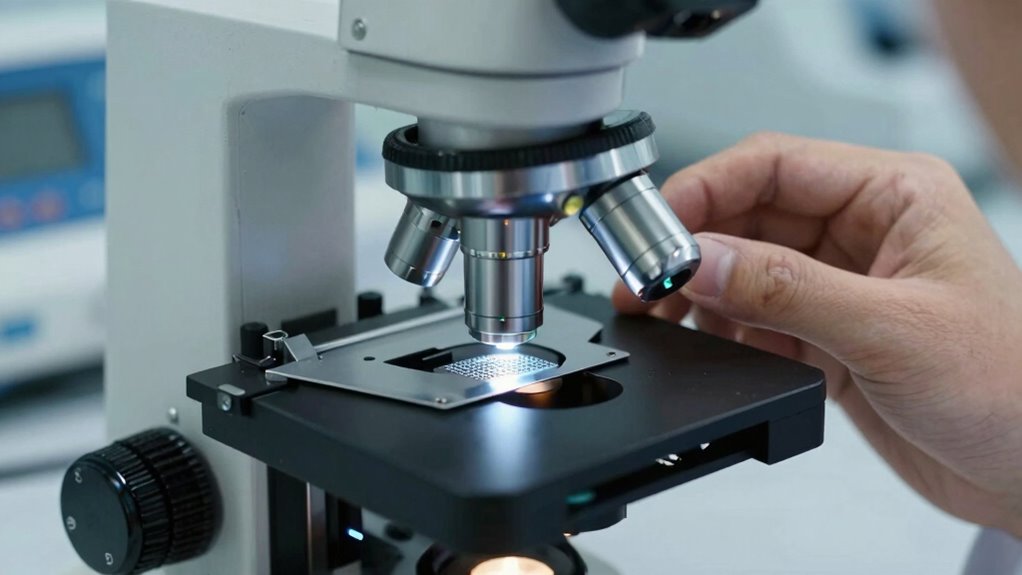
Microscopes are designed to provide accurate measurements of tiny objects, overcoming the limitations of simple zooming. They enhance magnification clarity, allowing you to see details clearly and make precise measurements. Using specialized measurement tools and calibration techniques, microscopes help guarantee measurement accuracy. For instance, the Calibration Scale ensures measurements are accurate by providing a reference for size estimation. Additionally, understanding the magnification levels helps users interpret measurements correctly across different scales. This understanding supports the application of comparative advantage principles in scientific measurement, ensuring efficiency and accuracy. Properly calibrated microscopes also account for water distortion, which can affect measurement precision when observing aquatic samples. Advances in local automation and digital measurement integration further improve measurement consistency and ease of use, reducing human error. For example, the following table highlights key features:
| Feature | Benefit | Explanation |
|---|---|---|
| Calibration Scale | Precise size estimation | Ensures measurements are accurate |
| Fine Focus | Sharp image detail | Improves measurement precision |
| Measurement Tools | Quantitative data | Facilitates exact size determination |
Using Calibration and Scale Bars for Precise Measurements
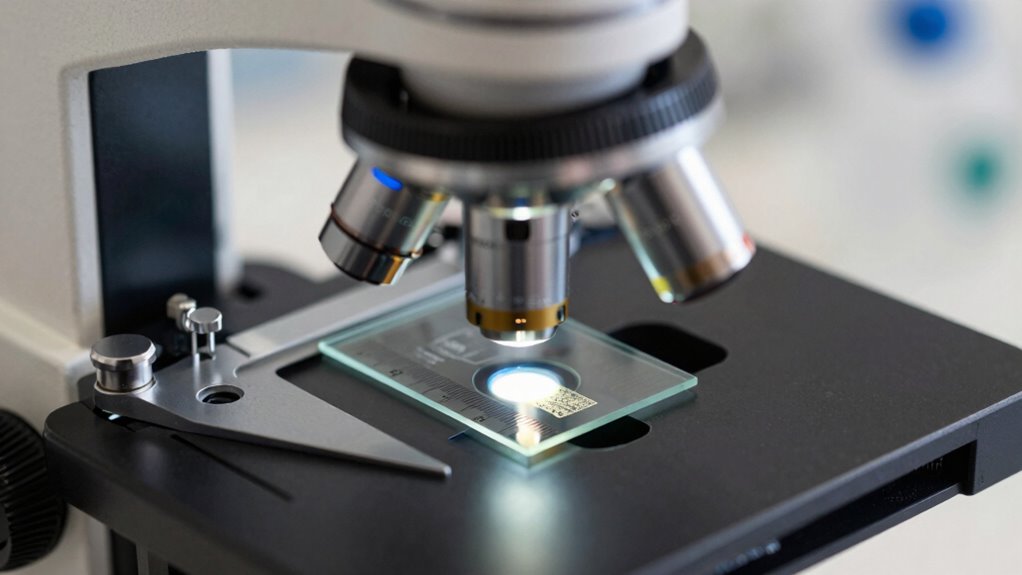
To achieve accurate measurements under a microscope, you need to utilize calibration and scale bars effectively. Calibration standards are essential for translating the image’s apparent size into real-world units. First, you calibrate your microscope using a calibration standard with a known measurement, such as a stage micrometer. Once calibrated, you can add scale bars to your images, providing a visual reference for size. These scale bars represent a specific length in the sample, making measurements consistent and reliable. Always guarantee your calibration standards are precise and up-to-date, as inaccuracies here will affect every measurement you take. Understanding projector contrast ratios can help ensure your visual measurements are accurate when correlating microscopic images with display outputs. Additionally, integrating connected fitness technology can enhance your training by providing real-time measurement feedback, ensuring your observations are both precise and meaningful. By properly using calibration standards and scale bars, you ensure your measurements are accurate, consistent, and scientifically valid.
Common Mistakes When Estimating Sizes Under a Microscope

Even with proper calibration and scale bars in place, several common mistakes can lead to inaccurate size estimations under a microscope. One major error is ignoring eye strain, which can cause you to misjudge the size due to fatigue or blurred vision. Prolonged sessions without breaks make it harder to stay precise. Calibration errors are also frequent; if your microscope isn’t properly calibrated or if the scale bar isn’t correctly aligned, measurements will be off. Additionally, inconsistent focusing or changing magnifications without recalibrating can distort size estimates. These mistakes often lead to under- or overestimating specimens, compromising your results. To avoid this, always take regular breaks, double-check calibration settings, and verify your scale bars are correctly aligned before making measurements.
Tips for Getting Accurate and Reliable Measurements

Achieving accurate and reliable measurements under a microscope requires careful attention to detail and consistent techniques. To improve measurement accuracy, always calibrate your digital magnification tools before starting. Use a stage micrometer for precise calibration and verify your digital magnification settings regularly. Keep your microscope clean and properly aligned to prevent distortions. When measuring, record the scale factor and double-check calculations. For clarity, refer to this quick guide:
| Tip | Action | Benefit |
|---|---|---|
| Calibrate regularly | Use a stage micrometer | Ensures measurement accuracy |
| Maintain cleanliness | Clean lenses and slides | Prevents distortions |
| Verify magnification | Recheck digital zoom settings | Maintains consistency in results |
In addition, understanding the foundational principles behind food and measurement can help you interpret results more effectively, much like understanding culinary fundamentals enhances cooking skills. Regularly practicing microscope techniques can further improve your measurement consistency. To further ensure precision, consider using calibration tools regularly to maintain measurement standards. Incorporating proper measurement procedures is essential for producing trustworthy data. Paying attention to body jewelry measurements and materials can also help in fields that require precise sizing, such as piercings. Following these tips helps guarantee your measurements are both accurate and reliable.
Frequently Asked Questions
How Do I Choose the Right Microscope for Measurement Tasks?
To select the appropriate microscope for measurement tasks, start with your required magnification selection based on sample size and detail. Guarantee your sample preparation is suitable for the microscope type, like clean slides for optical microscopes or proper staining. Opt for a microscope with precise focusing and measurement tools, such as reticles or digital readouts. Consider your budget and the microscope’s compatibility with your specific measurement needs to make an informed decision.
What Are the Limitations of Digital Measurement Tools?
Digital measurement tools offer great digital precision, but they have limitations. You might find that software limitations can affect accuracy, especially with complex or irregular samples. Calibration errors and resolution constraints can also skew results. Additionally, lighting conditions and user skill impact measurement quality. While digital tools are convenient, understanding these limitations helps you avoid over-relying on them and guarantees more reliable measurement outcomes.
Can Environmental Factors Affect Measurement Accuracy?
Environmental factors can definitely influence your measurement accuracy. Fluctuations in temperature, humidity, and vibrations can disrupt environmental stability, leading to less precise measurements. You should maintain a controlled environment to guarantee measurement precision. By minimizing these external influences, you improve the reliability of your readings, especially when working with sensitive equipment. Regular calibration and stable conditions are key to achieving consistent, accurate measurements in your microscopy work.
How Often Should Calibration Be Performed?
You should perform calibration regularly, ideally aligned with your maintenance schedules, to guarantee measurement accuracy. The calibration frequency depends on how often you use the microscope and the precision required for your work. For routine use, calibrate at least once a month, but if you handle critical measurements, consider more frequent calibrations. Maintaining consistent calibration helps prevent errors and keeps your equipment reliable over time.
Are There Specific Techniques for Measuring Biological Specimens?
When measuring biological specimens, you should use specific techniques like proper sample preparation to guarantee accurate measurement precision. Carefully mount your samples to avoid distortion, and use calibration tools for consistent results. Employing consistent lighting and focusing techniques also helps. Avoid relying solely on the zoom feature; instead, use the microscope’s measurement tools and reference scales for precise, reliable measurements that reflect the true size of your biological specimens.
Conclusion
Remember, relying solely on zoom is like using a ruler without markings—you’re missing the full picture. To measure tiny objects accurately, you need proper calibration, scale bars, and careful techniques. Think of your microscope as a trusted compass guiding you through uncharted territory; with the right tools and attention, you’ll navigate measurements confidently. Master these basics, and you’ll transform your microscope from just a magnifier into a precise measurement tool.