Augmented reality helps you visualize geometry directly in your real environment by overlaying digital shapes and structures onto physical space. With AR tools, you can see how objects, angles, and spatial relationships fit and interact in real time, making complex concepts easier to understand. It transforms abstract and 3D mathematical ideas into tangible experiences right before your eyes. Keep exploring to discover how AR can deepen your understanding of geometry in everyday settings.

Prime made for students and young adults
- Fast, free delivery for dorm and study essentials
- Prime Video and Amazon Music included
- Member-only deals
Key Takeaways
- AR overlays 3D geometric models onto real-world environments for intuitive visualization and spatial understanding.
- It enables interactive exploration of shapes, angles, and measurements directly within physical spaces.
- AR tools assist in designing and adjusting structures by projecting geometric concepts onto actual surroundings.
- Visualizing complex geometries in context helps learners grasp spatial relationships more effectively.
- AR enhances architecture, engineering, and education by blending digital geometry with real-world views.
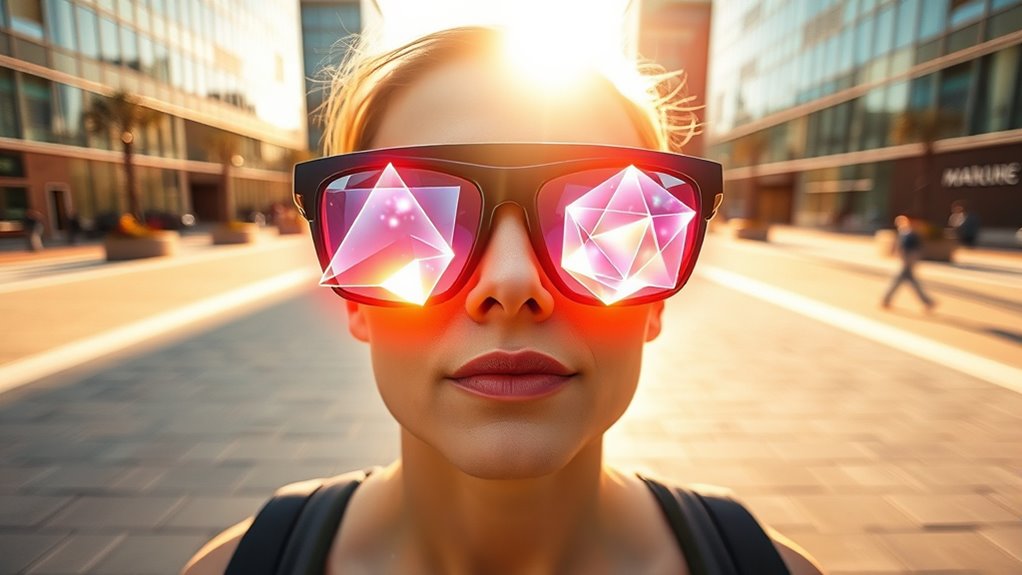
Have you ever wondered how digital images and information can seamlessly blend with the real world? That’s the magic of augmented reality (AR), a technology that overlays computer-generated visuals onto your view of the physical environment. As you look through your smartphone or AR glasses, virtual objects appear to coexist with real-world surroundings, creating a layered experience that enhances how you perceive and interact with space. This integration isn’t just a gimmick; it’s transforming fields like education, design, and entertainment by making abstract concepts tangible and accessible.
One of the most engaging ways AR is changing how we learn and explore is through interactive tutorials. Instead of reading static instructions or watching videos, you can now follow step-by-step guidance overlaid directly onto real objects or environments. Imagine learning to assemble a complex piece of machinery or craft a piece of furniture while seeing the exact placement of each component right in front of you. These interactive tutorials leverage AR’s ability to provide contextual information precisely where you need it, reducing confusion and speeding up the learning process. They turn passive learning into an active, immersive experience, making complex concepts easier to grasp.
AR transforms learning with interactive tutorials that overlay guidance directly onto real objects, making complex concepts easier to grasp.
Design applications are another area where AR’s influence is profound. As a designer, you can visualize your ideas in real-world settings before committing to a final product. Instead of imagining how a new piece of furniture or a building will look, AR allows you to project it into your actual space. This capability helps you evaluate proportions, colors, and placement more accurately, saving time and resources. When working on interior design, for instance, you can walk around with your device and see how different color schemes or furniture arrangements look in real-time. It’s an intuitive way to make adjustments on the fly, ensuring your vision aligns perfectly with reality. These design applications not only streamline workflows but also inspire creativity, as they enable you to experiment freely without the need for physical prototypes.
In essence, augmented reality bridges the gap between digital and physical worlds, offering a richer, more interactive way to learn, create, and explore. Whether through interactive tutorials that teach you new skills or design applications that visualize your ideas in real space, AR empowers you to see possibilities beyond traditional boundaries. It transforms how you perceive and manipulate your environment, making the abstract concrete and the complex simple. This seamless blend of digital images and real-world context is opening up new horizons, turning everyday experiences into extraordinary ones. Understanding the role of emotional support can further enhance your experience when facing challenges in adopting new technologies.
augmented reality geometry visualization glasses
As an affiliate, we earn on qualifying purchases.
As an affiliate, we earn on qualifying purchases.
Frequently Asked Questions
How Does Augmented Reality Enhance Geometric Learning Experiences?
Augmented reality enhances geometric learning by providing interactive models that you can explore in your real environment. It improves your spatial understanding by allowing you to see and manipulate 3D shapes and angles firsthand. With AR, you actively engage with geometric concepts, making abstract ideas concrete and easier to grasp. This hands-on approach boosts your comprehension, making learning more immersive and enjoyable.
What Devices Are Best for Augmented Reality Geometry Applications?
Like Icarus reaching for the sun, you should choose the best AR devices for your journey. AR headsets, such as Microsoft HoloLens or Magic Leap, offer immersive experiences ideal for detailed geometry visualization. Mobile devices, including high-end smartphones and tablets, provide portability and ease of use for quick learning. Both options enhance your understanding—just pick the device that aligns with your goals and comfort level.
Can Augmented Reality Be Used for Professional Engineering Design?
Yes, you can use augmented reality for professional engineering design. AR hardware enhances engineering workflows by allowing you to visualize complex geometries in real-world environments. You can interact with 3D models directly, make adjustments on the spot, and improve collaboration with team members. This technology streamlines the design process, reduces errors, and speeds up decision-making, making it a valuable tool for modern engineers.
How Accurate Is Augmented Reality in Visualizing Complex Geometrical Models?
Augmented reality offers high precision accuracy in visualizing complex geometrical models, but calibration challenges can affect its effectiveness. You may find that small misalignments occur if devices aren’t properly calibrated, leading to less accurate representations. However, with ongoing improvements in hardware and calibration techniques, AR’s precision accuracy continues to improve, making it a valuable tool for visualizing intricate models with increasing reliability.
What ARe the Future Developments Expected in AR for Geometry Visualization?
Like Da Vinci exploring new perspectives, you’ll see AR evolve with hardware innovations that make visualization seamless and more immersive. AI integration will enhance accuracy, enabling real-time adjustments and smarter model interactions. Future developments include lightweight headsets, improved depth sensing, and more intuitive interfaces, empowering you to explore complex geometries effortlessly. These advancements will bridge the digital and physical worlds, transforming how you learn, design, and innovate in geometry visualization.
AR educational kits for geometry
As an affiliate, we earn on qualifying purchases.
As an affiliate, we earn on qualifying purchases.
Conclusion
As you step into the world of augmented reality, imagine your surroundings transforming into a canvas where geometry comes alive like colorful paint splashed across a blank wall. With each glance, complex shapes and structures appear effortlessly, turning your environment into a three-dimensional playground of discovery. This fusion of digital and real worlds paints a vivid picture of limitless possibilities, where understanding geometry isn’t just a concept—it’s an immersive adventure waiting to unfold right before your eyes.
As an affiliate, we earn on qualifying purchases.
As an affiliate, we earn on qualifying purchases.
Halloween Picks
halloween
As an affiliate, we earn on qualifying purchases.