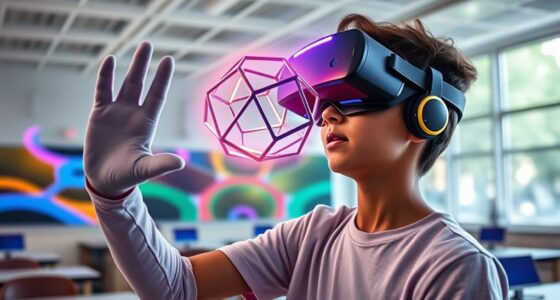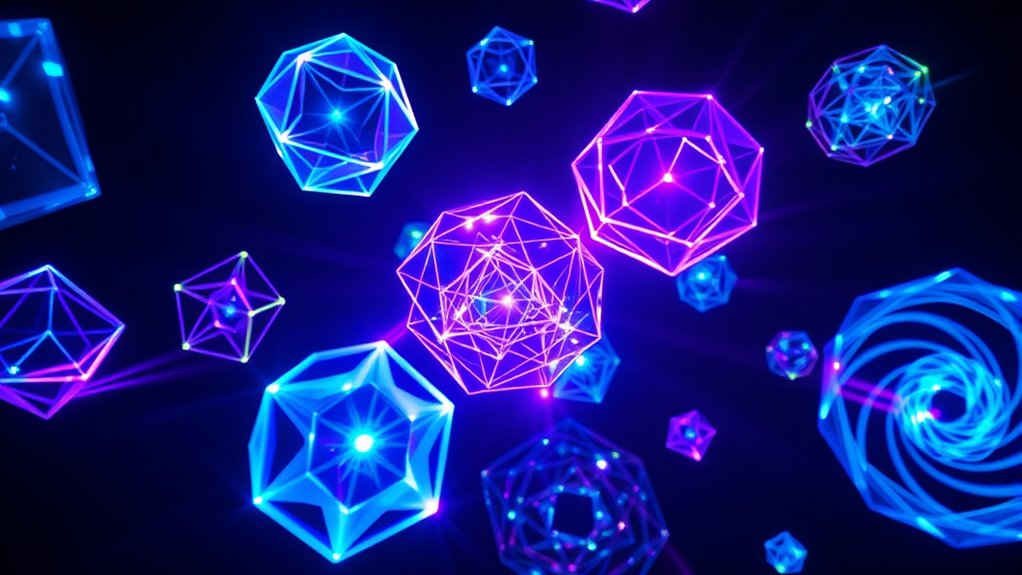

Holograms and geometry work together to let you visualize shapes in 3D light by using light diffraction and interference patterns. When you view a hologram, the surface structures manipulate light waves, creating intricate patterns that encode the shape and depth of objects. Geometric transformations, like rotations and translations, help the hologram shift perspective, making the images appear realistic from different angles. Continue exploring to understand how precise geometric principles shape these stunning 3D illusions.

Prime made for students and young adults
- Fast, free delivery for dorm and study essentials
- Prime Video and Amazon Music included
- Member-only deals
Key Takeaways
- Holograms utilize diffraction patterns shaped by geometric surface structures to encode 3D shapes and spatial relationships.
- Geometric transformations like rotation and scaling maintain perspective and enhance 3D visualization from different viewpoints.
- Precise control of light diffraction enables accurate rendering of complex shapes and textures in holographic images.
- The integration of optics and geometry allows dynamic manipulation of holograms, creating realistic three-dimensional illusions.
- Geometric principles guide the design of hologram surfaces to ensure consistent, multi-angle visualization of 3D objects.
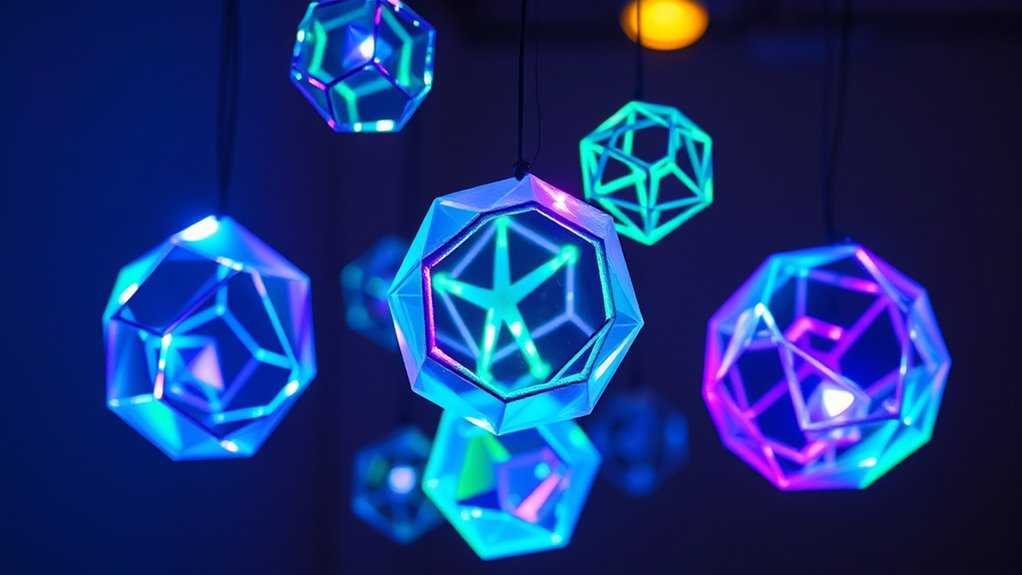
Holograms, with their three-dimensional illusions, challenge our understanding of space and form by blending advanced optics with geometric principles. When you observe a hologram, you’re witnessing how light diffraction plays a pivotal role in creating those stunning visual effects. Light diffraction occurs when light waves bend around tiny structures within the hologram’s surface, causing interference patterns that encode the image’s depth and shape. These interference patterns manipulate the light’s path, reconstructing the illusion of a solid object floating in space. This process relies on precise control of diffraction to produce sharp, realistic images that seem to extend beyond the flat surface. As you move around a hologram, you notice how the image shifts and changes, highlighting the importance of geometric transformations in maintaining perspective. These transformations—rotations, translations, and scaling—allow the hologram to adapt dynamically to your viewpoint, giving you a true sense of three-dimensionality. Fundamentally, the hologram’s design involves mapping the geometric relationships of the object onto a surface that directs light in specific ways, ensuring the illusion holds from different angles.
Understanding the interplay of diffraction and geometric transformations helps you appreciate the complexity behind hologram creation. The diffraction pattern isn’t static; it’s shaped by the geometry of the holographic surface and the arrangement of its internal structures. When light passes through or reflects off these structures, it undergoes transformations that encode the shape’s contours and spatial relationships. The precise positioning of these features determines how the light diffracts, ultimately influencing the clarity and realism of the hologram. This geometric encoding allows for the recreation of intricate shapes and textures in three dimensions, which you can explore from various perspectives just as if the object were physically present. Additionally, the geometric principles involved in holography are fundamental to ensuring the accurate representation of complex forms in three-dimensional space.
The process of generating holograms demonstrates a seamless fusion of optical physics and geometry. It’s not just about projecting a flat image; it’s about manipulating light through diffraction to produce a convincing three-dimensional form. As you study how light interacts with holographic surfaces, you realize that geometric transformations are integral to controlling how images appear and move in space. Whether scaling up a miniature model or rotating a complex shape, your understanding of these principles helps you grasp how holograms can depict both simple and complex shapes with astonishing accuracy. This synergy between diffraction and geometry doesn’t just create visual illusions—it expands the very way you see and interpret the physical world in three dimensions.
As an affiliate, we earn on qualifying purchases.
Frequently Asked Questions
How Do Holograms Change Perception of Three-Dimensional Space?
Holograms change your perception of three-dimensional space by creating a perception shift, making objects appear fully three-dimensional and floating in real space. This enhances your spatial awareness, as you can view shapes from multiple angles without physical contact. By adding depth and realism, holograms allow you to better understand complex structures, transforming your experience of space and making digital objects seem more tangible and integrated into your environment.
Can Holograms Be Used to Teach Complex Geometric Concepts Effectively?
You can definitely use holograms to teach complex geometric concepts effectively; they’re a real game changer. Holograms promote interactive learning, allowing students to manipulate and explore shapes in 3D space firsthand. This hands-on approach enhances spatial understanding, making abstract ideas more concrete. With holograms, you’ll find students grasp challenging concepts quicker and retain information longer, proving that seeing is indeed believing when it comes to learning geometry.
What Are the Limitations of Current Hologram Technology in Geometric Visualization?
You’ll find that current hologram technology faces limitations in geometric visualization due to material resolution and depth accuracy. Low resolution can make detailed shapes appear blurry or indistinct, reducing clarity. Additionally, depth accuracy issues can distort spatial relationships, making it harder to interpret complex structures precisely. These factors hinder the ability to fully represent intricate geometric concepts, though ongoing advancements aim to improve hologram fidelity for education and visualization.
How Do Holograms Differ From Traditional 3D Models in Geometry?
A picture is worth a thousand words, especially with holograms. Unlike traditional 3D models, holograms provide real-time, interactive depth perception, enhancing your spatial awareness. They float in space, allowing you to view shapes from multiple angles without screens or glasses. This immersive experience makes holograms more dynamic, engaging, and intuitive, whereas traditional models often lack the depth and immediacy that holograms bring to understanding complex geometries.
Are There Ethical Concerns Related to Holographic Representations of Shapes?
Yes, there are ethical concerns with holographic representations of shapes. You might worry about privacy concerns if holograms reveal sensitive or proprietary designs without permission. Additionally, intellectual property issues arise if creators’ 3D shapes are copied or used without authorization. It’s important to guarantee holographic technology respects privacy rights and protects intellectual property to prevent misuse and uphold ethical standards.
As an affiliate, we earn on qualifying purchases.
Conclusion
As you explore the world of holograms and geometry, you’ll find that light gently guides you through a universe of shapes and forms. Though the technology is still unfolding, it’s like peering into a softly lit window of endless possibilities. With each new discovery, you’re quietly expanding your understanding, appreciating the elegance in how light and space dance together. Embrace this journey, knowing that brighter horizons are just around the corner.
As an affiliate, we earn on qualifying purchases.
As an affiliate, we earn on qualifying purchases.
Fall Picks
fall essentials
As an affiliate, we earn on qualifying purchases.