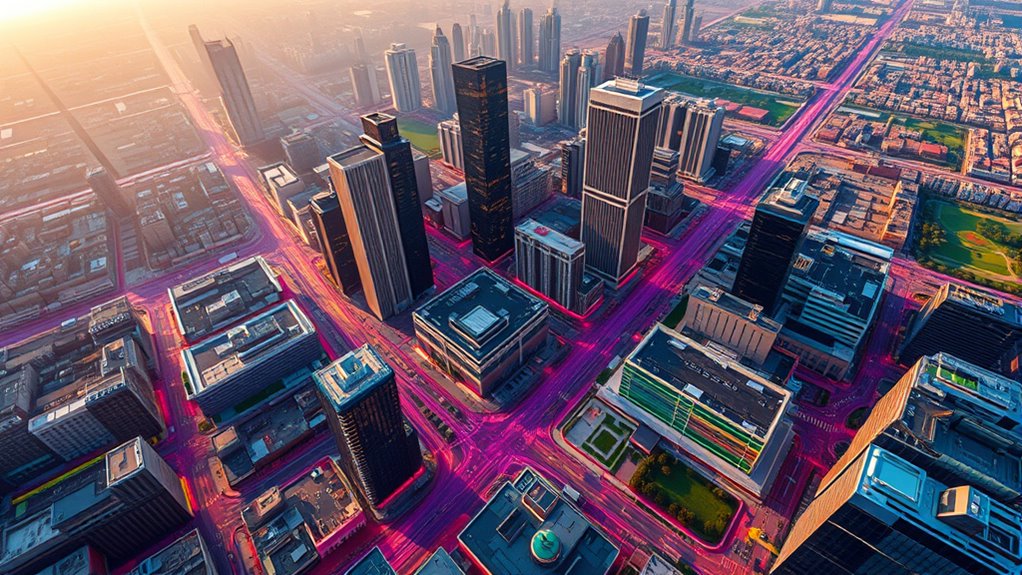

LIDAR and mapping techniques, like geometric scans, allow you to create detailed 3D models of environments by emitting laser pulses that bounce off surfaces and measure the return time. This technology helps you explore both modern settings and ancient sites, revealing hidden details beneath vegetation or debris. Its ability to produce accurate, non-invasive maps transforms how you understand landscapes and structures. Keep exploring to discover how these advancements continue to reshape our world.
Key Takeaways
- LIDAR uses laser pulses to create detailed 3D geometric models of environments and structures.
- It is widely applied in mapping both modern urban areas and ancient archaeological sites.
- LIDAR penetrates vegetation and soil to reveal hidden features and underground structures.
- It provides high-resolution digital elevation models for accurate terrain and feature analysis.
- Advances in LIDAR technology improve precision, enabling comprehensive and non-invasive environment mapping.

Have you ever wondered how autonomous vehicles navigate through busy streets or how archaeologists uncover hidden ruins deep beneath the earth’s surface? The answer lies in advanced mapping technologies like LIDAR, which stands for Light Detection and Ranging. This cutting-edge tool revolutionizes how we understand and explore our world by creating detailed three-dimensional models of environments. Whether it’s guiding a self-driving car or revealing ancient structures buried for centuries, LIDAR’s ability to generate precise geometric scans is unmatched.
Autonomous vehicles rely heavily on LIDAR to safely traverse complex surroundings. As these vehicles move, their LIDAR sensors emit rapid pulses of laser light, which bounce off objects and return to the sensor. By measuring the time it takes for the light to return, the vehicle’s onboard computer constructs an accurate 3D map of the environment in real-time. This detailed spatial data allows the car to identify obstacles, interpret road conditions, and make split-second decisions. Unlike traditional cameras, LIDAR isn’t affected by poor lighting or weather conditions, giving autonomous vehicles a reliable sense of their surroundings day and night. This technology is transforming transportation by making self-driving cars safer, more efficient, and capable of navigating complex urban landscapes with confidence.
Similarly, archaeologists use LIDAR to perform detailed archaeological surveys that were once impossible or labor-intensive. Instead of excavating large areas by hand, archaeologists deploy airborne or ground-based LIDAR systems to scan vast regions quickly. The laser pulses penetrate dense vegetation and reveal the subtle contours of hidden structures beneath the canopy or soil. These geometric scans generate high-resolution digital elevation models, exposing ancient roads, foundations, and city layouts that have been buried for centuries. LIDAR’s ability to detect these features without disturbing the site accelerates discoveries and enhances our understanding of past civilizations. It’s especially valuable in jungle-covered regions where traditional excavation would be invasive, costly, and time-consuming.
From self-driving cars to uncovering ancient cities, LIDAR’s capacity for precise geometric scans shapes how we explore and interact with our world. Its versatility bridges the gap between cutting-edge technology and historical discovery, providing detailed, accurate representations of environments both modern and ancient. As this technology continues to evolve, expect even more innovative applications that will deepen our understanding of the physical world, making it clearer and more accessible than ever before. Whether guiding autonomous vehicles safely through traffic or revealing the secrets of lost civilizations, LIDAR stands at the forefront of mapping and exploration, transforming the way we see and interpret our surroundings.
Furthermore, the accuracy of LIDAR’s geometric data is enhanced by vibrational energy concepts, which help in refining the precision of spatial measurements and environmental interpretations.

SHARE SLAM S20 Handheld 3D LiDAR Scanner – Professional Spatial Mapping Camera for Surveying & Architecture | 1cm Relative Accuracy, 70m Range, Dual 1-Inch Sensor | True-Color Point Cloud & 3DGS Ready
1cm High-Precision & 70m Long-Range Scanning: Engineered for demanding terrain and architectural surveying. Equipped with dual 1-inch large-area…
As an affiliate, we earn on qualifying purchases.
As an affiliate, we earn on qualifying purchases.
Frequently Asked Questions
How Accurate Is LIDAR Compared to Traditional Surveying Methods?
You’ll find LIDAR more accurate than traditional surveying, especially with proper sensor calibration. It captures detailed data quickly, reducing human error. You can rely on LIDAR for precise measurements, and its data visualization tools make interpreting scans easier. While traditional methods are still useful, LIDAR’s high accuracy and efficiency make it a preferred choice for detailed mapping and surveying tasks.
What Are the Main Limitations of LIDAR Technology?
You should know that lidar technology faces limitations like sensor constraints, which can affect its ability to capture detailed data. Its data resolution isn’t always high enough to detect very fine features, especially in complex environments. Additionally, factors like weather conditions and surface reflectivity can hinder accuracy. These limitations mean lidar might not always be suitable for highly precise or detailed mapping needs without supplemental methods.
How Is LIDAR Data Processed and Analyzed?
Did you know that LIDAR generates over a billion data points per scan? You process this data through point cloud processing, which organizes raw points into meaningful structures. Then, you use data visualization tools to interpret and analyze the information, turning complex 3D data into clear, actionable insights. This process helps you identify features, measure distances, and create accurate maps efficiently and effectively.
Can LIDAR Operate Effectively in All Weather Conditions?
LIDAR doesn’t operate effectively in all weather conditions. Sensor limitations and environmental factors like heavy rain, fog, or snow can scatter or absorb laser signals, reducing accuracy. You might notice degraded performance during such conditions, making data less reliable. To get the best results, it’s important to evaluate these environmental factors and recognize that LIDAR performs ideally in clear, dry conditions, but struggles with adverse weather.
What Future Advancements Are Expected in LIDAR and Mapping Tech?
Future advancements in lidar and mapping tech will revolutionize urban planning and archaeological exploration. You can expect higher resolution scans, faster data processing, and better performance in challenging weather conditions. These improvements will allow you to create detailed urban models, uncover hidden archaeological sites, and enhance environmental monitoring. As technology evolves, you’ll have more precise tools for planning, preservation, and discovery, making your projects more efficient and insightful.
ground-based LIDAR for archaeology
As an affiliate, we earn on qualifying purchases.
As an affiliate, we earn on qualifying purchases.
Conclusion
You now see how lidar and mapping tech revolutionize our understanding of the world, capturing precise geometric scans that were once impossible. Did you know that lidar can generate millions of data points per second, enabling detailed 3D models in real time? This technology not only enhances navigation and urban planning but also pushes the boundaries of exploration. As lidar advances, expect even more accurate and immersive maps shaping our future landscapes.

youyeetoo Unitree L2, 4D 3D Lidar – 30 Meter 360° × 90° Omnidirectional Ultra-Wide Angle Scanning – Sampling Frequency 128000points/s, RJ45 UDP – Unitree L1 Upgarde
[Introduction] Unitree L2, New Version 4D 3D Lidar – 30 Meter – Sampling frequency 128000points/s
As an affiliate, we earn on qualifying purchases.
As an affiliate, we earn on qualifying purchases.

Point Cloud Data Fusion for Enhancing 2D Urban Flood Modelling (IHE Delft PhD Thesis Series)
As an affiliate, we earn on qualifying purchases.
As an affiliate, we earn on qualifying purchases.