
TL;DR

Prime made for students and young adults
- Fast, free delivery for dorm and study essentials
- Prime Video and Amazon Music included
- Member-only deals
IdeaClyst acts as a digital war room, giving founders a structured space to pressure-test ideas, find new opportunities, and plan confidently. It’s a local-first tool, developed privately and not publicly available, that keeps your ideas secure and organized.
Imagine you’re staring at three promising ideas, each with its own set of dreams and doubts. The build part is easy these days—thanks to AI and rapid prototyping. But choosing which idea to chase? That’s the real challenge. It’s the difference between launching a hit or sinking months into a flop.
That’s where IdeaClyst steps in. It’s not just a tool—it’s a dedicated war room for your most expensive, most important decision: which idea deserves your time, energy, and resources. In this article, we’ll explore how this digital war room helps founders cut through the noise and make smarter bets that stick.
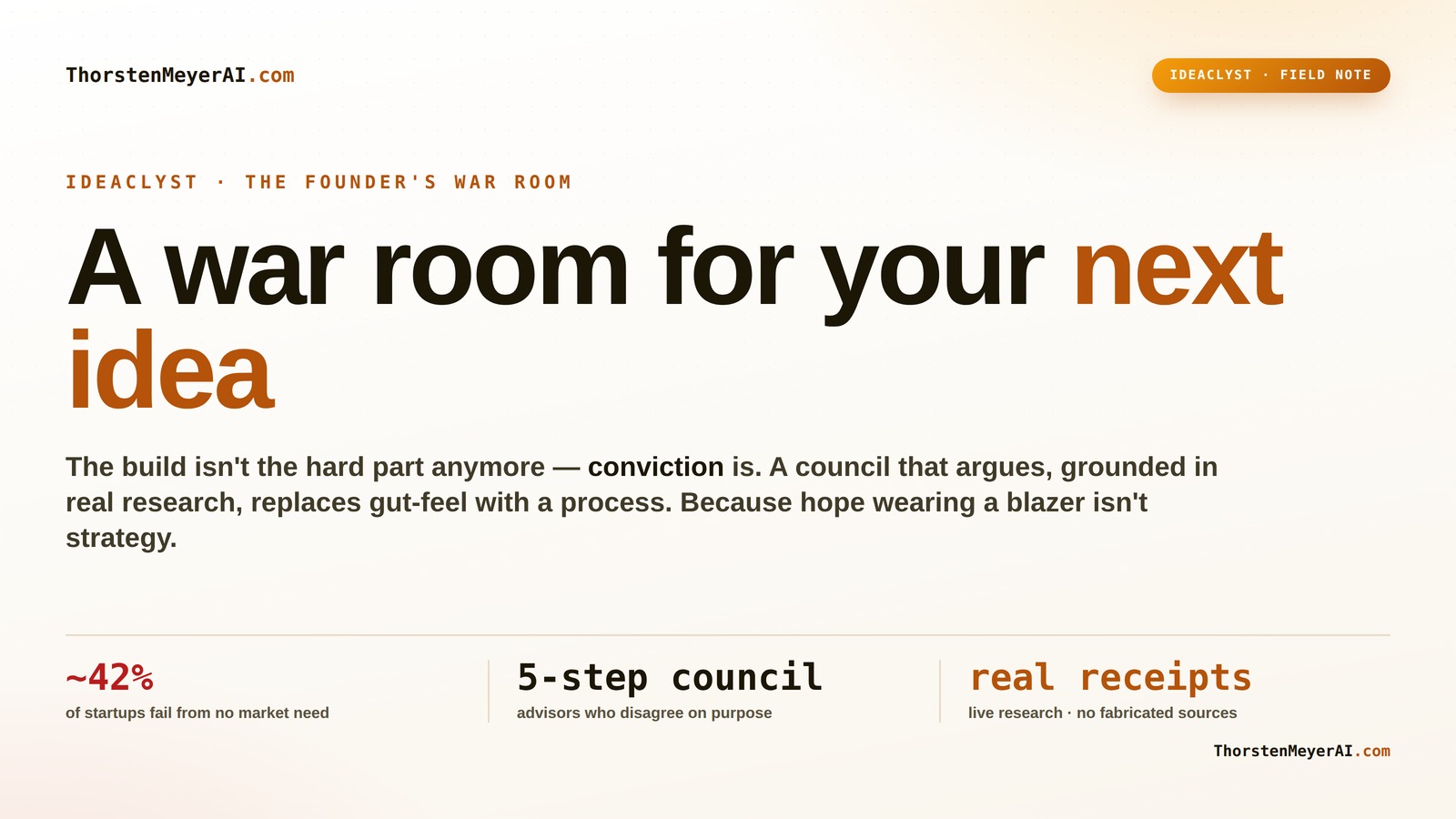
A war room for your next idea
The build isn’t the hard part anymore — conviction is. Knowing which idea deserves the next six months, and being able to defend it. Most founders answer with gut feel and optimistic math. That’s hope wearing a blazer. IdeaClyst replaces it with a process.
The most expensive decision is what to build
The single most valuable thing a tool can do is talk you out of the wrong six months. The numbers make the case better than any pitch.
Three tools in one — on your own machine
Strip away the framing and IdeaClyst is three things at once, all running locally with nothing leaving your laptop.
An AI council
Pressure-tests an idea you bring it — advisors who argue on purpose.
A discovery engine
Finds ideas you didn’t know to look for by hunting real demand signals.
A founder’s workspace
Carries winners from “interesting” all the way to “ready to build.”
Advisors who disagree on purpose
Not one confident, agreeable answer — a structured five-step deliberation where models play different roles and turn on their own work. The disagreement is the feature.
The five-step deliberation
A council that leads with the bad news surfaces the objections you’d otherwise find the expensive way, on month five.
Product strategy
Who’s it for, what’s the wedge, why now, what’s the business model.
Technical architecture
What would it actually take to build — and where’s the risk.
Critique pass
The council turns on its own work. Where’s the hand-waving? What kills this?
Second, independent critique
A different voice, a different angle — so blind spots don’t survive.
Final synthesis
Everything into one coherent founder packet: strategy, architecture, validation, plan.
When IdeaClyst cites a source, it actually fetched it
The hard departure from “ask an AI what it thinks of my startup.” It runs in a strict, real-data-only mode — if it can’t gather genuine evidence, it says so plainly rather than inventing a plausible paragraph.
Confidence with receipts
No fabricated statistics, no imaginary competitors, no made-up citations. The packet survives a skeptical co-founder or a sharp investor because the reasoning has receipts.
Market research first
Scouts the landscape before the council reasons about anything.
Competitor read
Real positioning, pricing signals, feature claims — differentiation vs. reality.
Validation with links
Not “talk to customers” — concrete signals & sources you can click.
From the blank page to build-ready
Evaluation is half the problem; the blank page is the other half. And a plan is worthless if it dies in a tab you never reopen.
Bring a space, not an idea
“AI for accountants,” “tools for indie game studios” — plus your goal and real capacity. It hunts demand signals across HN, Reddit, Product Hunt, GitHub, pricing pages.
- An honest market read — leads with the bad news when a space is hard
- An opportunity map — high pain, thin competition
- Ranked candidates — wedge, who pays, effort, risk, confidence
- each with KILL CRITERIA — when to walk away
A home and a forward path
Every promising idea gets carried forward, with every artifact in plain files on your disk.
- Validation tooling — sprint board, interview list, evidence browser
- Founder profile — a personal-fit lens; same discovery, different advice
- Build workspaces — funnel, personas, landing draft, version history
- “Build this idea” → a PRD + task queue, ready for a coding agent
What Is a War Room for Ideas — and Why You Need One
A war room isn’t just a war room anymore. It’s a dedicated space—physical or digital—where teams gather to focus on a single goal. Think of it as the command center for your startup’s future. It’s where you keep all your intel, track your progress, and make critical decisions with clarity.
For founders, a war room is like having your own battle map. It keeps the chaos of multiple ideas from spiraling out of control. Instead, you have a clear hub for testing assumptions, spotting risks, and rallying your team around the best move. It’s the difference between flying blind and steering with purpose.
Why does this matter? Because startups often face uncertainty and rapid change. A dedicated war room fosters discipline and focus—allowing teams to confront assumptions head-on, identify weak points early, and pivot swiftly. It transforms guesswork into strategic moves, reducing costly mistakes and increasing the likelihood of success.
As an affiliate, we earn on qualifying purchases.
Why a Digital War Room Like IdeaClyst Changes the Game
Traditional war rooms are often physical spaces—whiteboards, sticky notes, and late-night strategy sessions. But for modern founders, a digital war room offers unmatched flexibility. And here’s the kicker: IdeaClyst isn’t just a digital space; it’s a local-first tool, developed privately and not publicly available, that keeps your ideas on your own machine.
Picture this: You’re brainstorming at 2 a.m., and suddenly a new angle strikes you. With IdeaClyst, you jot it down, and it becomes part of a structured debate involving AI models that challenge your assumptions. No cloud, no data leaks—just your raw, valuable ideas safe on your laptop.
This approach matters because it balances flexibility with control. Digital tools allow you to iterate quickly, access your war room from anywhere, and collaborate asynchronously. The local-first design enhances security, ensuring sensitive ideas aren’t vulnerable to breaches or leaks. It also means you’re not dependent on internet connectivity or cloud providers, giving you full control over your strategic assets. This flexibility and security enable founders to experiment more freely, make faster decisions, and maintain ownership of their data—crucial advantages in competitive environments.
As an affiliate, we earn on qualifying purchases.
How IdeaClyst’s AI Council Turns Ideas into Battle-Tested Strategies
IdeaClyst’s core strength is its AI council—a team of models that debate your idea from different angles. Each model takes on a role: product strategist, technical architect, or skeptic. They push back, poke holes, and surface risks.
For example, you might suggest a subscription-based app for pet owners. The council will challenge the target market, question the tech feasibility, and identify hidden assumptions. After five structured steps—strategy, architecture, critique, second critique, and synthesis—you get a comprehensive founder packet, ready for action.
This structured disagreement isn’t just about finding flaws; it’s about uncovering blind spots that might otherwise be overlooked. When multiple models debate your idea, you gain a multi-faceted perspective that reveals both opportunities and vulnerabilities. This process encourages critical thinking, reduces confirmation bias, and leads to more resilient strategies. The result is a more robust plan, built on thorough scrutiny rather than optimistic assumptions, ultimately increasing your chances of success and saving resources in the long run.
As an affiliate, we earn on qualifying purchases.
The Five-Step Process That Turns Ideas Into Actionable Plans
Here’s how IdeaClyst guides your idea through a structured debate to produce a solid plan:
- Strategy: Who’s the customer? What’s the wedge? Why now?
- Architecture: What’s the tech blueprint? Where are the risks?
- Critique: The council tears into the idea—what’s weak or unproven?
- Second Critique: A different model questions the first, catching blind spots.
- Synthesis: All insights merge into a clear, actionable plan, written in Markdown.
This step-by-step process ensures that your idea isn’t just superficially evaluated but deeply scrutinized from multiple angles. Each stage builds upon the previous one, allowing you to identify weaknesses early and refine your approach systematically. The final synthesis consolidates insights into a coherent, prioritized plan, reducing ambiguity and increasing confidence in your next steps. This disciplined process helps prevent costly pivots later and ensures your strategy is grounded in well-validated assumptions, ultimately saving time and resources while boosting your startup’s chances of success.
prototyping and idea testing tools
As an affiliate, we earn on qualifying purchases.
As an affiliate, we earn on qualifying purchases.
Grounded in Reality: How IdeaClyst Validates Without Fluff
Many AI tools sound promising but lack real-world grounding. IdeaClyst stands out because it pulls live web research into the debate, making validation concrete and current. It doesn’t just tell you an idea ‘sounds good’; it shows you the latest market data, competitors, and risks.
For instance, instead of guessing whether a niche market is growing, it fetches real-time stats and recent news, giving you a factual basis for your decision. This approach saves founders from falling for hype or outdated info—saving thousands and months of wasted effort. By integrating live data, IdeaClyst helps you make decisions rooted in reality, rather than assumptions or incomplete information. This means your validation process isn’t just theoretical; it’s backed by current market conditions, enabling you to adapt swiftly to changing landscapes and avoid costly missteps.
Why Local-First Matters for Founders
Unlike cloud-based tools that send your ideas to servers, IdeaClyst runs entirely on your machine. It is developed privately and is not publicly available, meaning your ideas stay private and under your control. This feature isn’t just about privacy—it’s about trust.
Imagine working late on a sensitive project. You don’t want your ideas floating in the cloud where leaks happen. With IdeaClyst, your raw concepts, critiques, and plans remain on your local disk, safe from prying eyes or data breaches. This local-first approach also means you avoid dependency on third-party cloud providers, reducing points of failure and ensuring your strategic data isn’t exposed to external risks. For founders dealing with proprietary technology or confidential market insights, this security model is vital. It empowers you to innovate confidently, knowing your ideas are protected by design, not just policy.
Success Stories: Turning Ideas Into Wins with IdeaClyst
Startups using IdeaClyst report faster decision-making and fewer costly pivots. One founder used it to evaluate a new SaaS feature, catching a flawed assumption early. Instead of building for six months, they pivoted in two weeks—saving over $20,000 and gaining clarity. This demonstrates how early, disciplined validation can prevent wasted effort and steer projects in the right direction from the start.
Another team used the structured critique to refine their target market, leading to a successful beta launch. They credit the war room setup with making their planning sharper, their risks clearer, and their execution smoother. These stories highlight that, beyond theory, IdeaClyst provides tangible, real-world value—helping founders avoid costly mistakes, accelerate development, and ultimately turn ideas into successful businesses.
What Tools Do You Need to Build Your Own War Room (or Use IdeaClyst)
If you’re thinking about setting up your own war room, here’s what you need:
- A laptop or dedicated workstation
- Basic knowledge of Markdown and local file management
- Optional: a simple web browser for live research
- For IdeaClyst users: get started via [https://ideaclyst.com](https://ideaclyst.com)
It’s surprisingly straightforward. Even a solo founder can turn a simple folder structure into a powerful, private war room for strategic debates, risk assessments, and planning. This simplicity allows founders to customize their setup based on their specific needs, balancing ease of use with depth of analysis. Whether you’re a solo entrepreneur or a small team, the core principles of disciplined debate, organized data, and secure storage remain the same—making it accessible and effective for all.
Key Takeaways: How to Make Smarter, Faster Decisions
- Structured debate: Use IdeaClyst’s council to surface weaknesses and hidden risks.
- Ground your validation: Rely on real-time web research, not just model vibes.
- Local-first security: Keep your ideas private and secure, especially with sensitive projects.
- Use the process: Follow the five-step method to turn raw ideas into clear plans.
- Build or buy: Set up your own war room with simple tools or use IdeaClyst for a ready-made solution.
Frequently Asked Questions
What exactly is IdeaClyst?
IdeaClyst is a local-first software that acts as a digital war room for developing, debating, and validating startup ideas. It combines AI-driven council debates with live web research to help founders make smarter decisions.How does the AI council work in IdeaClyst?
It stages structured debates among different AI models, each playing a role like strategist or skeptic. These models challenge your idea from multiple angles, surfacing risks and opportunities you might miss on your own.Should I build my own war room or use IdeaClyst?
If you want a ready-made, privacy-focused tool, IdeaClyst is a perfect choice. For those who prefer DIY, you can set up a simple folder structure on your laptop as a personal war room with basic tools.Why is local-first better for founders?
Running on your own machine keeps your ideas private and reduces the risk of leaks. It also means you’re not dependent on cloud services, giving you full control over your strategic assets.What kind of projects is a war room best for?
Any project that benefits from structured debate, clear planning, and risk assessment. This includes product ideas, market strategies, marketing campaigns, or innovation sprints.Conclusion
In a world where your next idea can make or break your startup, having a dedicated war room isn’t just smart—it’s essential. IdeaClyst offers a disciplined, private space to challenge, validate, and refine your ideas, saving you time and money.
Think of it as your personal command center—where every decision is backed by debate, data, and discipline. With the right tools and mindset, you’ll turn wild guesses into confident moves. Your next big idea deserves a war room. Why not start building yours today?
Fall Picks
fall essentials
As an affiliate, we earn on qualifying purchases.