
When you see “accuracy” in handheld 3D scanners expressed in millimeters, it means how precisely the device captures real-world measurements, not just visual detail. Typically, this ranges from 0.01 to 0.2 mm, depending on the scanner. Several factors like sensor type, calibration, environment, and user skill influence this accuracy. If you want to understand how these details affect your projects, continue exploring the key points behind achieving precise results.
Key Takeaways
- Accuracy indicates how closely the scanned measurements match real-world dimensions, often expressed in millimeters.
- Calibration ensures the scanner’s measurements remain precise over time, reducing errors in millimeter accuracy.
- Higher data resolution captures finer details but can influence measurement precision in millimeters.
- Environmental factors like lighting and surface reflectivity can affect the scanner’s millimeter-level accuracy.
- Actual accuracy depends on scanner technology, calibration, and proper usage, not just the device’s advertised specs.

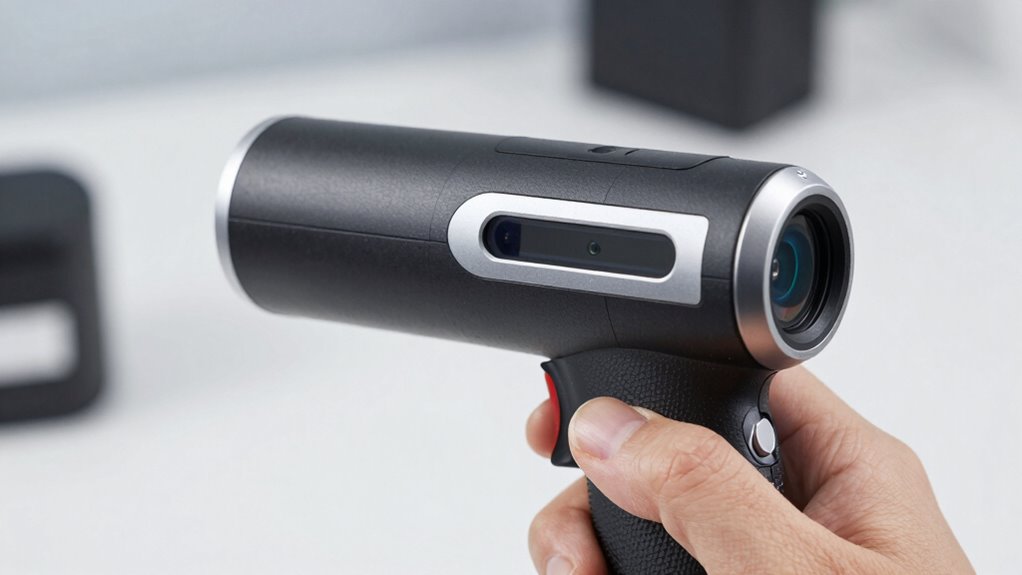
Revopoint MetroY Ultra Laser 3D Scanner for 3D Printing Handheld, 0.01mm Precision, 34+15+1 Blue Laser, Up to 90 FPS Speed, Anti-Shaking, Wireless Outdoor Scanning, Standard Edition
Industrial-Grade Accuracy: Flawlessly capture intricate geometric details with up to a 0.01 mm single-frame precision and 0.015 +…
As an affiliate, we earn on qualifying purchases.
As an affiliate, we earn on qualifying purchases.
What Does “Accuracy” Really Mean in Handheld 3D Scanning?

When it comes to handheld 3D scanners, accuracy isn’t just about how detailed the scan looks; it’s about how precisely the scanner captures real-world measurements. Calibration standards play a vital role here, guaranteeing your device provides consistent, reliable results over time. Proper calibration minimizes errors and aligns the scanner’s data with real-world dimensions. Data resolution also impacts accuracy, as higher resolution captures finer details and smaller features more precisely. Keep in mind, higher data resolution often means larger file sizes, but it results in more accurate measurements. Additionally, the contrast ratio of a projector can influence how well details are distinguished in images, which parallels how calibration and resolution influence measurement precision. Ultimately, understanding how calibration standards and data resolution influence your scanner’s accuracy helps you choose the right device for your needs and ensures your measurements are trustworthy.
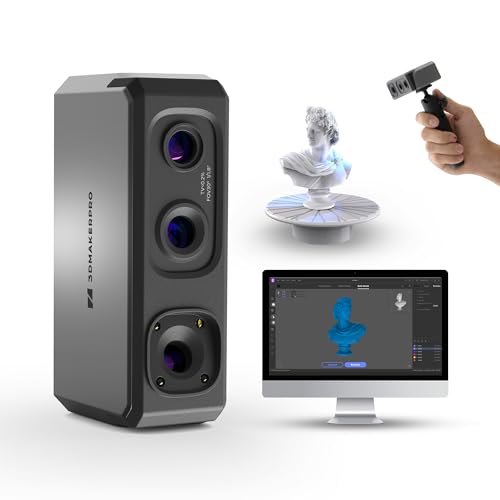
3DMakerpro Handheld 3D Scanner for 3D Printing, 0.02mm Detailed Precision, 10FPS Scanning Lightning-Fast Speed with Anti-Shake Lenses, Portable 3D Scanner for Win10/MacOS -Seal Lite Advanced Version
[Capture Accuracy Precise Details] The 3DMakerpro Seal Lite 3D scanner utilizes refined structured light technology to achieve accuracy…
As an affiliate, we earn on qualifying purchases.
As an affiliate, we earn on qualifying purchases.
How Do We Measure 3D Scanner Accuracy in Millimeters?

Measuring 3D scanner accuracy in millimeters involves comparing the scanner’s captured data to a known reference standard or a highly precise measurement. Calibration techniques guarantee your scanner produces consistent results, reducing errors. Data resolution also impacts accuracy; higher resolutions capture finer details, leading to more precise measurements. To evaluate accuracy, you typically scan a calibration object with known dimensions and compare the results. Here’s a quick overview:
| Calibration Method | Data Resolution | Typical Accuracy Range |
|---|---|---|
| Geometric Calibration | High | 0.05 – 0.2 mm |
| Photogrammetry Calibration | Medium | 0.1 – 0.5 mm |
| Contact Calibration | Very High | 0.01 – 0.05 mm |
| Environmental Calibration | Variable | 0.1 – 0.3 mm |
These methods help you judge how close your scans are to real-world measurements. Understanding the accuracy standards applied in calibration ensures confidence in your measurement results.

Creality Original Calibration Board for 3D Scanner,
Purposes: Designed to improve 3D scanner calibration, this board ensures greater accuracy during the scanning process. It is…
As an affiliate, we earn on qualifying purchases.
As an affiliate, we earn on qualifying purchases.
What Factors Affect the Accuracy of Handheld 3D Scanners?

The accuracy of handheld 3D scanners depends on several key factors. Your choice of scanner technology, the environment you work in, and your own skill level all play vital roles. Understanding these influences helps you get the most precise results. Additionally, brewing methods can impact the way surfaces are captured, affecting the scanner’s performance and the final measurement accuracy. Recognizing how sensor resolution impacts data quality allows users to select the most suitable device for their specific needs. Moreover, environmental conditions such as lighting and surface reflectivity can significantly influence scanning precision.
Scanner Technology Differences
Have you ever wondered what makes some handheld 3D scanners more accurate than others? It all comes down to scanner technology differences. The quality of sensor calibration guarantees precise data collection, reducing errors. Advanced software algorithms process data more effectively, refining the scan’s accuracy. Variations in sensor types—like laser versus structured light—also influence results. Some scanners integrate multiple technologies for superior detail, while others rely on simpler systems. Additionally, sensor calibration techniques are continually evolving to enhance measurement reliability. Improvements in hardware design can further reduce movement-induced errors, ensuring higher precision. Here’s a quick comparison:
| Feature | Impact on Accuracy |
|---|---|
| Sensor calibration | Guarantees reliable, consistent measurements |
| Software algorithms | Improve data processing and precision |
| Sensor type | Affects resolution and detail |
| Data capture speed | Balances accuracy and efficiency |
| Hardware design | Minimizes movement-induced errors |
Understanding these differences helps you choose a scanner that truly meets your accuracy needs. Calibration Methods play a crucial role in ensuring consistent and reliable measurements across different scanning sessions.
Environmental Influences
Environmental conditions can substantially impact the accuracy of handheld 3D scanners, often disrupting their data collection process. Poor or inconsistent lighting conditions make it difficult for the scanner’s sensors to capture precise surface details, leading to errors in the 3D model. Bright sunlight or harsh shadows can interfere with optical systems, reducing measurement accuracy. Additionally, ambient vibrations from nearby machinery, footsteps, or handling can cause slight shifts during scanning, resulting in distorted data. Even small vibrations can affect the scanner’s ability to maintain a stable reference point, especially over prolonged scans. To guarantee the highest accuracy, you should scan in a stable environment with controlled lighting and minimal vibrations, reducing the risk of data inaccuracies and ensuring reliable results. Moreover, understanding the impact of environmental stability helps optimize the scanning process for better performance. Ensuring the scanner is used in an environment with consistent conditions minimizes errors and enhances overall precision. Recognizing how external factors influence the results can help you adapt your setup for optimal accuracy, especially since external influences are a common concern in Gold IRA markets. Additionally, awareness of environmental variability allows for better planning and adjustment during the scanning process, further improving accuracy.
User Skill Impact
Your skill level plays a critical role in the accuracy of handheld 3D scanning, as even small mistakes can lead to significant errors in the final model. User proficiency directly impacts how well you can operate the scanner, maintain a steady hand, and follow proper scanning techniques. Operator training is essential to develop these skills, ensuring you understand how to handle different surfaces and environmental conditions. Without proper training, you might misalign scans, miss details, or introduce noise into the data. Consistent practice improves your ability to scan smoothly and accurately, reducing errors. Additionally, understanding the importance of floating on water can inspire patience and precision during scanning, especially when working in humid or aqueous environments. Proper environmental awareness is also crucial to avoid common pitfalls caused by lighting, temperature, and surface reflectivity. Being aware of ambient conditions helps you adapt your scanning approach to achieve better results. Furthermore, having a solid understanding of personality traits can enhance your ability to stay focused and methodical during complex scanning tasks. Developing a keen sense of environmental factors can further help you anticipate and mitigate potential issues that affect scan quality. Ultimately, your expertise determines how effectively you can minimize common pitfalls and maximize the scanner’s potential, making operator training a pivotal factor in achieving precise, reliable results.
3DMakerpro Handheld 3D Scanner for 3D Printing, 0.02mm Detailed Precision, 10FPS Scanning Lightning-Fast Speed with Anti-Shake Lenses, Portable 3D Scanner for Win10/MacOS -Seal Lite Advanced Version
[Capture Accuracy Precise Details] The 3DMakerpro Seal Lite 3D scanner utilizes refined structured light technology to achieve accuracy…
As an affiliate, we earn on qualifying purchases.
As an affiliate, we earn on qualifying purchases.
What Can I Expect From 3D Scanner Accuracy in Real-World Use?

In real-world use, environmental factors like lighting, surface reflectivity, and movement can affect your scanner’s accuracy. Different scanning modes may also yield varying results depending on the detail and speed you need. Being aware of these variables helps you set realistic expectations for your scans. Additionally, understanding thermal behavior can help optimize the scanner’s performance in different outdoor conditions. For example, surface reflectivity can significantly impact the accuracy of certain scans, especially when dealing with shiny or transparent objects. Recognizing sensor limitations can further assist in choosing the appropriate settings for challenging environments. Moreover, considering ambient conditions, such as temperature and humidity, is essential for achieving consistent results across diverse environments. Awareness of environmental influences can aid in troubleshooting and improving scan quality in unpredictable settings.
Environmental Factors Impact
When using handheld 3D scanners in real-world settings, environmental factors can considerably affect their accuracy. Unfavorable weather conditions, like rain, fog, or strong sunlight, can interfere with the scanner’s sensors and reduce precision. For example, bright sunlight may cause glare, while moisture can distort laser or structured light readings. Ambient noise, though less direct, might impact scanner operation if it triggers automatic adjustments or affects the operator’s stability and focus. Wind can shift your position or cause vibrations, leading to inaccuracies. Overall, unpredictable environmental elements can compromise scan quality, making it essential to control or adapt to your surroundings whenever possible. Expect some variability in accuracy depending on external conditions, and plan your scans accordingly.
Scanner Mode Variability
Different scanner modes are designed to optimize accuracy under specific conditions, but in real-world use, you can expect variability depending on the environment and application. Scanner mode variability affects measurement consistency, as each mode prioritizes different aspects like speed, detail, or range. For example, a mode optimized for rapid scans may sacrifice some precision, while high-resolution modes improve detail but take longer. Your results will fluctuate based on surface reflectivity, distance, and ambient light, making it essential to choose the right mode for your task. Understanding how different modes influence measurement consistency helps you set realistic expectations and select the appropriate settings, ensuring you get the most accurate data possible within the scanner’s limitations.
How Do I Choose a Handheld 3D Scanner Based on Accuracy Needs?

Choosing a handheld 3D scanner hinges largely on your accuracy requirements, as different tasks demand varying levels of precision. To select the right device, consider these factors:
Selecting a handheld 3D scanner depends on your specific accuracy needs and project requirements.
- The scanner’s specified accuracy in millimeters, matching your project’s tolerances
- The calibration procedures, which guarantee consistent precision over time
- The effectiveness of software algorithms that refine scan data and minimize errors
- The discrepancies between advertised accuracy and real-world performance, which can impact your results
Higher-accuracy scanners often have more rigorous calibration routines and advanced software processing. If you need detailed, precise measurements, opt for a device with tight accuracy specs and proven calibration stability. Conversely, for quick, less detailed scans, a lower-accuracy model may suffice. Balancing these factors ensures you pick a scanner aligned with your specific accuracy needs.
Common Myths About 3D Scanner Precision: Debunked

Many people assume that the higher the listed accuracy of a 3D scanner, the better the results will be for all applications. However, this isn’t always true. Factors like sensor calibration and software algorithms play vital roles in real-world precision. A scanner with excellent accuracy specs may still produce poor results if its sensor calibration is off or if its software algorithms aren’t optimized for your specific task. For example, surface complexity or environmental conditions can influence accuracy more than the listed millimeter precision. Understanding measurement reliability helps users select the right equipment for their unique needs.
Frequently Asked Questions
How Does Scanner Accuracy Impact Detailed Model Reconstruction?
You’ll notice that higher scanner accuracy improves detailed model reconstruction by enhancing mesh fidelity and point density. When accuracy is high, the scanner captures fine details more precisely, resulting in smoother, more accurate meshes. Lower accuracy can lead to gaps, distortions, or less detailed models. So, investing in a scanner with better accuracy means you get more reliable data, making your final models clearer, more precise, and true to the original object.
Can Environmental Conditions Alter Measured Accuracy?
Yes, environmental conditions can definitely disturb your scanner’s accuracy. Ambient interference like dust, sunlight, or reflections can distort data, while temperature effects may cause the scanner’s sensors to drift or misalign. These factors can lead to less precise measurements, impacting your detailed model reconstructions. To maintain *best* accuracy, keep your scanning environment controlled, minimize ambient interference, and avoid extreme temperature fluctuations.
What’s the Difference Between Accuracy and Resolution in 3D Scanning?
Accuracy refers to how close your 3D scan measurements are to the true dimensions, which depends on proper sensor calibration and measurement repeatability. Resolution, on the other hand, determines the level of detail your scanner captures, affecting the smallest feature it can detect. While accuracy ensures correctness, resolution affects detail richness. Understanding both helps you select the right scanner for your project’s precision and detail needs.
How Often Should 3D Scanners Be Calibrated for Precision?
You should calibrate your 3D scanner regularly, ideally after every few uses or weekly, depending on how often you operate it. Proper equipment maintenance and consistent calibration frequency guarantee your scans stay accurate and reliable. Keep an eye on manufacturer recommendations, and if you notice deviations or errors, recalibrate immediately. Regular calibration helps maintain precision, minimizes errors, and extends the lifespan of your handheld 3D scanner.
Is Higher Accuracy Always Necessary for Industrial Applications?
You don’t always need the highest precision metrics for industrial applications, but it’s wise to contemplate the specific standards you’re aiming to meet. While increased accuracy can enhance detail, it may not be necessary for every task. Often, balancing precision with efficiency aligns better with industrial standards, ensuring your scans are reliable without over-investing. Ultimately, assess your project requirements to determine if ultra-high accuracy benefits outweigh the costs.
Conclusion
Now that you know what “accuracy” really means in handheld 3D scanning, are you ready to find the perfect scanner for your needs? Remember, understanding how accuracy is measured and what factors influence it helps you make smarter choices. Don’t just chase the smallest millimeters—consider your project’s real-world requirements. After all, isn’t it more exciting to use technology that truly fits your goals than just aiming for perfection?