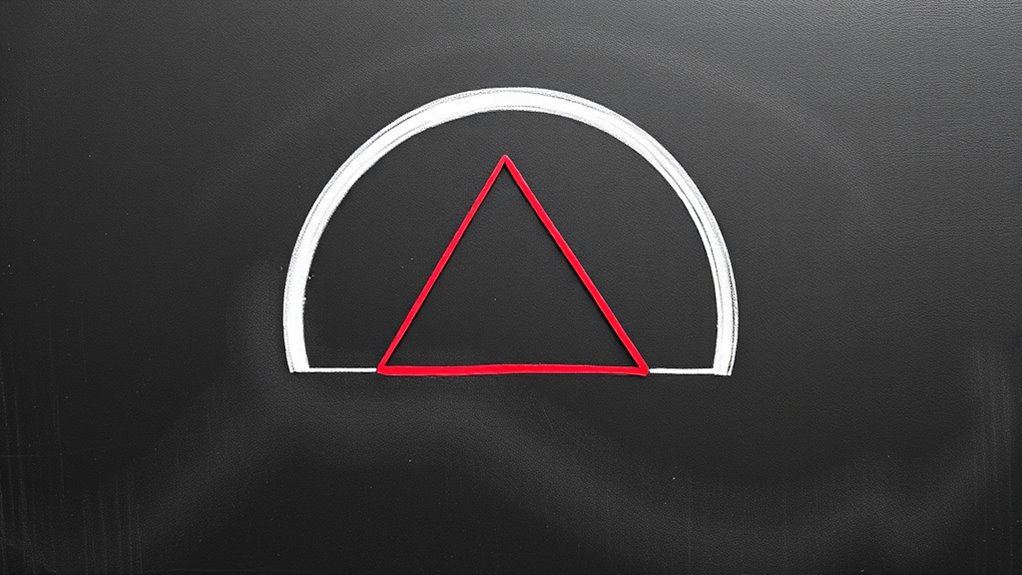

Thales’ theorem states that if you draw a triangle inside a circle with the diameter as one side, the angle opposite that diameter will always be a right angle. This means any inscribed angle sweeping across a semicircular arc measures 90 degrees. You can easily see this with a semicircle where the diameter is the base. Continue exploring, and you’ll discover even more fascinating properties of circles and their inscribed angles.
Key Takeaways
- Thales’ Theorem states that an inscribed angle subtending a diameter measures exactly 90°.
- Any triangle inscribed in a circle with the hypotenuse as the diameter is a right triangle.
- The semicircular arc opposite the inscribed angle always measures 180°, resulting in a right angle.
- The inscribed angle’s measure is half of the intercepted arc, confirming the 90° angle in a semicircle.
- This theorem simplifies identifying right-angled triangles inscribed in circles without measuring tools.

Have you ever wondered why a triangle inscribed in a circle with a diameter as one of its sides is always a right triangle? This intriguing fact is a direct consequence of some fundamental circle properties and inscribed angles. When you draw a circle and select any diameter, you’re creating a special chord that has unique properties. According to circle properties, when a triangle is formed inside a circle with one side as a diameter, the angle opposite that side, called an inscribed angle, always measures 90 degrees. This is because inscribed angles that subtend a diameter have a very specific measure, which leads to the right angle in the triangle. Additionally, this theorem is a powerful example of how circle geometry principles underpin many geometric relationships and proofs.
Think about what happens when you draw such a triangle. The side that acts as the diameter serves as the base, and the third point, which is somewhere on the circle, forms the apex. The inscribed angle at this point is what determines the shape of the triangle. Due to the properties of inscribed angles, any inscribed angle that subtends a diameter is a right angle. This rule doesn’t depend on where the third point is on the circle’s circumference; the inscribed angle will always measure 90 degrees. It’s a fascinating aspect of circle properties that holds true regardless of the circle’s size or the position of that third point.
This theorem, known as Thales’ Theorem, highlights how inscribed angles behave in relation to the circle’s diameter. It simplifies understanding the geometry of circles and triangles, providing a quick way to identify right triangles without using a protractor or measuring tools. You can use this knowledge to solve problems involving right triangles inscribed in circles or to understand why certain geometric configurations always result in right angles.
The principle behind this theorem also emphasizes the importance of inscribed angles in circle geometry. Since inscribed angles measure half of their intercepted arc, when the arc is a semicircle (half of the circle), the inscribed angle always turns out to be a right angle. This relationship is a cornerstone of circle properties and plays a vital role in many geometric proofs and constructions. So, whenever you see a triangle with one side as a diameter, you can immediately recognize that the angle opposite the diameter is a right angle, thanks to the properties of inscribed angles and the fundamental principles established by Thales’ Theorem.
Frequently Asked Questions
How Does Thales’ Theorem Apply to Non-Circular Shapes?
Thales’ theorem specifically applies to circles, so it doesn’t directly apply to non-circular shapes. However, understanding inscribed angles and chord lengths helps you analyze other polygons and shapes. In non-circular shapes, you examine how angles relate to sides and chords, which can reveal key properties like symmetry or congruence. While the theorem isn’t directly applicable, the concepts of inscribed angles and chord lengths still guide your geometric understanding.
Can Thales’ Theorem Be Used in Coordinate Geometry?
Think of the coordinate plane as a vast canvas where you can paint geometric truths. You can definitely use Thales’ theorem here; it’s like a key to access right angles in a coordinate geometry setting. By applying the theorem, you analyze points on a circle’s diameter, showing that the angle subtended is a right angle. This theorem application helps you solve problems involving circles and right triangles within the coordinate plane.
Are There Real-World Applications of Thales’ Theorem?
You’ll find Thales’ theorem useful in real-world situations involving angle inscribed and circle segments. For example, architects use it when designing structures with circular elements to guarantee stability and proper angles. Surveyors apply it to measure distances accurately across a circle segment, and in navigation, it helps determine positions by analyzing angles inscribed in a circle. These practical applications showcase how the theorem relates directly to everyday geometric problems.
What Are the Limitations of Thales’ Theorem?
You might think Thales’ theorem is limitless, but it has significant limitations. The theorem’s angle restrictions only apply when the triangle is inscribed in a circle with a diameter as its side, so shape constraints matter. If the triangle isn’t positioned correctly or the circle isn’t a semicircle, the right angle property doesn’t hold. This coincidence reminds you that geometric rules depend heavily on specific conditions.
How Is Thales’ Theorem Related to Other Circle Theorems?
You see that Thales’ theorem connects with other circle properties and angle relationships by highlighting how angles subtended by the same arc are equal. It’s part of a broader set of circle theorems that explain how angles formed by intersecting lines or chords relate within a circle. By understanding these relationships, you can solve complex geometry problems involving inscribed angles, central angles, and other key circle properties.
Conclusion
Imagine you’re building a bridge, carefully aligning each part to guarantee stability. Thales’ theorem is like that careful craft—you see, just as a perfect bridge relies on precise angles, this theorem shows how a right angle always finds its place in a semicircle. It’s a reminder that even in geometry, harmony and balance create something reliable. So, next time you see a semicircle, remember, sometimes the simplest shapes hold the most profound secrets.