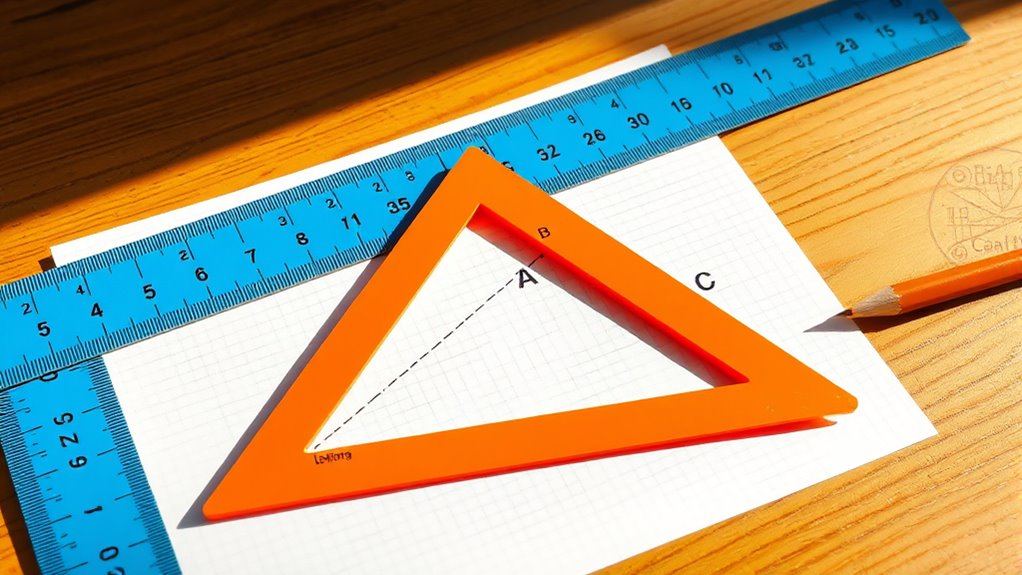

The Pythagorean theorem, C²=A²+B², matters because it helps you find the length of the hypotenuse in right triangles easily. Whether you’re designing a building, steering, or working with computer graphics, this formula simplifies complex problems. It links the sides of a right triangle and has been crucial for thousands of years across many cultures. Keep exploring how this simple relationship can solve real-world challenges and open new understanding.
Key Takeaways
- It enables precise calculation of unknown sides in right triangles, essential for accurate measurements and design.
- The formula reflects the fundamental relationship between a triangle’s hypotenuse and legs, aiding spatial understanding.
- Its historical use across civilizations highlights its importance in construction, astronomy, and engineering.
- The theorem is crucial in real-world applications like architecture, navigation, and computer graphics for practical problem-solving.
- Its enduring relevance demonstrates its foundational role in geometry, science, and technological advancements.
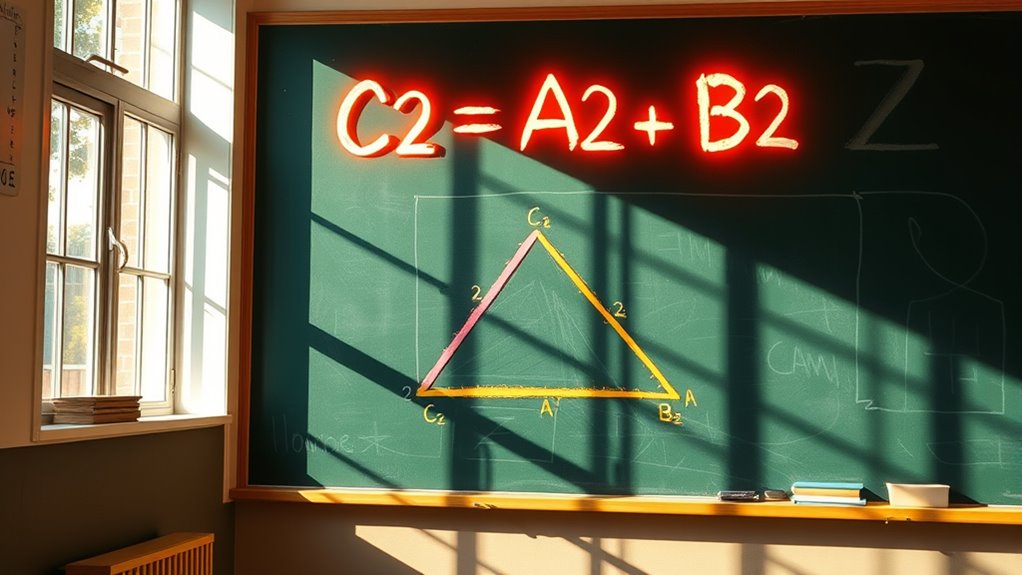
Have you ever wondered how to find the length of a side in a right triangle? The Pythagorean Theorem makes this possible by providing a simple formula: C² = A² + B². But understanding why this works and how it originated can deepen your appreciation for this fundamental principle. The historical origins of the theorem trace back to ancient civilizations. The earliest known references appear in Chinese texts from around 1045 BCE, in the “Chou Pei Suan Ching,” which describes a version of the theorem well before Pythagoras‘s time. The Greeks, however, popularized and formalized it around the 6th century BCE, attributing the theorem to Pythagoras himself. Despite this attribution, evidence suggests that knowledge of the relationship existed in earlier cultures, possibly used for practical purposes like construction and astronomy. Recognizing its long history underscores how essential the theorem has been across civilizations for thousands of years. Historical development of the theorem highlights its evolution and diverse origins.
In real-world applications, the Pythagorean Theorem plays an indispensable role in many fields. Architects and engineers frequently use it to guarantee structures are built with proper angles and measurements. For example, when designing a roof, they might calculate the length of rafters needed or verify that corners form right angles. Surveyors rely on the theorem to determine distances that are difficult to measure directly, such as creating accurate maps of land parcels. In navigation, it helps determine the shortest path between two points, especially when traveling along straight lines at right angles. Even in technology, computer graphics utilize the theorem to calculate distances between pixels or objects on a screen, ensuring accurate rendering and positioning. The theorem’s applicability extends beyond these examples, influencing any situation where right triangles are involved, demonstrating its timeless importance.

Pythagorean Theorem Calculator
Easy to use
As an affiliate, we earn on qualifying purchases.
As an affiliate, we earn on qualifying purchases.
Frequently Asked Questions
How Was the Pythagorean Theorem Originally Discovered?
Ancient civilizations, like the Babylonians and Egyptians, discovered the Pythagorean Theorem through practical geometric problems, such as surveying and construction. They observed patterns in right triangles and recorded mathematical discoveries that showed the relationship between the sides. Over time, Greek mathematicians like Pythagoras formalized and proved the theorem, recognizing its importance in understanding geometry and laying the foundation for future mathematical advancements.
Are There Alternative Proofs for the Pythagorean Theorem?
Imagine you’re in ancient Greece, but today you’d explore the Pythagorean theorem through multiple lenses. Yes, there are alternative proofs, including geometric proofs using rearrangements and algebraic methods like coordinate geometry. These approaches help you understand the theorem from different perspectives, making it more intuitive. Whether you prefer visual geometric proofs or algebraic derivations, exploring these alternatives deepens your grasp of why C²=A²+B² truly matters.
How Does the Theorem Apply in Non-Euclidean Geometries?
In non-Euclidean geometries, like curved spaces, the Pythagorean theorem doesn’t apply as it does in flat, Euclidean spaces. Instead, you’ll find modified versions that account for curvature, such as hyperbolic or spherical geometries. These geometries alter how distances and angles relate, meaning the classic C²=A² + B² formula changes. Understanding these differences helps you navigate curved spaces and grasp the broader scope of geometry beyond flat surfaces.
Can the Theorem Be Extended to Three-Dimensional Space?
Yes, you can extend the theorem to three-dimensional space, where it becomes the distance formula. While a simple triangle inequality applies in 3D, the spatial extension uses the same principle: the square of the hypotenuse (or space diagonal) equals the sum of the squares of the other two sides. This extension helps you understand distances in 3D, emphasizing how geometry adapts beyond flat surfaces to more complex, real-world shapes.
What Are Common Real-World Applications Beyond Geometry?
You use the Pythagorean Theorem in architectural design to calculate distances and create accurate blueprints, ensuring structures are stable. Navigation systems rely on it to determine shortest paths and precise locations, especially in GPS technology. It also helps in physics for calculating vectors and forces, making it essential for real-world applications beyond pure geometry. Your understanding of this theorem makes complex tasks more accurate and efficient in everyday life.

Westcott Triangular Scale Ruler Set, 30/60- and 45/90-Degrees, Back-to-School, School Supplies, Classroom Supplies, 2-Pack
Two-Triangle Precision Set – Includes two triangle rulers for precise marking and line work, featuring 6-inch and 8-inch…
As an affiliate, we earn on qualifying purchases.
As an affiliate, we earn on qualifying purchases.
Conclusion
Remember, the Pythagorean theorem isn’t just about numbers; it’s about understanding how shapes fit together. By knowing that c² = a² + b², you can solve real-world problems with confidence. Keep in mind, “A problem shared is a problem halved,” so embracing this theorem makes your math journey smoother. When you grasp its power, you’ll see that even complex shapes become simple puzzles waiting to be solved.

Mr. Pen Geometry Set with 6 Inch Swing Arm Protractor, Divider, Set Squares, Ruler, Compasses and Protractor, 15 Piece Set
Geometry Set For All Levels Designed in USA
As an affiliate, we earn on qualifying purchases.
As an affiliate, we earn on qualifying purchases.

Laser Measure Device, MiLESEEY 229ft Digital Laser Tape Measure with Upgrade Electronic Angle Sensor, 2mm Accuracy, Area Measurement,Volume and Pythagoras, 2" LCD Backlit,Mute, Battery Included
[Reliable and Efficient] Upgraded electronic level with accuracy up to +/-0.3°and laser tape measure with accuracy up to…
As an affiliate, we earn on qualifying purchases.
As an affiliate, we earn on qualifying purchases.