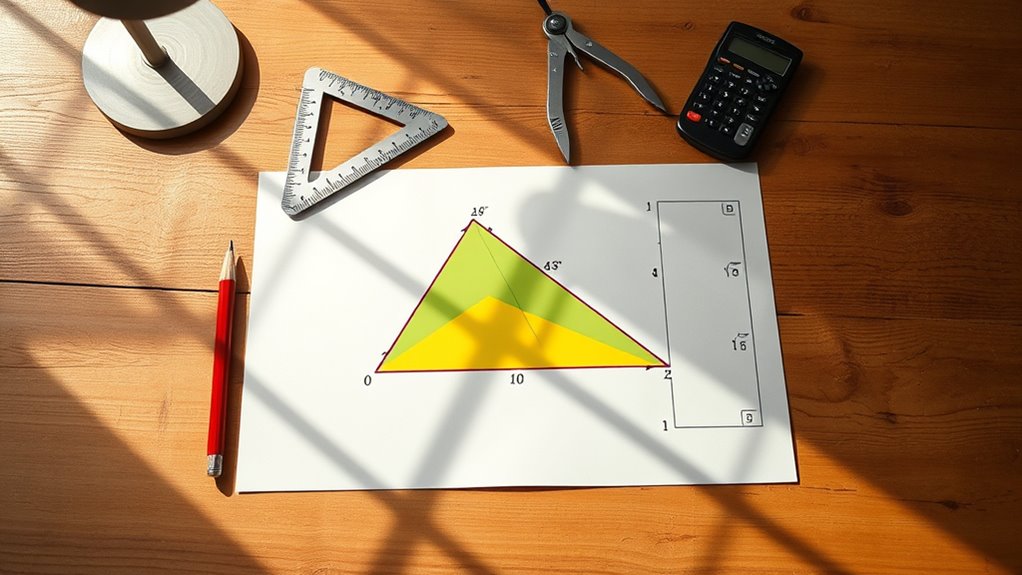

The Law of Cosines generalizes the Pythagorean theorem by working with any triangle, not just right ones. It lets you find an unknown side when you know two sides and their included angle, or determine angles when all sides are known. Unlike the Pythagorean theorem, it accounts for oblique triangles with the formula c² = a² + b² – 2ab cos C. If you’re curious about applying this to different triangles, there’s more to explore below.
Key Takeaways
- The Law of Cosines extends the Pythagorean theorem to all triangles, including obtuse and scalene ones.
- It relates sides and angles with the formula c² = a² + b² – 2ab cos C, generalizing Pythagoras.
- When the included angle is 90°, the Law of Cosines reduces to the Pythagorean theorem.
- It allows calculation of unknown sides or angles in non-right triangles using known elements.
- The Law of Cosines is essential in navigation, construction, and advanced geometric problem-solving.

Have you ever wondered how to find the length of a side in a triangle when you know the other two sides and the included angle? This is where the Law of Cosines comes in—a powerful tool that expands on familiar triangle properties and helps solve for unknown sides in any triangle, not just right-angled ones. Unlike the Pythagorean theorem, which only applies to right triangles, the Law of Cosines covers all triangles, making it a versatile formula in geometry and trigonometry. Its applications are especially useful when you have two sides and the included angle or three sides and need to find a missing side.
Discover how the Law of Cosines helps find missing sides in any triangle beyond right-angled ones.
The Law of Cosines states that for any triangle with sides (a), (b), and (c), and the angle (C) opposite side (c), the relation is: ( c^2 = a^2 + b^2 – 2ab cos C ). This formula directly links the triangle’s sides and angles, essentially generalizing the Pythagorean theorem. When the angle (C) is 90 degrees, (cos C) becomes zero, and the formula reduces to the familiar ( c^2 = a^2 + b^2 ). This illustrates how the Law of Cosines naturally extends the Pythagorean theorem to non-right triangles, broadening your toolkit for solving diverse geometric problems.
Understanding the properties of triangles is vital for effectively applying the Law of Cosines. By knowing how sides and angles relate, you can use cosine applications to determine unknown measurements. For example, if you have two sides and the included angle, plugging these values into the Law of Cosines allows you to find the third side. Conversely, if all three sides are known, you can rearrange the formula to solve for an angle using the inverse cosine function. This flexibility makes the Law of Cosines an essential component of triangle properties, especially in real-world situations like navigation, construction, and physics.
In practice, you’ll find the Law of Cosines especially handy when working with oblique triangles—triangles that are neither right-angled nor equilateral. It helps you derive missing information efficiently, reducing guesswork. The cosine applications involved often require a calculator, but once familiar, you’ll appreciate how seamlessly it links sides and angles. Whether you’re solving a problem in a math class or analyzing a real-world scenario, understanding the Law of Cosines enhances your grasp of geometry and boosts your problem-solving skills, making it an indispensable part of your mathematical toolkit. Additionally, understanding the historical development of these formulas can deepen your appreciation for their significance.
Frequently Asked Questions
How Does the Law of Cosines Relate to the Law of Sines?
You see that the Law of Cosines relates to the Law of Sines through triangle similarity and angle relationships. When you understand how the Law of Cosines helps find sides using angles, you can use the Law of Sines to find unknown angles or sides in similar triangles. Both laws connect side lengths and angles, allowing you to switch between them based on what information you have, making your problem-solving more flexible.
Can the Law of Cosines Be Used in Non-Euclidean Geometry?
You can’t directly apply the law of cosines in non-Euclidean geometry because it deals with curved surfaces, where straight lines and angles behave differently. In non-Euclidean spaces, like spherical or hyperbolic geometry, formulas change to account for curvature. Instead, you use specialized versions of the law of cosines tailored to these curved surfaces, which help you solve triangles on spheres or other non-flat geometries.
What Are Practical Applications of the Law of Cosines?
You’re really on the ball when you realize the law of cosines helps in navigation tools and engineering design. It allows you to find unknown distances and angles in triangulation, making it fundamentally important for map reading and GPS technology. Engineers use it to calculate forces in structures like bridges and towers. Essentially, it’s a handy tool that helps you solve real-world problems where direct measurement isn’t possible, saving time and effort.
How Do You Derive the Law of Cosines?
To derive the Law of Cosines, you start with a triangle derivation by dropping an altitude to split the triangle into two right triangles. Then, use the cosine formula in one right triangle to relate the side lengths and the angle. Applying the Pythagorean theorem to these triangles and simplifying leads you to the cosine formula: c² = a² + b² – 2ab cos C.
Is the Law of Cosines Useful in Three-Dimensional Space?
Yes, the Law of Cosines is useful in 3D applications because it helps you find the angle between vectors or the length of a side in a triangle embedded in space. You can use it for vector calculations, especially when dealing with non-right-angled triangles in 3D models, physics simulations, or navigation. It simplifies complex spatial problems by extending familiar 2D concepts into three dimensions.
Conclusion
Think of the Law of Cosines as a bridge that connects the familiar Pythagorean theorem to the wider world of triangles. Just like a key open a door, it reveals how sides and angles intertwine beyond right angles. With this tool, you can navigate any triangle’s landscape, transforming complex shapes into understandable forms. Embrace it as your compass, guiding you through the geometric wilderness with confidence and clarity.