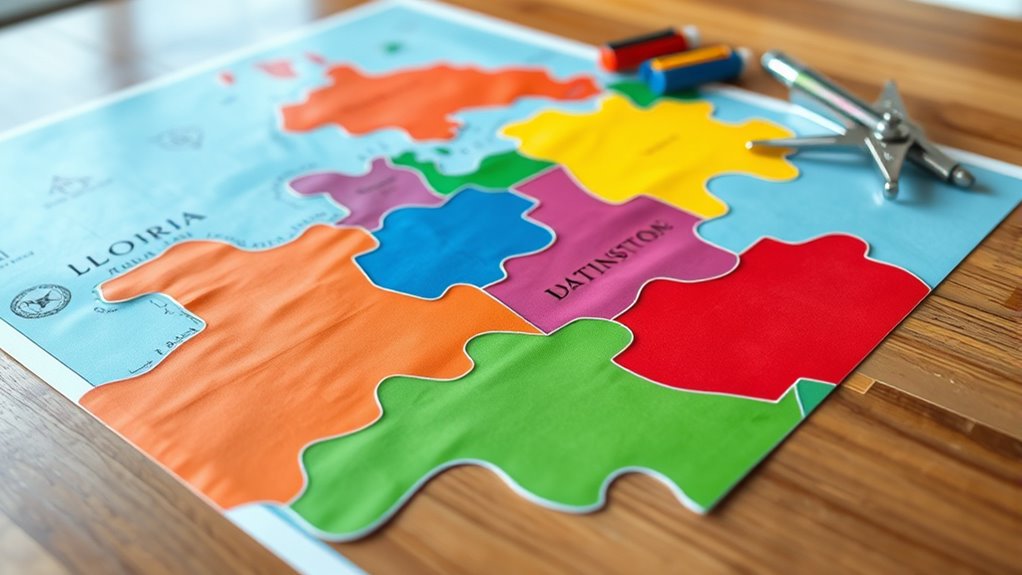

The Four Color Theorem shows that you only need four colors to color any map so no neighboring regions share the same color. It models regions as points connected by lines, and the goal is to assign colors so adjacent areas differ. This theorem was proven in the 1970s using computer algorithms to check countless configurations. If you want to understand how mathematicians solved this complex problem, keep exploring the fascinating details behind this groundbreaking proof.
Key Takeaways
- The Four Color Theorem states any planar map can be colored with four colors so adjacent regions differ.
- It models the problem using graph theory, where regions are vertices and shared borders are edges.
- The 1970s proof by Appel and Haken used computer algorithms to verify a finite set of configurations.
- The theorem confirms a universal property of planar maps, ensuring no more than four colors are needed.
- The proof’s reliance on computers was initially controversial but is now recognized as a rigorous mathematical solution.
Have you ever wondered if it’s possible to color any map with just four colors so that no two adjacent regions share the same color? This intriguing question has fascinated mathematicians for centuries and is at the heart of the Four Color Theorem. To understand how this problem was tackled, you need to explore the world of graph theory, a branch of mathematics that models relationships between objects. In this context, each region on a map can be represented as a vertex in a graph, with edges connecting vertices that represent neighboring regions. The challenge then becomes finding a way to assign colors to each vertex so that no connected vertices share the same color. This is where the concept of graph coloring comes into play, and it forms the core of the theorem.
The Four Color Theorem states that four colors are sufficient to color any planar map so that adjacent regions are differently colored. But proving this wasn’t straightforward. For centuries, mathematicians tried and failed to establish a solid, universal proof. The breakthrough came in the 1970s when mathematicians Kenneth Appel and Wolfgang Haken used a mathematical proof that relied heavily on computer algorithms. Unlike traditional proofs that are purely logical, this proof involved checking a vast number of configurations—thousands of potential map arrangements—to ensure they could all be colored with four colors. This approach was groundbreaking because it combined classical mathematical reasoning with computational power, marking a new era in proof techniques.
The proof itself isn’t a simple one; it involves reducing the problem to a finite set of configurations called reducible configurations, which can be systematically checked. By verifying that none of these configurations required more than four colors, Appel and Haken confirmed the theorem’s truth. Although controversial at the time because of its heavy reliance on computers, the proof has since become accepted as a rigorous mathematical demonstration. It showcases how graph theory can be harnessed to solve complex, real-world problems, and it exemplifies the importance of mathematical proof in establishing universal truths. Additionally, the development of computational tools has significantly advanced mathematical proof techniques, opening new avenues for solving other complex problems.
Frequently Asked Questions
How Was the Theorem First Discovered Historically?
You discover that the historical discovery of the Four Color Theorem began in 1852 when Francis Guthrie first noticed that four colors seemed enough to color any map without neighboring regions sharing the same color. He shared his idea with mathematicians, sparking a long-standing debate. Over the years, mathematicians attempted various proofs, but it wasn’t until 1976 that the theorem was finally proven with the help of computer-assisted calculations.
What Are the Modern Applications of the Theorem Today?
Think of the Four Color Theorem as a master key opening modern innovations. Today, it guides efficient map coloring, ensuring clear distinctions between regions. Practical applications extend to frequency assignment in wireless networks, optimizing data transmission, and circuit design, preventing overlaps. You benefit from these advancements in everyday life, as the theorem helps streamline complex systems, making data transmission and geographic representations more accurate, efficient, and visually organized.
Are There Exceptions or Special Cases to the Theorem?
You might wonder if there are any exception cases in map coloring related to the Four Color Theorem. While the theorem states that four colors suffice for any map, certain complex maps or specific constraints could pose challenges, known as exception cases. However, in standard map coloring, these exceptions are rare. Generally, the theorem holds, but special cases may require more careful analysis or alternative coloring strategies.
How Does the Theorem Relate to Graph Theory?
You see, the Four Color Theorem relates directly to graph theory through graph coloring of planar graphs. It states that any planar graph, which models a map, can be colored with just four colors so that no adjacent regions share the same color. This theorem helps you understand how to efficiently assign colors in graph coloring problems, ensuring minimal colors are used while avoiding conflicts in planar graphs.
Can the Theorem Be Extended to More Than Four Colors?
Ever wondered if you can use more than four colors for a map? Yes, you can, but it’s less efficient. Extending the theorem involves color extension techniques and algorithm optimization, which allow for more colors while maintaining proper adjacent coloring. However, these methods often complicate the problem and reduce the elegance of the original theorem. So, while possible, it’s not always practical or necessary for simpler map coloring challenges.
Conclusion
Now that you’ve seen how the Four Color Theorem proves any map can be colored with just four colors, aren’t you amazed by the power of mathematical reasoning? It’s incredible how a simple question about map coloring led to such a complex proof. Next time you look at a colorful map, remember the clever logic behind it. Isn’t it fascinating how math helps us solve real-world puzzles so elegantly?