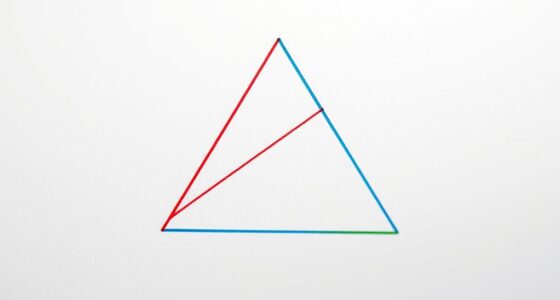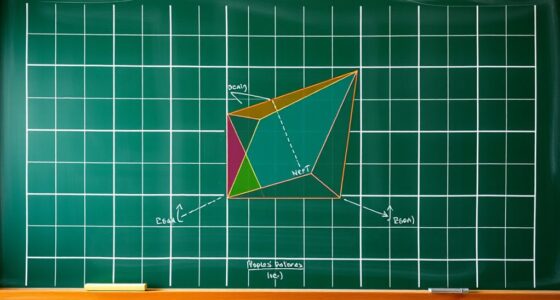
Euler’s polyhedron formula shows that for any convex shape, if you count the vertices (corners), subtract the edges (sides), and add the faces (flat surfaces), the total always equals two. It reveals a fundamental relationship in geometry that helps classify and understand 3D shapes. This rule applies to many common polyhedra and remains valid despite shape complexity. Keep exploring to discover how this elegant rule connects to broader geometric ideas.
Key Takeaways
- Euler’s formula states that for convex polyhedra, V – E + F always equals 2, linking vertices, edges, and faces.
- It applies specifically to convex polyhedra with flat faces and straight edges, helping classify and understand their structure.
- The formula is used to verify the consistency of polyhedral models and analyze how adding or removing elements affects shape integrity.
- It reveals fundamental topological properties, showing the interconnectedness and possible configurations of 3D shapes.
- Euler’s formula serves as a foundational tool in geometry and topology, aiding in the study and design of polyhedral forms.

Have you ever wondered if there’s a simple way to relate the faces, edges, and vertices of a polyhedron? If so, you’re not alone. Mathematicians have long sought a straightforward relationship that links these fundamental components. That’s where Euler’s Polyhedron Formula comes into play, revealing a beautiful and elegant connection: V – E + F = 2. Here, V represents the number of vertices, E the edges, and F the faces. This formula isn’t just a curiosity; it’s a powerful tool that helps you understand the structure of polyhedra and classify them accordingly.
Euler’s formula links faces, edges, and vertices: V – E + F = 2—key to understanding polyhedra.
When you explore polyhedron classification, Euler’s formula becomes incredibly useful. It applies to convex polyhedra—solid shapes with flat faces, straight edges, and sharp vertices. As you analyze different polyhedra, you’ll notice that despite their diverse shapes, they all satisfy Euler’s relation. This consistency allows you to categorize polyhedra into classes, like Platonic solids, which are highly symmetrical and composed of identical regular polygons. Recognizing these patterns helps you distinguish between various types of convex polyhedra and understand their properties more deeply.
Beyond classification, Euler’s theorem applications extend into fields like topology and geometry. For example, if you modify a convex polyhedron by adding or removing faces, edges, or vertices, Euler’s formula helps you predict whether the resulting shape maintains its fundamental properties. It’s also useful when studying polyhedra that are more complex or have holes—like toroidal shapes—where the formula may need adjustments, but the core idea still provides a foundation for understanding how these shapes behave.
Understanding this relationship gives you insight into why certain shapes are possible or impossible in three-dimensional space. For instance, you can quickly verify if a given set of faces, edges, and vertices forms a valid convex polyhedron. If the counts don’t satisfy the formula, you know something’s off. This makes Euler’s theorem a handy check for your geometric constructions or when designing complex models in computer graphics and architecture.
In addition, visualizing polyhedra can deepen your understanding of how the formula applies across different shapes and complexities. In short, Euler’s Polyhedron Formula isn’t just a mathematical equation; it’s a key that unravels the structure and classification of polyhedra. Whether you’re studying simple shapes or exploring advanced geometric concepts, this relationship provides clarity and consistency. It’s a tribute to the underlying order in the seemingly diverse world of three-dimensional shapes—showing that, no matter how complex, they all follow a fundamental rule.
Frequently Asked Questions
How Does Euler’s Formula Apply to Non-Convex Polyhedra?
You can apply Euler’s formula to non-convex polyhedra, but with some complexities. Non-convex geometries introduce topological distortions, like holes or indentations, which affect the straightforward use of V – E + F=2. Instead, the formula adapts by considering the polyhedron’s genus (number of holes). This way, the formula accounts for non-convex complexities, accurately describing their topological structure and maintaining its usefulness beyond convex shapes.
Can Euler’s Formula Be Used for 3D Printed Models?
Yes, you can use Euler’s formula for 3D printed models, especially when analyzing mesh topology in 3D modeling. It helps you understand the relationship between vertices, edges, and faces, ensuring your model’s geometry is consistent and well-structured. For complex or non-convex shapes, Euler’s formula may need adjustments, but generally, it’s a valuable tool for verifying the integrity of your 3D printed designs.
What Are Common Mistakes When Applying Euler’s Formula?
You often make mistakes with face counting and edge counting when applying Euler’s formula. Double-check your counts, especially for complex models, because missing a face or an edge can throw off the calculation. Avoid assuming all shapes are convex, as non-convex models can break the formula. Take your time to verify each count carefully, and confirm your model’s geometry aligns with the assumptions behind Euler’s formula.
How Does Euler’s Formula Relate to Topology?
You see, Euler’s formula relates directly to topology because it helps identify topological invariants that classify surfaces. When you apply the formula, you’re fundamentally analyzing how shapes can be deformed without tearing, leading to surface classification. It shows that the number of vertices, edges, and faces stay consistent for different polyhedra, reflecting their topological properties. This connection makes it a fundamental tool in understanding how surfaces behave in topology.
Are There Exceptions to Euler’s Formula?
You should know that there are polyhedron exceptions and topological anomalies where Euler’s formula doesn’t hold. These cases typically involve polyhedra with holes, handles, or non-convex shapes, which alter the topology. In such situations, the formula adjusts with a modified term related to the genus of the surface. So, while Euler’s formula is powerful, always remember that exceptions exist when the shape’s topology becomes more complex.
Conclusion
Imagine you’re an architect designing a magical, endless dome. No matter how complex your shapes become, Euler’s formula acts like a guiding map, revealing the hidden balance between vertices, edges, and faces. It’s your secret blueprint, ensuring everything fits perfectly. Just like a master builder trusts their tools, trust Euler’s formula to keep your polyhedra stable and beautiful. With this knowledge, you can confidently create wonders, knowing the fundamental harmony always holds true.