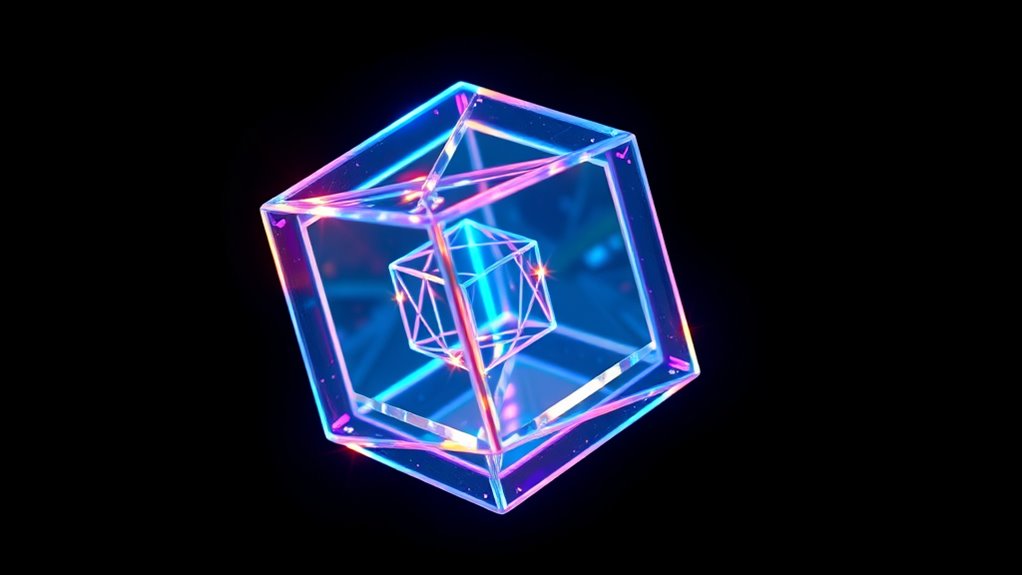

A tesseract is a four-dimensional shape that extends the idea of a cube into higher dimensions. It’s made of eight cubes connected in a way that’s impossible to visualize fully in our three-dimensional world. Instead, you see projections or shadows of it, which reveal its complex structure and symmetry. If you want to explore how this fascinating shape works and what makes it special, keep going — there’s much more to discover.

Prime made for students and young adults
- Fast, free delivery for dorm and study essentials
- Prime Video and Amazon Music included
- Member-only deals
Key Takeaways
- A tesseract is a four-dimensional extension of a cube, known as a 4D hypercube.
- It is composed of eight cubical cells connected along shared faces.
- Visualizing a tesseract relies on projections or shadows in 2D or 3D to understand its structure.
- It has 16 vertices, 32 edges, and 24 square faces, showcasing high symmetry.
- Advanced visualization techniques and AI tools help interpret and explore this higher-dimensional shape.

High-dimensional shapes are fascinating objects that extend our familiar concepts of geometry beyond three dimensions. When you explore these shapes, you begin to realize how much more complex and intriguing the universe of mathematics becomes as you venture into higher dimensions. One of the most captivating examples is the tesseract, also known as the 4D hypercube. Unlike cubes in our three-dimensional world, a tesseract exists in four dimensions, making it impossible to visualize directly. Instead, you rely on projections, specifically tesseract projections, to grasp its structure. These projections are two- or three-dimensional representations that help you understand the shape’s properties, much like how shadows give you a hint of an object’s form.
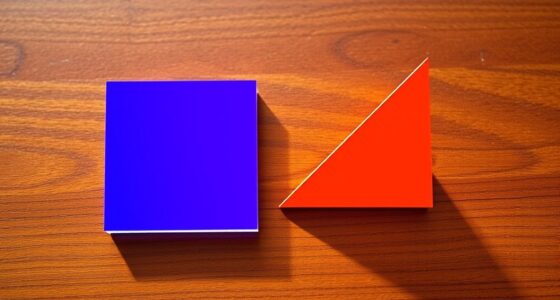
Understanding the tesseract involves higher dimensional visualization. Since you can’t physically see or touch four-dimensional objects, you have to use clever techniques to imagine them. By projecting the tesseract onto three-dimensional space, you see familiar shapes like cubes nested within each other, connected in a way that hints at the higher-dimensional connections. These projections distort and compress the shape, but they preserve the relationships between vertices and edges, helping you comprehend how a tesseract extends the concept of a cube into an additional dimension. This approach allows you to explore how higher-dimensional shapes behave and interact, even if you can’t perceive all their dimensions directly. Additionally, advancements in AI visualization techniques are making it easier to represent and understand these complex shapes.
As you study tesseracts, you find that their structure is built from eight cubical cells, each connected to its neighbors along shared faces. Visualizing this in higher dimensional space can seem formidable, but by focusing on the projections, you see patterns that resemble familiar geometric forms. These projections serve as a bridge between what you can see and what exists in the higher dimension, making higher dimensional visualization a powerful tool for understanding complex shapes. They reveal how the tesseract’s 16 vertices, 32 edges, and 24 square faces relate to one another, providing insight into the symmetry and regularity that define the shape.
In essence, exploring a tesseract through projections and higher dimensional visualization expands your understanding of geometry. It pushes you beyond the limitations of three-dimensional space and challenges you to think about shape, space, and structure in new ways. While you may not be able to see a true four-dimensional object, these tools allow you to grasp its essence, making the abstract tangible and the complex accessible. The tesseract exemplifies how higher-dimensional shapes can be both mind-bending and beautifully structured, inviting you to imagine worlds beyond the ordinary.
As an affiliate, we earn on qualifying purchases.
Frequently Asked Questions
How Can We Visualize a Tesseract in Three Dimensions?
To visualize a tesseract in three dimensions, you can use projection techniques that flatten its four-dimensional structure into 3D. These methods create shadow illusions, similar to how a shadow reveals an object’s shape in 2D. By studying these projections, you get a sense of the tesseract’s complexity. Interactive models and computer animations help you understand its structure, making the abstract more tangible and easier to grasp.
What Real-World Applications Do High-Dimensional Shapes Have?
You use high-dimensional shapes in quantum computing to represent complex data states and optimize algorithms. They also enhance data visualization, making it easier to interpret multifaceted information across multiple dimensions. These shapes help solve problems that traditional methods can’t handle, improving efficiency and accuracy. By exploring high-dimensional shapes, you push the boundaries of technology and understanding, opening new possibilities in science, engineering, and data analysis.
Are There Physical Objects That Resemble a Tesseract?
You won’t find physical objects that perfectly resemble a tesseract, but artists often use visual metaphors and artistic representations to depict its complex, four-dimensional nature. These creative interpretations help you understand the concept by translating abstract ideas into familiar forms. While a true tesseract exists only mathematically, such visual metaphors allow you to grasp its essence through imaginative, tangible imagery that sparks curiosity and insight.
How Does a Tesseract Relate to Other Higher-Dimensional Shapes?
A tesseract is a higher-dimensional analog of a cube, illustrating multi-dimensional relationships. It relates to other higher-dimensional shapes like the 4D simplex or 120-cell by extending the concept of edges, faces, and cells into more dimensions. You can think of it as a way to explore how shapes connect across dimensions, revealing complex structures that challenge your understanding of space and geometry beyond the familiar three dimensions.
Can a Tesseract Be Used in Computer Graphics or Virtual Reality?
You can definitely use a tesseract in computer graphics and virtual reality modeling. It helps with hyperspace rendering, creating visual effects that simulate higher dimensions. When you incorporate a tesseract, you allow users to experience complex, multi-dimensional shapes, enhancing virtual reality environments. This application makes your visualizations more immersive and intellectually stimulating, offering a unique way to explore concepts beyond traditional three-dimensional space.
visualization of higher-dimensional shapes
As an affiliate, we earn on qualifying purchases.
As an affiliate, we earn on qualifying purchases.
Conclusion
So, now you see, understanding a tesseract isn’t just about grasping a four-dimensional shape—it’s like revealing the universe’s deepest secrets! You’re not just imagining a cube’s four-dimensional cousin; you’re stepping into a mind-bending maze of endless possibilities. With this knowledge, you’re wielding a cosmic key, opening doors to dimensions beyond your wildest dreams. Embrace it, and you’ll never see shapes—or reality—the same way again!
As an affiliate, we earn on qualifying purchases.
mathematical models of hypercubes
As an affiliate, we earn on qualifying purchases.
As an affiliate, we earn on qualifying purchases.
Fall Picks
fall essentials
As an affiliate, we earn on qualifying purchases.